


Q&A with novelist and Yaak Valley conservationist, Rick Bass
By Mira Brody VP MEDIA
In the northwest corner of Montana’s Yaak Valley thrives an old-growth forest that has been identified as the most wildfire-resilient, stable ecosystem in the northern Rockies. When a 315-year-old Engelmann spruce blew down at the edge of that clearcut, Bozeman luthier Kevin Kopp turned its wood into a guitar. That instrument, and a second one built for actor Jeff Bridges as part of his sustainability-focused “All in This Together” project with Breedlove Guitars, has since become an emblem of a campaign to designate the region the nation’s first Climate Refuge.
The Black Ram Guitar Festival comes to Bozeman Oct. 2, at the Willson Auditorium with a lineup pairing tribal singing and poetry with performances by Jack Gladstone, Rob Quist, Corwin Clairmont, Ruth Moody and Montana State University climate scientist and violinist Pico Alt, all playing the Black Ram guitar itself. Fly-fishing artist Ben Miller will paint a live, fly-rod-cast portrait of the Yaak on the auditorium lawn, a piece that will go up for sale that night to benefit the cause, with more of his Yaak work and a related fashion collaboration on view around town at Beringia, Echo Arts and Plonk through the weekend.
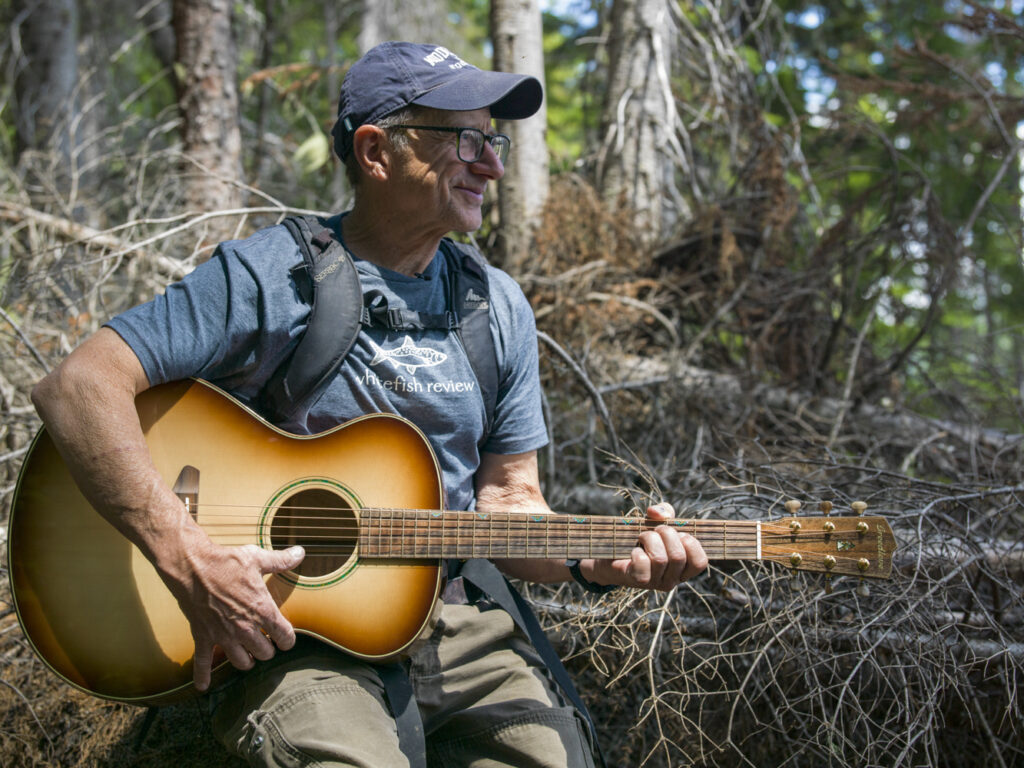
Ahead of the Black Ram Guitar Festival, longtime Yaak Valley advocate Rick Bass spoke with Explore Big Sky about the guitar’s origin, what “refuge” means in a warming world, and why he believes protecting one Montana forest could become a model for the planet.
Explore Big Sky: What is the Black Ram guitar, and why did an instrument become the symbol for this whole movement?
Rick Bass: The first Black Ram Guitar was made by Bozeman master luthier Kevin Kopp, from a piece of 315-year old Engelmann spruce that blew over from a clearcut at the edge of its forest, an ancient inland rainforest in northwest Montana’s Yaak Valley. The forest was slated to be clearcut under the “Black Ram” logging project. We decided that while science would remain a necessary and vital part of defending the old forest, the cultural embrace of this forest—100% public land—by the nation’s artists could provide another and perhaps equally lasting form of protection, and help educate people about the incredible diversity and integrity and functions of old-growth forests. Jeff Bridges heard the story, and commissioned another Black Ram guitar—the one that will be played at this year’s Climate Aid event—to be built from the same wood, using all domestic and sustainably sourced materials as part of his and Breedlove Guitars’ “All in This Together” sustainability campaign. Jeff gave us the guitar to use as advocacy for protecting the guitar’s forest, and all old and mature forests globally.
EBS: What makes the roughly 275,000 acres of the northwest corner of the Yaak Valley uniquely suited to be the nation’s first Climate Refuge, rather than just another protected forest?
R.B.: A recent analysis by independent scientists identified the Yaak River watershed as the most wildfire resilient in the northern Rockies; that it’s the most stable in the northern Rockies, and will remain cooler and wetter longer than any other ecosystem in the northern Rockies. It’s a baseline, an island to defend—a haven for existing endangered species, and a refuge for emigrating ones. And there is so much to learn from this intact forest.
EBS: How did a guitar festival become the vehicle for a forest conservation campaign — what made music and old-growth trees feel like the right pairing?
R.B.: The tight-grained fiber of Engelmann spruce creates a superior sound. The tree that blew over at the edge of the ancient inland rainforest when a clearcut and logging road was built to the forest’s edge had spent centuries growing the stable, cool conditions that gives spruce those qualities most desired by luthiers. Our thinking is that in listening to the incredible sound of the guitar, we can pause long enough to think about the value of old forests, and see them in a new light, and hear them, as well.
“To see scientists—who feel the same way about their science as artists do about their art—commune and collaborate toward a shared common goal is a powerful thing.
Rick Bass
EBS: In your interview for Mountain Outlaw’s “Songs From a Climate Refuge,” Jeff Bridges asked, “What does the word refuge mean to you?” How would you answer that question, and why has that word become central to your climate work?
R.B: To me, the word refuge is not far from the Spanish word querencia — a place to retreat to, and a place from which one draws one’s strength — but I also think refuge can be more basic than that: a place to take shelter, particularly in a storm. One of our most human aspects is the ability—the affinity—to take care of one another, or others. It’s not a characteristic that’s exclusive to our species, but one we like to think we possess, cultivate, and respect. Implicit in the idea of creating refuge or shelter for beings other than ourselves—regardless that it benefits us as well—opens in us one of the most ancient parts of ourselves. Like, oh yeah, right, this is what we do. We provide shelter for those who need it. And now the world needs it.
EBS: This event is happening in Bozeman, but the cause is about a valley most Montanans will never set foot in. For example, why should someone in Billings or Missoula or Havre care about what happens to the Yaak?
R.B.: The first words by the great landscape painter Clyde Aspevig, upon visiting the old forest in the Black Ram region of the Yaak for the first time, along with painter Monte Dolack, were “Oh, this is where the prairie comes from.” He got it instantly: that this unique ecosystem is central to the spokes of so many other vital connecting ecosystems—Glacier-two Medicine, Canada’s Purcell Range, the Cabinet Mountains and the Bitterroots, the Selkirks and Okanagan—it’s central. It’s round, like a nest. And in absorbing so much of the Pacific Northwest maritime weather system’s moisture, it dries the sky out and allows the prairie, just to the east, to exist, and be the prairie we love. As Thoreau and others have said, it’s all connected. As Jeff Bridges says, We’re all in this together. And when this made-in-Montana solution to slowing the rate of climate change is achieved, it becomes an example, a portable model applicable at global scale: protect the old forests that store such vast amounts of carbon in the long-term above-ground safekeeping. (Even if those old forests burn, the carbon remains in them in the form of the enormous dead standing snags).
EBS: The festival lineup mixes folk musicians, scientists, and Indigenous artists and speakers. What conversations or tensions come up when you put those voices on the same stage?
R.B.: We don’t generally think of entertainers and performers as being necessarily humble. But giving them a cause to unite for—a more livable future—while also celebrating the respect they have for craft—for a thing well-made by a passionate artisan—allows them to unite with shared respect and community. No one loves a fine instrument more than a musician. It’s a joy to see them marvel at the guitar’s sound. And to see scientists—who feel the same way about their science as artists do about their art—commune and collaborate toward a shared common goal is a powerful thing. A reminder, again, of the Dude’s koan: for better or worse, we are all in this together, and it can be better. It’s a message that resonates with particular power in Montana.
EBS: Why is it important to listen to all of them?
R.B.: We hear a lot of talk about community but I think there’s a default setting where we subconsciously think of community as consisting of people like us. We don’t mean to think that way, it can just be a tendency. What I see in the old forest in the Black Ram country are species that are not supposed to be found living next to one another not only co-existing, but prospering: old-growth cedar next to old-growth pine and larch, standing shoulder to shoulder, sometimes no more than two fists’ width apart. It defies the teachings of contemporary forestry. The per-acre basal area in the Black Ram region, and the unique species relationships in the old forests there, can teach us new truths, or remind us of old ones: cooperation is a form of fitness.
Similarly, the more diverse the elements there are in a population or community, or ecosystem, the healthier and stronger that system is, more stable to the rising perturbations of a tilting world.
We know almost nothing about the mysteries of ancient forests, particularly ancient inland rainforests like those remaining in the Yaak. How have they evolved to avoid or deflect fire, or survive it when it comes? What are the mycorrhizal relationships in these rare forests? Art brings a different way of seeing, a different way of knowing, and helps ask questions we might not have thought to ask otherwise. Most importantly, art spurs the human being to feel, and feel deeply. In an era in which we are besieged, exhausted, overstimulated, benumbed, this may be one of the most revolutionary acts that can be undertaken—encouraging people to feel deeply again.
EBS: What does long-term success actually look like for the Climate Refuge designation, and how attainable is it?
R.B. Long-term success—though we do not really have the luxury of waiting long-term, for Black Ram—I would suggest short-term–looks like a pilot project implemented as soon as possible that quantifies carbon storage in this ancient inland rainforest ecosystem, with a tribal nonprofit managing ancestral lands, and a greater commitment by U.S. Fish & Wildlife Service to recovering the endangered species in this forest: not just the most imperiled population of grizzly bears in North America, but the many other species that call the Kootenai National Forest home. (Fully 25% of Montana’s entire list of sensitive species are found on this one forest alone).
Mid-term looks like a Curtain of Green along the northern tier of the United States, where boreal and sub-boreal forests store such immense amounts of carbon in cold climates—a living, breathing semi-permeable curtain. Long-term would be a global adoption of protecting all old and mature forests. There’s no sane reason in the world not to.
It’s very attainable: all we need to do is ask. It’s too good of an idea to be kept down. It’s like a seed, that way.
EBS: For someone who buys a ticket to Black Ram in October, what’s the one thing you want them to walk away thinking about, beyond having heard good music?
R.B: The power of story, and to know that the chronic climate grief we carry can be converted to climate joy. There are steps we can take as a species, and they begin in our beloved Montana. They begin with a story.
EBS: Anything else we should understand about Black Ram—either the event or the guitar itself?
R.B.: It’s a made-in-Montana solution for preserving biodiversity and slowing the rate of climate change. Beginning in the Black Ram region of the Yaak Valley, and with one guitar that came from one tree that came from one seed, it’s a portable solution applicable at global scale.