
It’s our river, our responsibility to reduce pressure on strained water systems
By Kristin Gardner EBS COLUMNIST
For those of us living in headwaters communities like Big Sky, water isn’t just something that comes out of the tap—it is the lifeblood of our economy, our recreation and our environment. Our livelihoods depend directly on the delicate interplay of winter snowpack, spring weather and seasonal river flows that sustain healthy habitats year-round. It is a simple, logical reality of life in the mountains: the snow that blankets our peaks in the winter and the timing of its melt dictates the health of our drinking water aquifers and the strength of our river currents for the rest of the year.
But this year, the numbers are sending us a clear, urgent warning.

A shallow winter snowpack and an alarmingly fast melt through spring and early summer are directly impacting the Gallatin, and our community water supply. This isn’t just an abstract environmental concern; it impacts everything from local water management and aquatic ecosystem protection to flood predictability, water quality and wildfire preparedness.
To understand how snowpack affects our water systems, it’s important to know about Snow Water Equivalent. SWE is the depth of liquid water theoretically contained within the snowpack if it were to melt instantaneously. Monitored at automated SNOTEL (Snow Telemetry) stations across the West, SWE serves as our crystal ball, forecasting how much water will make it into our aquifers, creeks and rivers during the spring runoff.
This year, the forecast is unfortunately painting a grim picture. On June 1, the Lone Mountain SNOTEL station—which has tracked data since October 1988—measured zero snowpack, indicating a premature melt that is roughly two weeks earlier than the historic June 12 average. To put that in perspective, zero snowpack has been recorded on or before June 1 in just five other years since 1992, with the most recent comparable early melt occurring in 2015.
When this season’s snowpack finally reached its peak on April 30, it maxed out at just 16.7 inches of SWE, a 26.4% below the historical average of 21.8 inches. Shallow snowpacks simply mean less water is stored up in the mountains to be released gradually over the summer,, the consequences of which we are already seeing downstream on the Gallatin River.
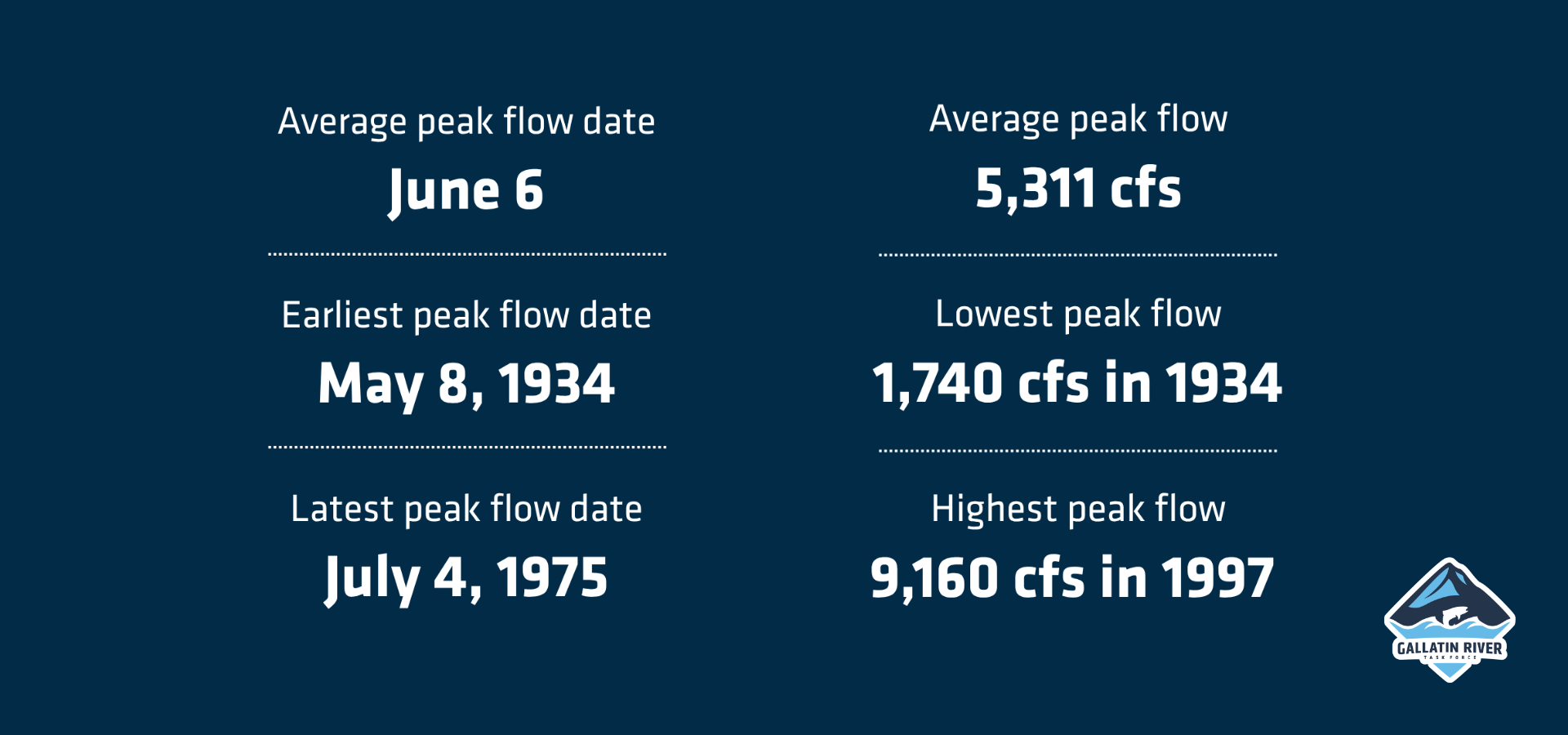
This year’s data recorded at the U.S. Geological Survey Gallatin Gateway gauge measured a low peak flow of 3010 cfs on May 31, qualifying 2026 as the sixth-lowest in recorded peak flow history at this gauge, which began recording data in 1890. This low peak underscores a troubling trajectory. Our mid-mountain snow was gone weeks ahead of schedule this year, causing the Gallatin’s peak flow to measure at just 3,000 cfs, the lowest peak flow in recent memory. What gives cause for increased concern isn’t just the low peak flow itself, but how rapidly Montana’s rivers are draining after that peak runoff, that could leave little water left for the late summer months.
While the Gallatin is measuring at 75% of median flow right now, early indicators suggest that the Gallatin River could see below-normal flows later this summer, as the shallow snowpack melts. And while long-term records show that low-flow years are not unusual, recent seasons show Montana rivers draining quickly after peak runoff, leaving significantly less water available later in the summer.
While drought is a natural climate progression that humans have adapted to for millennia, our changing climate has ushered in longer, more severe and relentless dry spells. For example, Big Sky has not had one droughtless day in 2026, and this prolonged condition cascades into a series of interconnected crises, including wildfire risk, ecological strain, economic concerns, water scarcity and water quality issues.
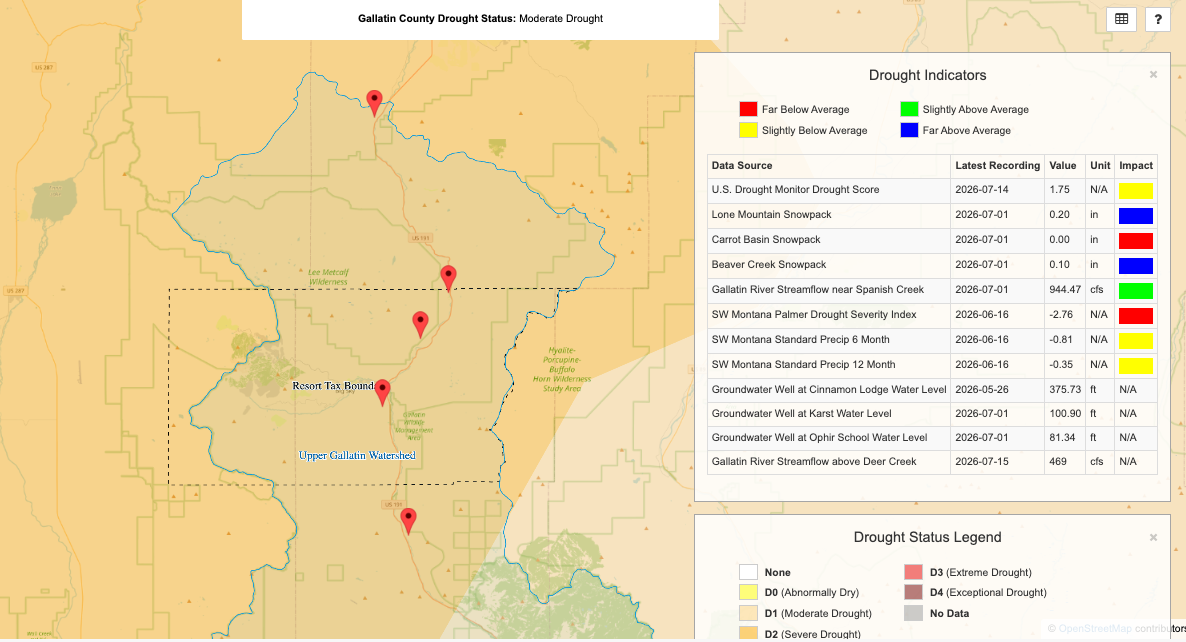
Drought makes fire especially dangerous. It creates inhospitable temperatures for fish who thrive in cold, swift-moving waters, it promotes algae blooms, it depletes our community aquifers that supply drinking water, limits water that supplies irrigation for agricultural land and impacts the quality and length of the working season for outfitters and guides. And as we have seen in recent years, it increases the likelihood of algal blooms along the river and throughout its tributaries.
We cannot force more snow to fall on Lone Mountain, nor can we pause the summer sun. Even with the summer’s rains that would indicate a relief, Big Sky remains in drought status. The one element we can control is how we prepare and how we respond. In low-water years like this one, community awareness is our strongest tool. Protecting the future of the Gallatin River requires a collective shift in how we view and use our shared water resources.
By aggressively reducing the pressure on our community water systems—clamping down on non-essential irrigation, practicing strict conservation and respecting the limits of our aquifer—we can mitigate the worst impacts of this drought. The Gallatin defines our way of life. It’s up to us to protect it.
Want to learn more about how you can help conserve water in your own home or business? Head to the Gallatin River Task Force website to find all the tips.
Kristin Gardner is the Chief Executive and Science Officer of the Gallatin River Task Force.