

By Colter Nuanez EBS CONTRIBUTOR
Clock controversies and untimely timeouts aside, the Kibbie Dome continues to be a house of horrors for the Montana State Bobcats.
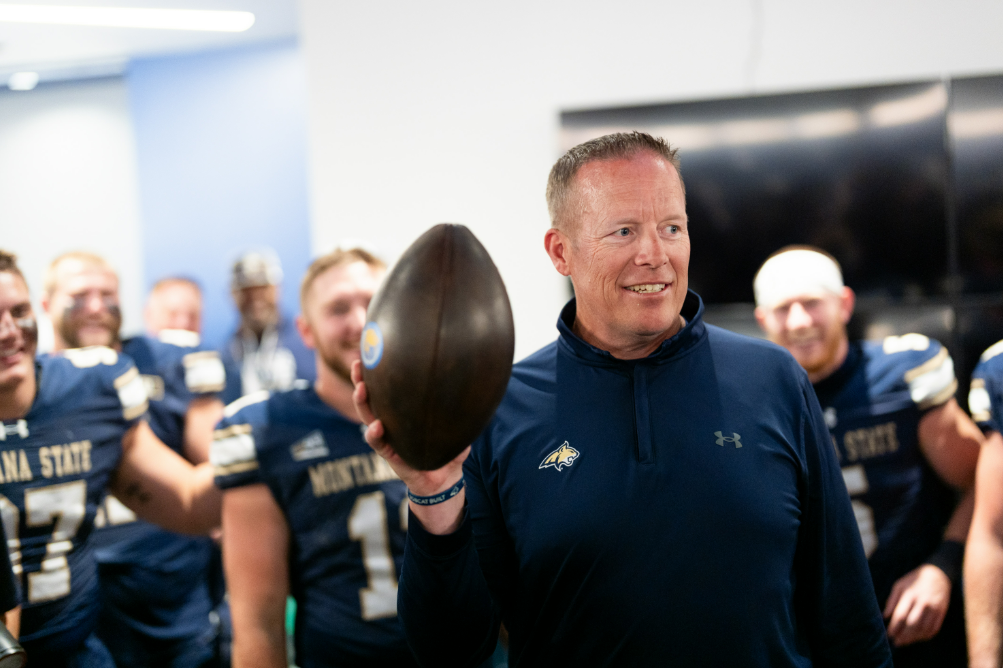
Montana State head coach Brent Vigen entered Friday night’s “Big Sky After Dark” affair at the Kibbie, an arena with a cult following (2000s NCAA Football video games, anyone?), with a 66-12 career record leading the Bobcats.

Of those 12 losses, almost every single one could be explained, at least to a certain extent. Two losses came in FCS national championship games to North Dakota State, Vigen’s alma mater and the juggernaut of all small-school Division I college football during an unprecedented run between 2011 and last season that saw NDSU win nine national championships.
Two more of Vigen’s losses came in the playoffs, once in the semifinals at eventual national champion South Dakota State in 2022 and another in the second round at home against North Dakota State on a blocked extra point in overtime.
Two of Vigen’s career losses came in his first two trips to Missoula to take on archrival Montana in one of the fiercest rivalries in college football.
Three more of the losses came at the hands of Football Bowl Subdivision teams like Wyoming (19-16 in 2021), Oregon State (68-28 in 2022) and Oregon (59-13 last season).
Two other regular-season losses other than FBS games or rivalry games came to South Dakota State in 2023 and 2025, respectively.
The one outlier? A 24-21 loss at Idaho in 2023 in which everything that could have gone wrong did go wrong, serving as a harbinger of what was to come. MSU followed that defeat at the Kibbie Dome with a pair of home wins before unraveling in Missoula in a 37-7 loss that preceded the 35-34 overtime loss to NDSU as a 2023 season with high expectations came crashing to a halt with an 8-4 record.
But Montana State went 15-1 in 2024 and won the national championship last season, so many thought the haunting memory of the Kibbie Dome was a thing of the past.
Instead, Montana State ran into a previously winless Idaho team that was out for blood and kept fighting until the bitter end. And MSU still hasn’t won in Moscow since 1990.
To be fair, Idaho was not in the Big Sky Conference between 1995 and 2018 and only played Montana State once–in 2016–during that span.Friday night, despite holding a two-touchdown lead in the fourth quarter, the game came down to a completely chaotic final possession that resulted in a litany of controversy.
Joshua Wood, Idaho’s slippery and savvy senior quarterback, found Noah West-Baranco for a 23-yard gain that appeared to be the final play of the game. But the officiating crew deemed that one second remained on the clock while they reset the first-down chains.
While Idaho scrambled up to the line, Vigen called a timeout that will linger with questions around it until the Bobcats take the field again following this week’s bye.
That allowed the Vandals to run one final play from scrimmage. Wood found Ryan Jezioro for a 25-yard touchdown with no time left on the clock. Trailing by one, Idaho head coach Thomas Ford Jr. elected to go for two. Wood knifed his way through the Montana State defensive front and into the end zone as the Vandals posted a walk-off win that will go down in Vandals lore.
And Montana State was left to wonder what the heck just happened.
“Well, they said they looked at it,” Vigen said of the play before the winning score, where it looked like time expired. “It’s one of those situations where you call a timeout or you don’t call a timeout. Ultimately, they made the play. I hope there was a second left.”
Multiple national football rules analysts weighed in on the way the last few seconds transpired, including Terry McAulay, who tweeted:
“Not going to comment on the timeout aspect, but it seems the officials reset the clock to :01. They are not supposed to do so. Replay rules only allow the clock to be reset when the clock starts on the ready for play and there are 3 or more seconds remaining and the offense has no timeouts. The reason is that the rules makers believe it is impossible for them to snap the ball from :02 or :01 before the clock hits :00 if the ready for play is correctly given and the clock starts accordingly. Onfield officials are instructed not to reset here and let it go to replay. Replay would have allowed the game to end at that point.”
Another rules official with knowledge of the situation, but who wanted to remain anonymous, said the officials handled the situation correctly and that Vigen’s timeout—not a review or putting time back on the clock—is what extended the game.
Either way, Vigen acknowledged that much more went wrong for his team than the management of Idaho’s final possession.
Montana State missed a pair of field goals, which surely brought back bad memories of the kicking errors that began at the Kibbie Dome in 2023 and haunted MSU the rest of that season.
The Bobcats allowed Wood to roll up 315 yards passing and another 41 yards rushing as he accounted for three total touchdowns. Jezioro, a player who entered the game with 180 receiving yards all season, finished with six catches for 147 yards and two scores as Montana State’s secondary suddenly looked lost after giving up nary a big play over the last season and a half.
“We knew Idaho wasn’t going to quit,” Vigen said. “We left a lot of things out there today, not being able to finish drives. We left a lot of field goals out there. Certainly, our defense had some good moments but some moments where they advanced the ball down the field. You leave it to chance there at the end, that’s what can happen.”
Montana State’s 19-game winning streak was snapped as Idaho earned its first victory of 2026 and its first win since Oct. 31 of last season.
MSU enters its bye week with plenty to clean up before returning to Big Sky Conference play and working its way back toward national championship form.
“This night cannot define us,” Vigen said. “It has to be an opportunity for us to get better, and that obviously didn’t happen tonight. We will do a lot of soul-searching to figure out if that’s the case.”