


Big Sky Rotary Club learned to build air cleaners from filters, box fans and handed them out to community as AQI climbed
By Jen Clancey STAFF WRITER
It only takes a box fan, air filter—MERV13-grade—and a few pieces of duct tape to do the same work as a small commercial air cleaner in reducing harmful particles from wildfire smoke, according to the Environmental Protection Agency. Big Sky Rotary Club members learned this, and how to make their own air cleaner at an Aug. 4 workshop with Montana Health and Climate’s Program Manager Julia Ryder.
At the end, the Rotary had 10 DIY units set aside for community members who needed one in Big Sky. It was good timing—by Aug. 7, the state issued an air quality alert for Gallatin and neighboring counties and the 10 cleaners were distributed over the weekend. In hot, smoky weather, solutions like DIY fans are helping residents reduce health impacts, especially in a state where an estimated 20% or more homes don’t have air conditioning.

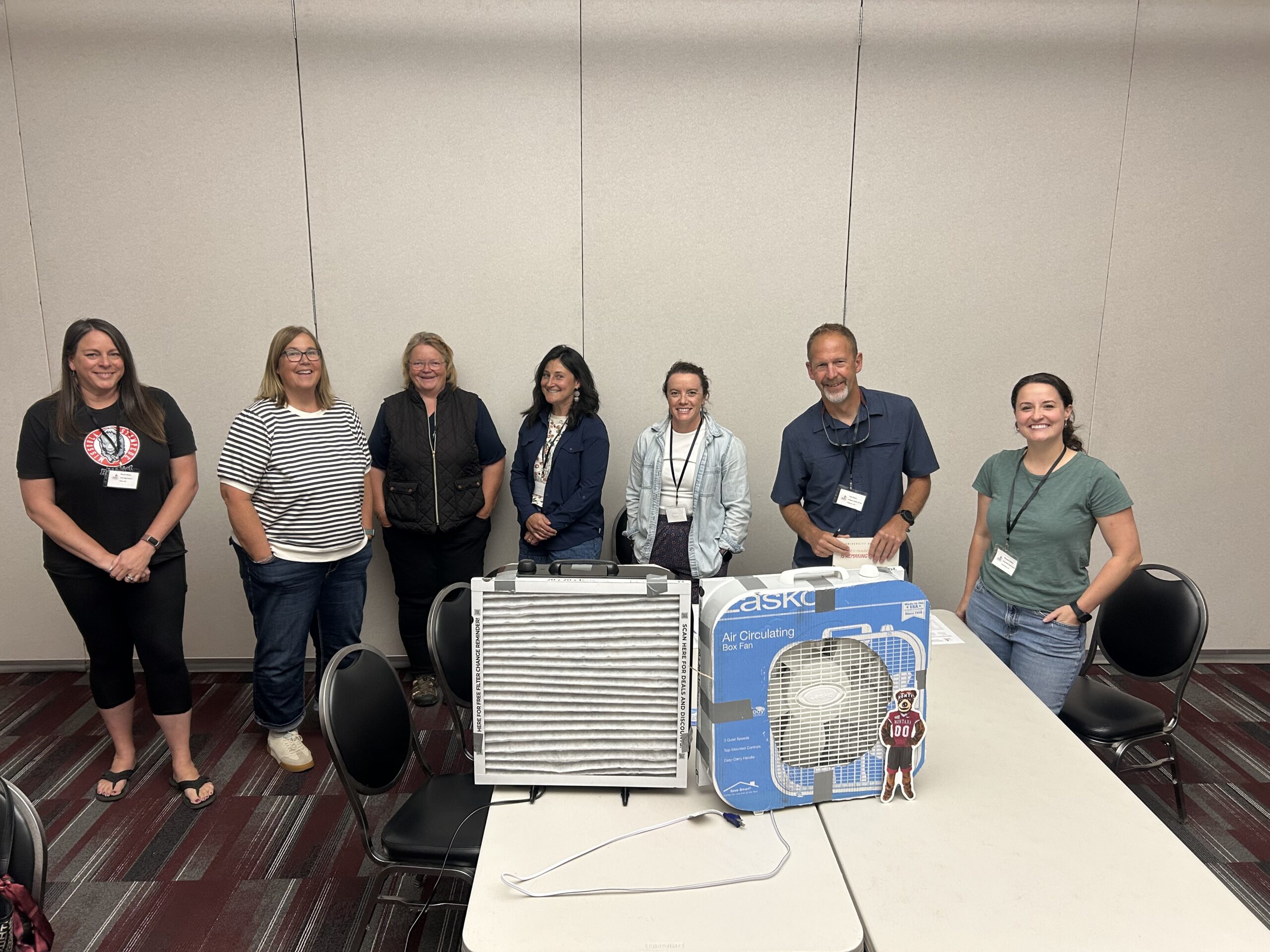
Big Sky resident and Rotary Club member Marian Kummer organized the Big Sky training with MHC. As a pediatrician for 36 years in Billings, she’s seen how air quality impacts kids’ health, especially if they have conditions like asthma. She’s also followed how Montana wildfires impacted community health.
“It can affect you not only short-term, but long-term,” Kummer said, reflecting on a study of sustained lung problems for people living near the 2017 Seeley Lake Fire northwest of Helena.
She doesn’t remember the smoke being as bad as it is now.
A study in Nature Ecology and Evolution found that between 2003 and 2023, wildfires have become more extreme, intense and larger globally. That’s because patterns overhead have favored hotter temps as the planet warms due to climate change. In dry, hot and windy conditions, communities need to be careful about fire hazards. In Big Sky, fire stations and emergency responders are on watch to manage any flames nearby, aided by advanced technology.
When smoke does come, whether from a nearby burn or a blaze hundreds of miles away, there are ways to adapt to changing conditions.
Taking air quality seriously
Some of the particles in wildfire smoke are coughed out and others are small enough to stay in the lungs and enter the bloodstream. Those checking their local AQI may see a note about particulate matter 2.5 or lower—these tiny particles have the ability to stay in the body, and as PM 2.5 increases, so does the AQI, alerting people when to mask up and find clean air.
Lori and Rob Byron, respectively chair and treasurer of the MHC, explained what exposure to AQIs higher than 150 means for health.
“It really isn’t safe for anybody, and if somebody has an underlying condition, you know, like asthma or heart disease, or if they are a child or young adult or an older person, they are at higher risk to have problems,” Rob said.
He noted that PM 2.5 particles have been found on the fetal side of the placenta in pregnant women, inside the blood-brain barrier in others, and have been associated with worsening lung conditions, heart attacks, stroke, dementia and impacts on unborn children and pregnancy outcomes. When people are exposed to wildfire smoke, they should wear a N95 mask only—not the cloth masks or blue surgical masks often seen during the COVID-19 pandemic.
Limiting exercise on red and purple days when the AQI is higher than 150, and using air purifiers at home is also helpful. They noted that DIY air cleaners work well too, and the organization is holding 25 instructional workshops across the state to spread the word.
“People have been really excited to have access to it because a lot of people live in homes that are leaky and … don’t have HVAC systems—which that goes for most of us—and can’t afford to buy an air purifier,” Lori said.
Cleaning air at home has its limits though. If air quality is very bad, Lori Byron noted that pregnant people should do their best to get away from wildfire smoke if they have the means to do so. As part of a statewide organization, the Byrons have seen examples of towns and cities coordinating clean air centers that they can open to the public when air quality is harmful.
“Having those places identified and then letting people know that they’re there by advertising is a good thing,” Lori said. To recap, for people without air conditioning, they can first check that their house isn’t “leaking”—think windows and doors that might let air seep into the home. Then, they can run an air purifier or cleaner, and check in with local organizations if there are any clean air centers near them.
When tracking AQI, check the airnow.gov’s Fire and Smoke Map for more specific air quality readings. Lastly, Rob noted people should use N95 masks, though he acknowledged the discomfort of the mask in 90F weather.
Kummer hopes that Big Sky stays aware of the impact wildfire smoke has on the lungs, and that residents assure they have a clean air room in their home if air quality worsens in the future.
“People have to be aware of it, that it is a health risk,” Kummer said.
Additional air filter units are available to the community through Fire Adapted Big Sky. Text FILTER to 317-691-7736 to arrange to pick up a filter through the Gallatin County Sheriff’s Office. If unable to travel, delivery can be arranged.