


Recent improvements are setting the stage for Black Eagle’s next chapter, but aging leaders wonder who will carry the torch.
By Matt Hudson MONTANA FREE PRESS
Black Eagle is a company town, 46 years removed from its company.
The Anaconda Mining Company’s impact on Black Eagle remains a defining feature of that hillside across the Missouri River from Great Falls. Although a different company ultimately closed the smelter in 1980, it was the Anaconda company that supported life in Black Eagle for much of the 20th century, and that legacy echoes today.

Banners along the main street, Smelter Avenue, depict the 506-foot-tall brick “big stack,” which was a local landmark until its demolition in 1982. The Anaconda Hills golf course, now operated by the city of Great Falls, started as an amenity for smelter families. And while many properties in the town are well-maintained, they also seem locked in time. New construction has been rare.
“I grew up in Black Eagle, and it was tight-knit. And my folks had us, five of us, and we stuck around,” said Frank Tuss, 86, who can point to features throughout town that he helped build or maintain. “A lot of the families, when they had kids, they left.”
Black Eagle’s civic leaders, many of them older, have strong ties to that industrial legacy but also wonder whether another generation will carry the torch. Substantial work has been done to modernize the local infrastructure, but the lingering question is what the future holds for this company town of fewer than 1,000 — and who will shepherd it forward.
Black Eagle appears on a map as part of Great Falls, but it’s actually an unincorporated community within Cascade County. More than a few people have compared it to Butte, not just because of the neighborhood’s hilly, closely packed working-class homes, but also because the two towns were economically linked. The Anaconda Mining Company dug copper ore out from beneath Butte and shipped it to Black Eagle, where the material was smelted and made into wire as the United States built out its electrical grid.
“It probably helped this country win two wars, provided employment for thousands — and I mean thousands — of people over the years,” said Dick Sloan, the plant’s last operations manager, in a documentary released in 2024 by the Big Sky Country National Heritage Area. “It produced all sorts of great engineers, designers. Provided funds for education.”
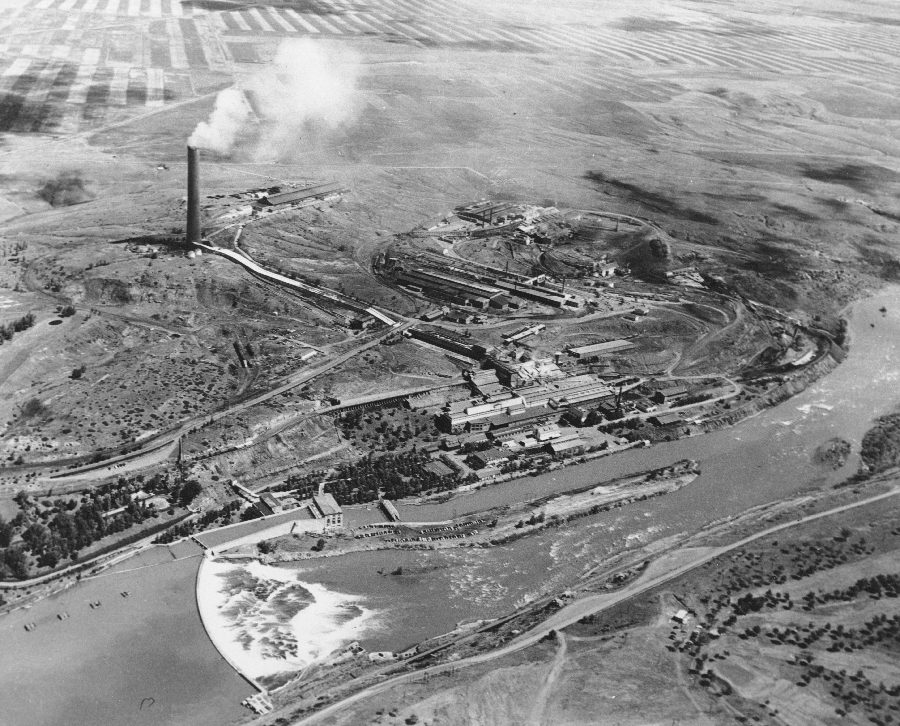
The Anaconda Mining Company’s smelter operation in Black Eagle is shown in the early 20th century. Credit: Courtesy of the Cascade County Historical Society
Sloan now participates in a stakeholder group aiding the U.S. Environmental Protection Agency’s cleanup of the pollution that remains nearly 50 years after the smelter closed. He represents the Montana Department of Environmental Quality in the group that also includes community members, federal agencies and representatives from the Atlantic Richfield Company.
The lasting physical legacy of Black Eagle’s industrial past is pollution that covers a vast area, including the town, parts of Great Falls and the adjacent Missouri River. The contamination was so pervasive that federal testing of residents’ attic dust in the mid-2010s turned up elevated levels of arsenic and lead. The EPA considered that contamination a minor risk compared to the lead and arsenic in people’s yards. Since 2024, workers have been digging up and replacing as much as two feet of contaminated topsoil on hundreds of homes.
The EPA identified lingering pollution in the early 2000s, but cleanup is still in the early stages today. Just one of the three pollution zones, called “operable units,” is being actively cleaned up. The first zone includes the homes and businesses in Black Eagle, where it was common to find a layer of smelter slag dust each morning while the plant was active. The other two zones are in testing and planning stages.
Work on the second operable unit, vacant land where much of the smelter operation was located, is ongoing to assess the level of contamination and potential to harm plants and animals. In the documentary, Sloan said that two arsenic “dump sites” are among the concerns and need to be evaluated for potential threats to groundwater.
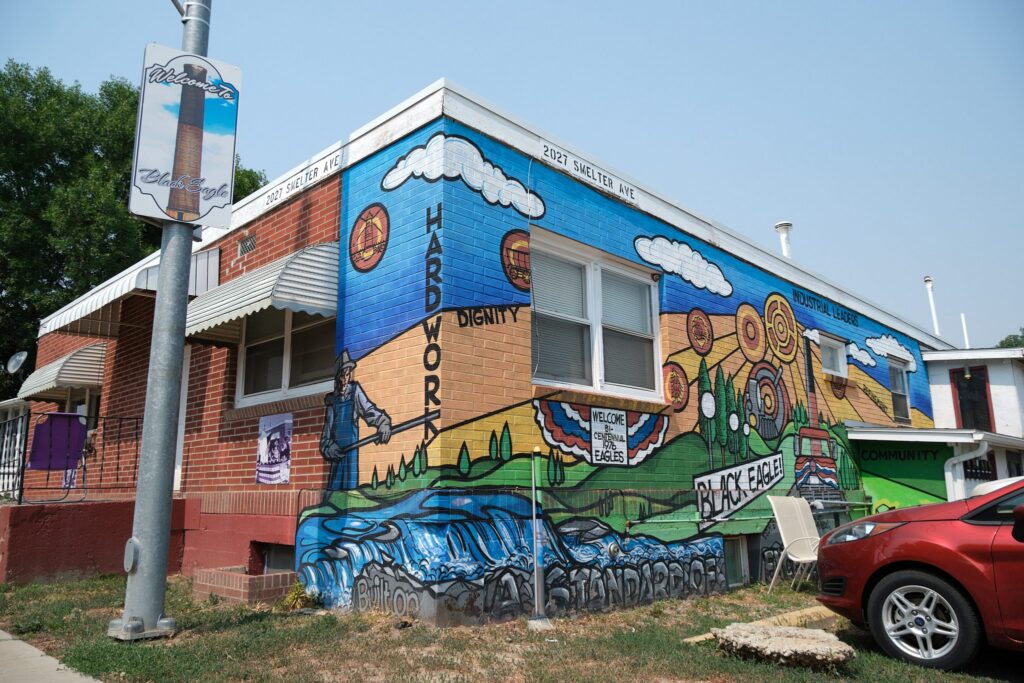
The legacy of the smelter operation is still very relevant in the character of Black Eagle, which is an unincorporated town adjacent to Great Falls. Credit: Matt Hudson / MTFP
The third operable unit represents the Missouri River. The Anaconda company and its predecessor dumped as much as 31 million cubic yards of smelter waste directly into the Missouri just between 1893 and 1915, according to EPA documents. Unrestricted river dumping continued “at a reduced rate” into the ’70s. Assessments of the river contamination haven’t yet begun, but it would be a difficult task for a Superfund cleanup that’s already painstakingly slow.
“It could potentially be massive and hard to characterize,” Mark Brooke, a Helena-based engineer and hydroecologist who has advised and managed the Superfund’s technical advisory group, told MTFP. “Trying to find pockets of sediments that have coalesced beneath the Missouri — to where?”
While Black Eagle keeps one foot in its industrial past, work has been done to modernize the town’s bones. Millions of dollars have gone toward updating the local water infrastructure, which at times required the complex coordination of multiple government jurisdictions and private entities. The replacement of a water and sewer mains in 2020, for example, occurred in tandem with the EPA-led removal of soils contaminated by smelter operations.
Sarah Peck, a lifelong Black Eagle resident who manages the local water and sewer district, has been at the center of much of this work. She scraped together a web of grants and government programs to make it happen.
“Actually, in nine years, we’ve done $6.5 million worth of work with 15 funding resources,” she told Montana Free Press last week.
One entity that benefits from water infrastructure improvements, including new fire hydrants, is the Black Eagle Volunteer Fire Department. The department has been making upgrades itself and recently moved into a new, larger building on Black Eagle’s west side.
Fire Chief Larry Dowell took the reins earlier this year. He is a transplant to Montana and lives just up the road from the fire department. He previously fought fires in California and moved to Montana after visiting his brother here.
The volunteer department has 14 members, and it’s looking to bring on more people. Most of the improvements the department makes above the operations budget are funded by grants, Dowell said.
As an unincorporated community, Black Eagle relies on volunteerism to keep it running. Tuss, the longtime resident, is involved in the Black Eagle Civic Club, which is a de facto city council of sorts. An 86-year-old, Tuss said that he’s been the VFW commander for 18 years and said that Monte Marzetta, who is president of the civic club, is about the same age. He expressed frustration that younger generations don’t appear as invested in Black Eagle’s future.
“Here you’ve got a couple guys, 86-year-olds, that’ve been at the helm for the past 17, 18 years,” he said.
Because home values tend to be a bit lower in Black Eagle than in the surrounding area, some worry that any influx of younger residents is more likely to be renters or home flippers rather than young families invested in the town’s future.
Peck, whose work at the water and sewer district includes billing, said the district has 511 accounts, about 170 of which are rentals.
Mary Ann Cosgrove, 82, said her house was the first built on Colorado Avenue, which is one block up from the main drag. She’s a former teacher and school administrator in Great Falls — a commuter from Black Eagle, if there is such a thing. The property includes the empty lot next door, which for years was a lush garden that Cosgrove and her husband maintained. After her husband died last year, she let the garden grow out a bit. It was a small comfort that the untended space grew sweet peas and looked lovely.
“It’s kind of neat because you put so much work into a garden, and then when you let it go, it does some beautiful things,” she said.
Like others who spoke with MTFP, Cosgrove longed for the old community ties among neighborhood residents. She remembered big cookouts and specialty dishes from the various immigrant families that characterized the area. Like Butte, Black Eagle had diverse pockets of European immigrants who arrived seeking work at the smelter. Cosgrove said she regards Black Eagle as its own place, distinct from Great Falls, despite the boundary between the two jurisdictions being little more than a street. She raised the possibility of Great Falls absorbing the town.
“You know, time is going to come when it’s going to be put to a vote,” she said. “And I hope I’m gone by then, because there will be some real hackles raised.”
Peck said that she also regards Black Eagle as separate from Great Falls in spirit. But as Great Falls eyes big changes, so goes Black Eagle. She’s been surprised by the recent sale prices of some Black Eagle homes and said that, in her view, more families actually are moving into town as Great Falls has struggled with its housing supply for low- to middle-income buyers.
It’s still unclear what, if anything other than time, will change the company-town spirit in Black Eagle. While crews have literally dug up the soil that decades of industrial activity have fouled, it hasn’t disturbed the kinship that Peck and others feel for that hillside.
“It’s like a tree planted, and our roots are here,” Peck said. “And you can’t pull your roots out.”