
Despite Cottonwood’s ‘reckless misstatements and disregard of facts,’ Big Sky’s water and sewer district burns $3M in five-year legal defense
By Jack Reaney SENIOR EDITOR
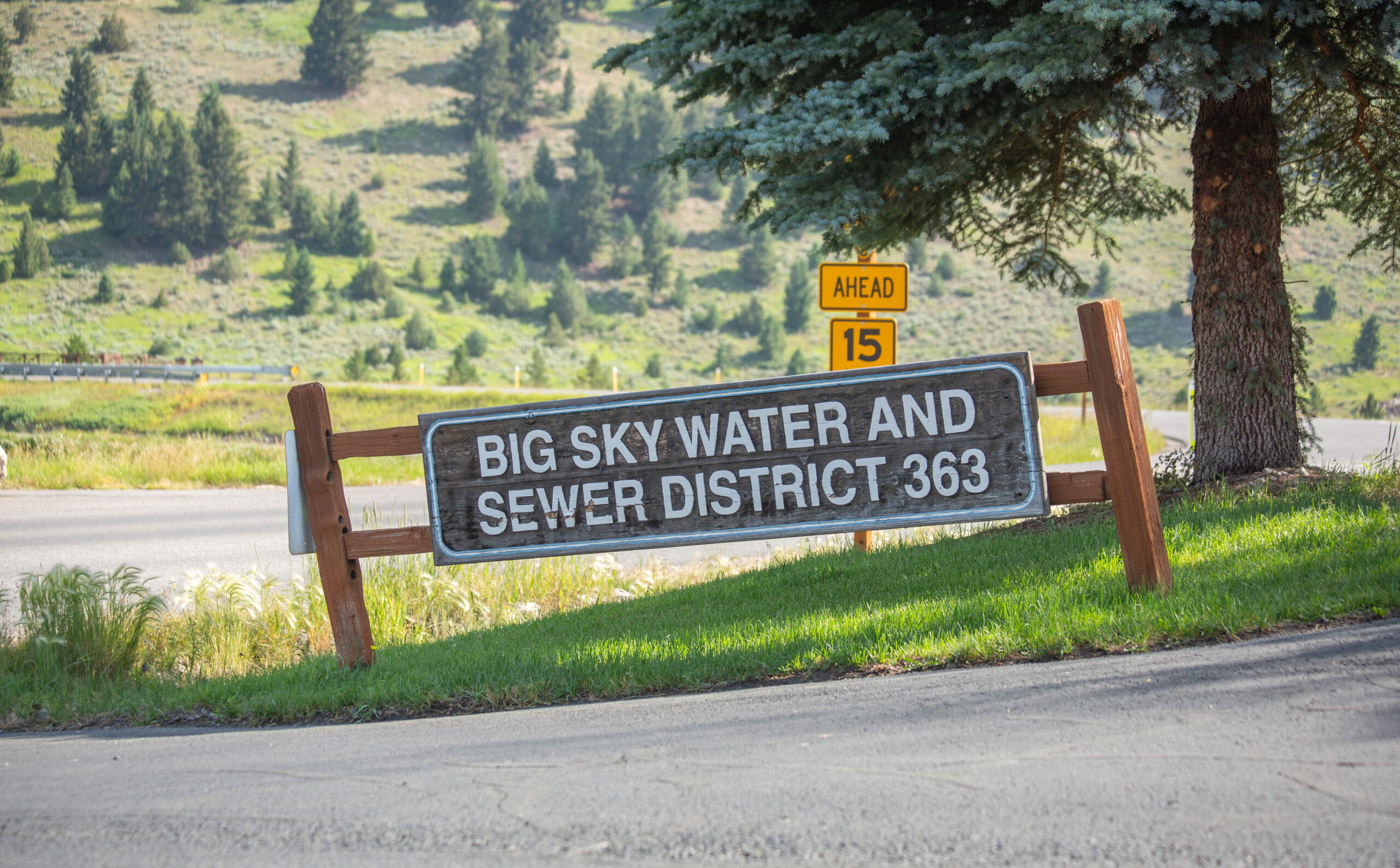
In a legal saga stretching back to July 2020, the Big Sky County Water and Sewer District has prevailed once more—this time earning $7,500 in legal recourse and a filing restriction against Cottonwood Environmental Law Center, whose series of failed lawsuits have cost Big Sky’s public water utility roughly $3 million in legal fees in the past five years.
Cottonwood’s allegations of fraud by BSCWSD “fall short,” according to a July 10 ruling by U.S. District Judge Brian Morris. The lawsuit alleged that BSCWSD had falsified data since the first trial filed July 2020, when Cottonwood first initiated a Clean Water Act lawsuit for alleged discharge of treated wastewater into Gallatin River tributaries—the April 2022 ruling favored BSCWSD. Cottonwood subsequently challenged the ruling in the U.S. Ninth Circuit Court of Appeals in 2023, again without success.

“Cottonwood persists in pushing a baseless fraud theory that has been debunked multiple times three years after trial,” Judge Morris’s ruling stated. “Cottonwood simply changes its theory when the facts fail to support the previous theory.”
In an email to EBS, Cottonwood Executive Director John Meyer stated that the court failed to discuss facts regarding EPA’s rejection of BSCWSD data. Meyer noted Cottonwood will be appealing the decision to the Ninth Circuit Court of Appeals.
BSCWSD board chair Brian Wheeler provided a written statement to EBS after the July 10 ruling.
“BSCWSD is glad that the judge recognized that Cottonwood and Mr. Meyer’s claim against the district is based on ‘reckless misstatements and disregard of facts.’ And we are happy that the judge made Cottonwood pay back some of costs that Big Sky Water and Sewer District rate payers incurred defending Cottonwood’s ‘baseless fraud theory.’ It is unfortunate that our ratepayers can’t recover more of the costs that Cottonwood’s baseless lawsuits have caused,” Wheeler stated.

Before the ruling, Wheeler discussed the financial impact of Cottonwood lawsuits at the district’s May 20 board meeting.
“It’s about $3 million in legal fees from one entity, that are paid by [BSCWSD] ratepayers,” Wheeler said. “… Do the math for 4,000 accounts. Think of that impact in this community—the things that could have been done. The water tank that could have been built. And it’s not like Big Sky water and sewer district is losing every one of these lawsuits.”
Finance Officer Terry Smith added that before its legal war with Cottonwood, BSCWSD used to budget up to $25,000 per year to handle legal fees for regular dealings such as annexations. Now, the district is budgeting $200,000 or more per year to fight, and win, fruitless lawsuits with legal fees that aren’t covered by insurance.
“This is one of the things that woke me up last night,” Smith said on May 20. “… We’ve supplemented the cost of our legal fees by digging into our reserves.”
Smith explained the district is projecting a $1.9 million operating loss—due to various factors including Big Sky’s expensive new treatment facility—for fiscal year 2026, even with higher customer rates set to balance the budget. Smith said $1.9 million is a $600,000 improvement over last year’s operating loss—hundreds of thousands of dollars in annual legal fees don’t help.
Sanctions imposed on Cottonwood
Judge Morris ruled that BSCWSD “did not falsify data” and reinforced previous rulings.
He described the situation bluntly when considering BSCWSD’s two-fold request for court-ordered sanctions: first, for Cottonwood to pay attorneys’ fees; second, to place a filing restriction on Cottonwood related to this litigation.
Morris noted a court must find “bad faith” or “reckless conduct” to impose such sanctions.
“Cottonwood’s reckless misstatements and disregard of facts, combined with the relentless pursuit of an alleged theory of fraud that has been rebutted multiple times, warrant sanctions,” Morris’s ruling stated, awarding $7,500 in legal fees and an order barring Cottonwood from filing any further motions in this case against BSCWSD and its employees.
Cottonwood’s argument cited massive gaps in BSCWSD data to prove water was disappearing from Big Sky’s holding ponds by way of illegal discharge. However, those gaps were directly accounted for in a dataset that Cottonwood failed to factor: treated wastewater that was pumped from storage ponds to the Yellowstone Club and Spanish Peaks Mountain Club outside of irrigation season—in 2020, irrigation spanned May 4 to Oct. 12.
Live cross-examination of Cottonwood’s expert source included admission of “a mistake” by failing to account for those non-irrigation months, which were discovered in a separate tab on the district’s spreadsheets, according to the ruling. Cottonwood then contended the separate tab was hidden intentionally.
“Cottonwood’s expert conceded that Cottonwood’s failure to include export data for irrigation from the holding pond to the golf courses at Yellowstone Club and Spanish Peaks resulted in errors in Cottonwood’s water budget,” the ruling stated. “… This testimony refutes Cottonwood’s theory of fraud.”
Cottonwood also mistakenly provided near-duplicates of one of its spreadsheets for evidence, intending instead to show two contrasting spreadsheets to support its claims.
“Your Honor, there is one issue. We had filed two exhibits and they are nearly identical,” said Cottonwood Executive Director John Meyer during the June 9 hearing, requesting to add a third and supposedly “real” spreadsheet into examination.
BSCWSD legal counsel objected on the grounds that BSCWSD had not had the opportunity to review it for accuracy and completion, given the document was not listed on Cottonwood’s trial exhibit list. Morris upheld the objection.
The additional spreadsheet was later deemed incomplete—a few months older, from February 2021, with some 2020 water export data yet to be included as part of BSCWSD’s periodic updates.
Justifying the court’s decision to restrict filings, Morris summarized Cottonwood’s five-year effort.
“Cottonwood remains unwilling to accept the judgment,” the ruling stated. “Cottonwood freely tried this case to a jury. The jury returned a defense verdict. Cottonwood pushed its false evidence theory in moving for a new trial. The court denied that motion. Cottonwood appealed to the Ninth Circuit on grounds unrelated to its false evidence theory. Cottonwood’s appeal was denied. Cottonwood pursued collateral attacks on the court’s judgment in Montana state district court and with DEQ and the EPA based on the same false evidence theory. Cottonwood’s attacks failed… Repose is this issue’s destiny.”
In a separate, ongoing Racketeer Influenced and Corrupt Organizations Act lawsuit, Cottonwood alleges corruption by CrossHarbor Capital Partners, Lone Mountain Land Company, Yellowstone Club, Spanish Peaks and BSCWSD, and five associated individuals.
“Basically they’ve created a scheme—a racket—to dispose of treated sewage unlawfully so that they can continue to develop unnecessary multi-million-dollar vacation houses,” John Meyer said in a video posted to social media on May 8. “… We have alleged they are lying to the jury, they are lying to the court, they’ve lied to the EPA, the Montana DEQ. The whole thing is an f’ing charade.”
Judge Morris’s ruling criticized the merit of the RICO lawsuit.
“Cottonwood also seeks to push this baseless theory through a civil RICO action related to this litigation. It appears that the same theory of fraud supporting this motion underpins Cottonwood’s civil RICO action,” Morris’s ruling stated.
The RICO suit remains unresolved. Meyer stated via email that Big Sky residents who pay utilities to BSCWSD have signed up to be plaintiffs.
District GM Johnny O’Connor shared a written statement to EBS celebrating the July 10 outcome and sanctions.
“We are pleased that the court has imposed sanctions, including restitution of attorney’s fees and restrictions on future filings,” O’Connor stated. “These measures send a clear message that misuse of the judicial system will not be tolerated.”
O’Connor added that the millions of dollars in legal fees spent defending against Cottonwood lawsuits are “significant” and “unfortunate,” but that the district will continue to focus on serving the community and maintaining the integrity of its operations.
‘Do a little homework on excel’
After the June 9 hearing, an anonymous caller left a voicemail with the court’s chambers encouraging the court to “do a little homework on Excel.”
The comment referred to the tab of data that was hidden on Microsoft Excel, containing non-irrigation season data. Cottonwood claimed the tab was hidden intentionally, but the court found those allegations “unpersuasive.”
In the conclusion of Morris’s ruling, he encouraged citizens to observe and engage with the court’s docket, matching the open and transparent setting of legal proceedings.
“Anonymous voicemails do not constitute open and transparent communication,” the ruling stated. “The court also has done its homework on Excel in this case.”
According to Cottonwood’s mission statement posted on its website, the law firm is “a group of free-thinking rabble rousers dedicated to protecting the people, forests, water, and wildlife of the American West, and having fun doing it.”
In the eyes of Chief Judge Brian Morris and the District of Montana within the U.S. District Court, Cottonwood will need to try a new angle if it wishes to continue rousing rabble with Big Sky’s water and sewer district.