


By Annie O’Neill EDITORIAL INTERN
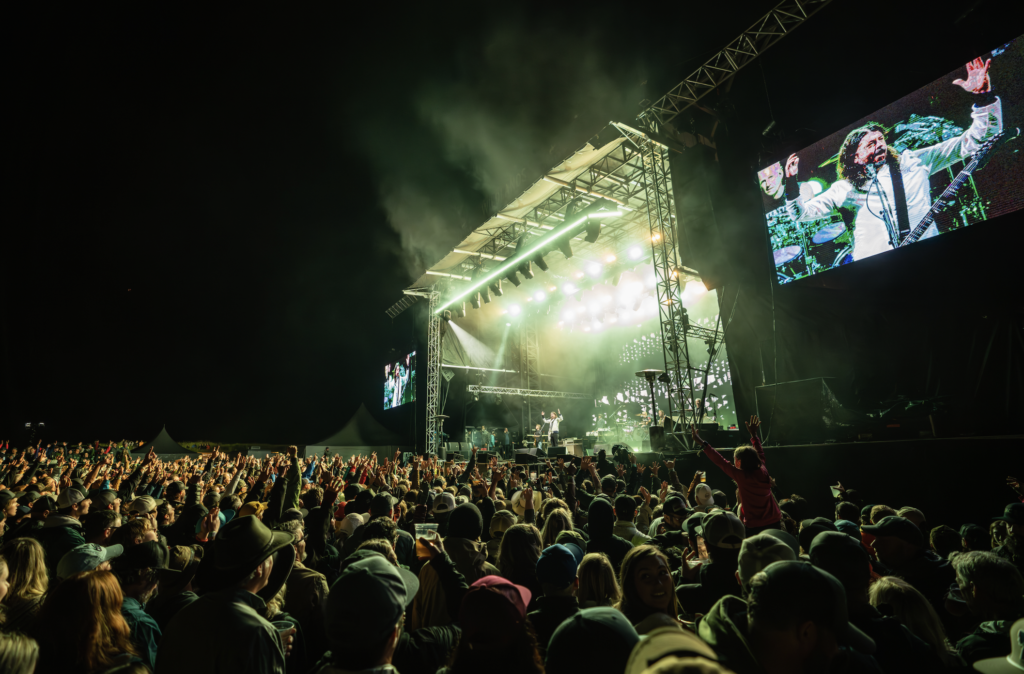
By the time the first band hits the stage at Wildlands, most of the crowd has no idea how it got there. The stage, the sound system, the video walls flying overhead, it all just appears. Nobody in the audience is thinking about the semitrucks that rolled in two days earlier, or the crew that spent the night building the rig.
That invisible work belongs to Cole Yarbrough and Jeremiah Slovarp, two Montana locals who have spent the better part of two decades building the infrastructure behind the region’s biggest shows. Yarbrough’s company, Rocky Mountain Rigging, gets the stage up and running. Slovarp’s company, Jereco, makes sure it sounds right once it’s up. Both got their start the same way: as young rock climbers who wandered into concert rigging almost by accident, and never really left.
Rock climbers first
Yarbrough was a student at the University of Montana, deep in the climbing scene, when he saw an ad looking for people to work rigging—”Do you like music? Do you like climbing? You want to get into rigging?” the ad read.
It wasn’t a hard sell. Before long, Yarbrough was installing the cables, trusses and equipment that suspend lights and speakers high above concert stages.
Slovarp’s way in came through Yarbrough himself, a few years later at Montana State University. They already knew each other from the climbing world, so when the MSU Fieldhouse needed more hands to rig, Yarbrough knew exactly who to ask.
The job meant working 50 or 60 feet in the air. “Super dangerous work,” Slovarp said, “but we were rock climbers, and we were like, oh yeah, let’s do that.”
Neither of them owned a company yet, nor did they have much sense that this could become one. They were hired labor, showing up when a bigger production outfit needed extra hands.
But the names on those early gigs were massive for two guys just starting. Yarbrough’s first real show was Pearl Jam. Slovarp’s was Van Halen or Mötley Crüe, he isn’t entirely sure which, sometime around 2000 or 2001. Neither treated it as a big deal at the time.
“We were a couple of rock climbers trying to use our skills to make money,” Yarbrough said.
Two companies, two paths
Yarbrough started Rocky Mountain Rigging with a college friend in 2002, supplying labor and stagehands before the company bought its first mobile stage in 2006. The early concept was an annual festival in Missoula that booked Poison. It was Yarbrough’s first time running a full stage crew, where, “we had no idea what that entailed,” he said. Despite the uncertainty, their work held up for the band and its fans.
Today, Rocky Mountain Rigging covers Montana, Arizona, Idaho, Washington and Oregon. A core crew of 10 to 15 people scales up to as many as 200 riggers for a stadium show like Mumford & Sons at Bobcat Stadium or Post Malone and Jelly Roll in Missoula.
Despite a buyout offer from a larger labor company a few years ago, Rocky Mountain Rigging has remained independent and family-run; Yarbrough’s wife, Jennifer, runs labor management..
Slovarp’s path started in Bozeman bar bands. He and his bandmates, Orion and Luke, kept buying gear for themselves until, as he put it, “we didn’t really have anywhere to put it.” While finishing an economics degree at Montana State, Slovarp had been quietly taking sound classes at the film school under a professor who eventually nudged him toward starting his own business. Jereco Studios followed, founded by Slovarp, Orion and Luke. The name is an acronym: Jeremiah’s Recording Company. Recording itself, he said, is now just a fraction of what Jereco does.
How a show actually gets built
A single show comes together over months. Slovarp starts coordinating with promoters and bands as early as nine months out.
“It’s nine months before the concert, and we are on the phone and emails … determining their needs, their desires; what do they absolutely need to critically execute the show,” Slovarp said.
Everything gets sorted into needs versus wants, and sometimes the wants pose a challenge. At Wildlands this year, a band’s request for a bigger video wall turned into an engineering problem once Yarbrough had to account for the added weight on the roof.
And, even at a single venue, each musical act’s stage setup can look different. Dave Matthews needs comparatively little. A band like Foo Fighters requires one of the largest mobile stages in the world, without which, Slovarp said, “we couldn’t have had Foo Fighters.”
Yarbrough and Slovarp coordinate through all of it, “Cole has to be on the whole time. It’s his stage. If the band doesn’t fit on the stage, we’ve got a problem,” Slovarp said.
When the weather turns
Montana doesn’t make it easy to put on a show. Weather can turn on a stage crew without warning, and both men have their own version of the night nearly everything went wrong.
For Yarbrough, it was a winter event called Powabunga in Vail, Colorado, when a snowstorm dumped roughly two inches an hour for two or three days straight. Mobile stages aren’t built to carry that kind of weight; the rigging, the video walls and the lighting rig are engineered for a fixed load, not accumulating snow.
All night long, Yarbrough climbed back up the structures to clear it, continued through the concert, and when the storm finally broke, the temperature dropped to well below zero.
Slovarp’s closest call came with Foo Fighters at Wildlands in 2023, when audio equipment failed after a severe thunderstorm. Torrential rain forced the crew to shut the stage down mid-show, and when the band’s own touring sound system rebooted afterward, it played out of sequence and crashed a few minutes into the set.
“That could have been catastrophic instead of just a temporary hiccup,” Slovarp said. After solving the technical issue, the show went on.
Why stay independent
Over the past few years, private equity has moved steadily into live event production across the country, buying up sound, lighting and labor companies and folding them into larger corporate structures. After receiving a buyout offer from a large labor company, Yarbrough chose to stay independent. What’s kept both companies standing on their own, Yarbrough and Slovarp say, isn’t scale. It’s trust.
“This business is all about relationships, reputation and reliability,,” Yarbrough said.
Slovarp’s version of the same idea lives on a sticker plastered across a lot of Jereco’s equipment cases: “Never trust the promoter.”
It’s a joke, mostly. But it comes from real experience at shows that fell apart because a promoter withheld information or simply didn’t have things under control.
Slovarp keeps Jereco close to Bozeman, occasionally traveling for the right client to Jackson Hole, Wyoming; Cody, Wyoming; or Red Lodge, with some rental partners in Butte. Yarbrough sees something specific in the crews who do this work in Montana, a level of effort he says stands out even against other production hubs in the West.
“Montana work ethic, it’s different. It’s not the same,” he said.
Slovarp calls Big Sky and Bozeman “an island” in terms of production resources. If a show needs equipment the region doesn’t have, it either goes without or gets trucked in at a real expense. That isolation is arguably why companies like Rocky Mountain Rigging and Jereco exist in the form they do. Without a deep bench of regional competitors to lean on, local companies have had to become the entire supply chain themselves, from stage to sound to crew.
Twenty-plus years later, Slovarp still finds it remarkable that it all began with a college climbing partnership.
“Two different walks of life and two different businesses altogether,” Yarbrough said.
That’s easy to miss from the crowd. Rocky Mountain Rigging and Jereco are separate companies, built by different people who met climbing and kept working together. And while the audience never sees that work—just the lights come up and the music start on time–that’s exactly how Slovarp and Yarbrough like it.