


Two-year course challenges juniors and seniors to analyze real companies, explore business strategy and develop critical thinking skills
By Leslie Kilgore EBS STAFF
In a community shaped by entrepreneurship, risk-taking and business ownership, students at Lone Peak High School have an opportunity to study the inner workings of business long before they enter college or the workforce.

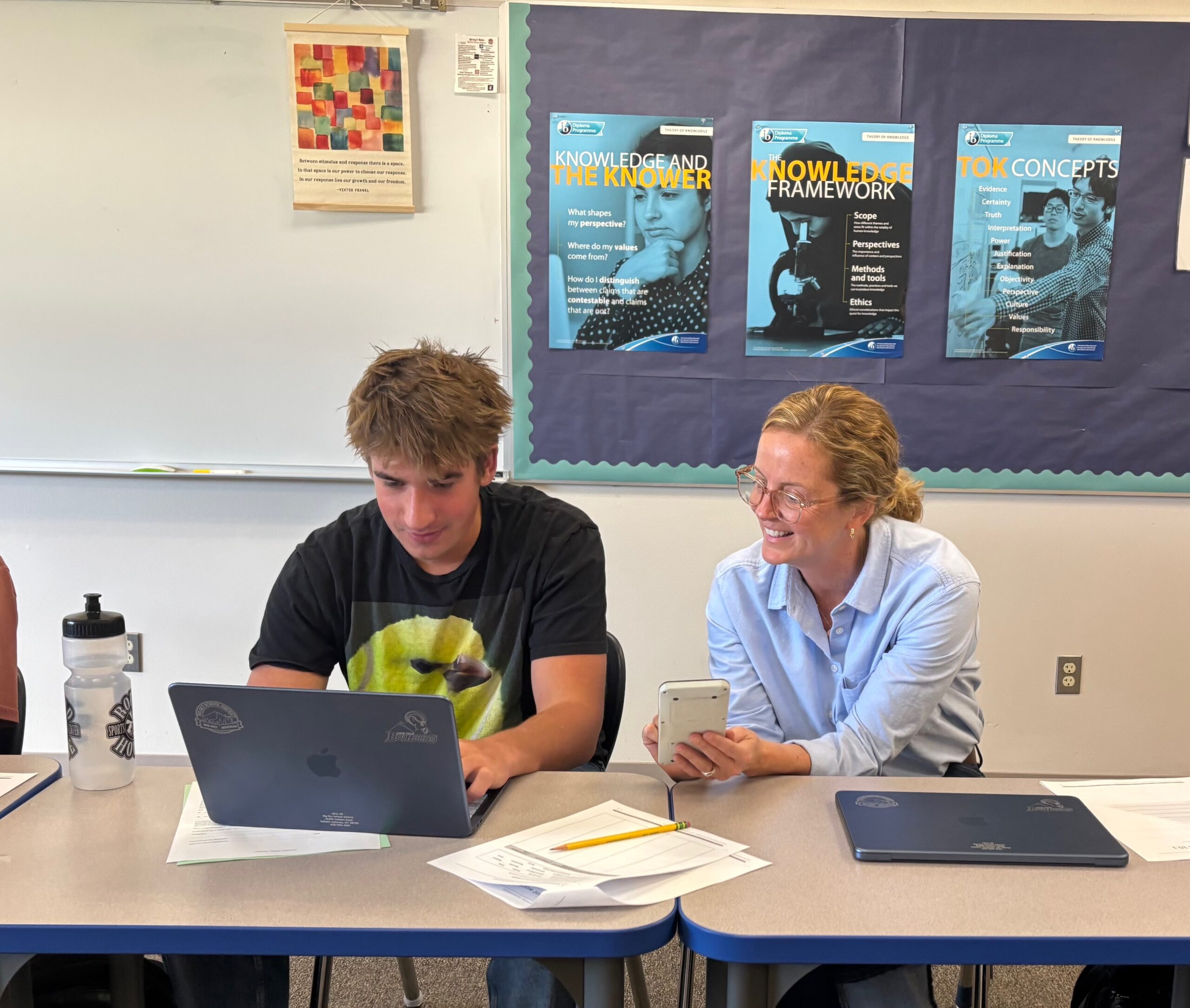
Through the International Baccalaureate Business Management course, juniors and seniors spend two years examining how businesses operate. From financial performance and marketing to leadership, human resources and long-term strategy, the course combines academic rigor with practical applications, asking students to analyze real companies, identify challenges and recommend solutions.
Dr. Marlo Mitchem, principal and longtime International Baccalaureate educator at Big Sky School District, describes the course as a “mini MBA program.”
“The students are learning some pretty sophisticated financial tools,” Mitchem said. “Marketing, finance, human resource management, operations management and the entire functioning of a business in different economic sectors.”
The course is part of the district’s IB curriculum, which was launched in 2016, with the first class beginning in 2017. Mitchem arrived in Big Sky in 2016 after teaching at several IB schools internationally and has taught Business Management for 15 years.
The curriculum is standardized internationally, allowing students to study the same course content as their peers at IB schools around the world. For Big Sky students, the focus on business is a natural fit.
“We live in a very business-centric community,” Mitchem said. “Many of their parents are involved in private industry, so it’s a natural fit.”
From business fundamentals to real-world analysis, the two-year course is designed to build students’ understanding gradually, beginning with the fundamentals of how businesses function within the larger economy before moving into more complex analysis and decision-making.
During their junior year, students examine the external environment in which businesses operate, including how economic conditions influence decisions. They then turn their attention inward, studying a company’s mission, strategy, business plan and opportunities for growth.
Finance and accounting follow, giving students tools to evaluate a company’s financial health beyond its profits. Students study assets and liabilities, financial ratios and the potential return on investments and projects.
Marketing builds on that foundation, exploring how businesses reach consumers, position products and determine pricing. The class also considers how emerging technologies, including artificial intelligence and social media, are changing the field.
“We can really tap into their own experiences as consumers when we’re studying things such as marketing,” Mitchem said.
In their senior year, students study human resource management and operations. They explore leadership and motivation theories, employee recruitment and training, and the systems that move a product or service from an idea to the customer.
For Mitchem, one of the strengths of the course is its relevance to students’ lives, whether they eventually pursue business careers or enter entirely different fields.
Leadership theory, in particular, encourages students to reflect on their own values and ambitions.
“They can think about what kind of leaders they would like to work under, whether in a classroom, at a job, or on a team,” Mitchem said. “And, they can also think about what kind of leaders they will become.”

Students in the class also become business analysts, which is a major component of the course, through an independent research project that requires students to select a business and investigate a specific problem or decision facing the company.
Students examine the business’s finances, history, products and other relevant information before developing a focused research question. They may look forward, evaluate a potential decision and recommend a course of action, or look backward, analyzing what went wrong and how the company might avoid similar problems in the future.
Students then work toward a final written assessment, which is submitted to IB for external evaluation. The project requires them to apply concepts from across the curriculum rather than simply memorize information.
Throughout the course, students also collaborate on research, writing and discussion, while the independent assessment must be completed individually.
Mitchem said the two-year structure gives students time to develop the knowledge and analytical skills necessary to tackle a complex question. Students submit their final research papers in the spring before preparing for cumulative IB examinations at the end of April.
She added that students who go on to study business, finance and economics often contact her after beginning college.
“They often reach back out to tell me that they already knew almost everything in an intro class, or the class was so helpful as they study for their business degree,” Mitchem said. “They generally feel really prepared.”
For students pursuing business degrees, that early exposure can provide a foundation for more advanced college coursework. But Mitchem said the benefits extend well beyond business majors.
“The IB program prepares students for higher education by emphasizing independent research, analytical writing and examinations that require students to demonstrate a depth of understanding,” she explained. “Rather than relying primarily on multiple-choice questions, students must develop arguments, synthesize information and explain their reasoning.”
At Lone Peak High School, students decide during the middle of their sophomore year whether to pursue the full IB Diploma Program. All students take IB classes, but the full diploma is an additional, externally awarded credential.
Mitchem explained that the two-year Business Management course helps students develop skills that will serve them whether they continue to college or move directly into the workforce.
“I see huge growth in the students over the two years of this class,” she said. “Not just academically but socially too.”
That development is especially important in a rapidly changing business environment. Mitchem brings current events and emerging technologies into classroom discussions, encouraging students to consider how innovations such as artificial intelligence may affect businesses, the broader economy and their own futures.
“Anytime you can discuss content that is very relevant to their own lives, it engages them intellectually and emotionally on a different level,” she said.
After nearly a decade of the IB program in Big Sky, Mitchem said one of the most rewarding aspects of teaching is seeing students become more confident and capable thinkers. The course asks a great deal of students, but she said they always rise to the challenge.