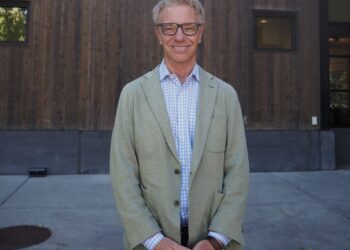



Water and sewer board secretary, Air Force vet, former Big Sky ski instructor says it’s his time to move on
By Jen Clancey STAFF WRITER
When asked what the most rewarding part of his storied career is, Big Sky’s Dick Fast responded confidently: “The people I’ve worked with.”
Those people he’s met span across the U.S., Europe, and here in Big Sky, as he bids farewell after 23 years with the Big Sky County Water and Sewer District board.

Fast moved to Big Sky in 2000, where he taught skiing and eventually began serving on the district board in 2003. Fellow board members credited his patience, humility and execution for seeing the district through construction of Big Sky’s advanced sewer plant and its use for affordable housing, as well as major negotiations with developers and planning for infrastructure that will serve the community for decades to come.
“The next thing I knew it was 23 years later, and I’m kind of finally saying maybe it’s time to hang it up and move on,” Fast said. Sitting in Caliber Coffee about a month before his final meeting in July, he walked through his water and sewer career. As the longest serving board member, there’s a lot to reflect on.
Fast was recruited to the board by the water and sewer district’s former General Manager Ron Edwards in 2003, just 10 years after the district was formed.
“It was just interesting work, kind of seeing how we could develop here in a way that was smart and that took the environment into consideration, and didn’t overdevelop,” Fast said. “I’m not sure how successful we’ve been at that, but we have managed to make sure that what development we have is not polluting the environment or the river.”
Edwards retired in 2024, and Fast’s time on the board also overlapped with Brian Wheeler, the board president, who reviewed notes of Fast’s accomplishments while on the phone with EBS.
“I had to put it down on paper and I said, ‘Wow. that’s impressive,’” Wheeler noted. “…The accomplishments are pretty extraordinary.”
Early-on, Fast helped negotiate and implement the district’s deals with the Yellowstone Club, Spanish Peaks and Lone Moose Meadows—now known as Flatiron—which ultimately set the tone for water use and discharge in Big Sky.
“Those deals that he was responsible for, those are the difference in success and failure at the water and sewer district being a zero discharge community,” Wheeler said. “You know, guys like that just don’t get the credit for it.”
Wheeler also credited Fast for getting a deal with Northwestern Energy and Big Sky Owners Association over the finish line: by acquiring a 100-foot-by-100-foot parcel from NWE, and negotiating with Big Sky Owners Association over Huntley-Kern Pond renovations and a water line to a new tank, the district incorporated a critical water storage and distribution facility known as the Sweetgrass Hill tank.
Tom Reeves, a longtime friend and former board president, recalled how Fast and the board discussed community needs when planning the roughly $60 million Water Resource Recovery Facility. Before the WRRF was built, the district set aside treatment capacity for the equivalent of 600 affordable single family homes, paving the way for future workforce housing locally. Big Sky voted to fund part of the facility’s construction through an additional 1% resort tax in 2020 and the sewer plant opened in April 2024. Cold Smoke, a 389-home workforce housing project, will be just one development to make use of the available treatment capacity for year-round residents.
“We always made our case at board meetings about [how] it’s not only about serving businesses, it’s about serving the community,” Reeves said. He noted other former board members like Packy Cronin and Bill Shropshire, who both served for over 20 years, did the same. Fast hopes that community-first attitude remains.
“I’m hoping [the board] can continue that tradition, that we have a mix of people on the board that represent all the different interests in the area to include the community as a whole, instead of being heavily tilted towards developers,” Fast said.
Before water and sewer
Fast and Reeves were already friends before they intersected on the board for eight years. The pair met through BSOA and soon were taking trips across the world with their families. In that time, Reeves learned more about his friend’s background.
“I ended up knowing a lot about him over the years, but it wasn’t something he bragged about—all that he’s done in his life,” Reeves said. Fast is a U.S. Air Force veteran, holds a doctorate in history and worked in national intelligence and political military in Washington D.C. and Europe.
When asked about that experience, Fast moved the yellow pages of water and sewer notes to the side of the table at Caliber Coffee, before describing his involvement in disarmament in the 1990s, and his work under Air Force leaders. Joining the effort to reduce arms across Europe as a part of the North Atlantic Treaty Organization, the U.S. negotiated arms limits in NATO and Warsaw Pact countries to limit high-impact weaponry like battle tanks, fighter jets and artillery pieces. Fast was involved in negotiations starting in 1990, where discussions began domestically, progressed to the 15 NATO countries, then to Warsaw Pact countries. Eventually the process would lead to meticulous inspections of military bases, which Fast worked to plan and implement.
“So it was very complicated and long drawn out, and it often turned out that the hardest negotiations were within our own country,” Fast said. The complexity didn’t end on paper. During inspections of military bases in Europe, he remembers detailed conversations like which doors an inspector could open based on the height and width of the frame.
“Nobody wanted to give an inch,” Fast said. Inspections and negotiations also happened in a time of unrest and massive change for former Soviet countries when the Warsaw Pact dissolved in 1991, which Fast said eased some of the negotiations. He spent three years working in disarmament until 1993, and moved on to work under Air Force chiefs of staff, four star generals and the secretary of the Air Force, including the first woman in the role, Sheila Widnall.
In 1997, he retired from the Air Force and he and his wife Sherrie, who also worked in Washington D.C. under Montana politicians, moved to Big Sky three years later. It’s been almost 30 years since his time in the armed forces, but his experience engrained valuable lessons in handling tense conversations and solutions.
“Patience, paying attention to details,” Fast said. “Treat people like you want to be treated.”
“It’s one thing to get the agreement, then you have to implement it,” Fast continued. According to Wheeler, this is one of Fast’s strong suits: to execute with “meticulous detail” and see it to the end.
“He is extraordinary at it,” Wheeler said, expressing how the role will be hard to fill. For Fast, the end to his time on the board comes with gratitude and admiration for the people he’s worked with over the course of his career.
He lists his Air Force colleagues; the cadets and officers he taught; the dedicated Big Sky Resort ski instructor crew who were “willing to take an old guy and give him a little slack when he couldn’t keep up”; and the water and sewer district and board.
With water and sewer agreements made and deals done, Fast will have some more time on his hands. He looks forward to traveling with his wife, and perhaps visiting warmer places when Big Sky winter arrives.