

By Jack Buban GUEST COLUMNIST
Have you ever wondered how that trout you caught on the Gallatin measures up? Well, with the release of the 2025 Montana Fish, Wildlife and Parks Gallatin River fish count data report, now you have the resources to find out.
FWP Fisheries Biologist Keith Wellstone visited Big Sky last month to present some of the important findings of the report to a curious local crowd. What he shared tells a story about the Gallatin River. What we do now and in the future will determine the next chapters of this story and have a lasting impact on the health of our beloved trout and their habitat.

Fish data collection 101
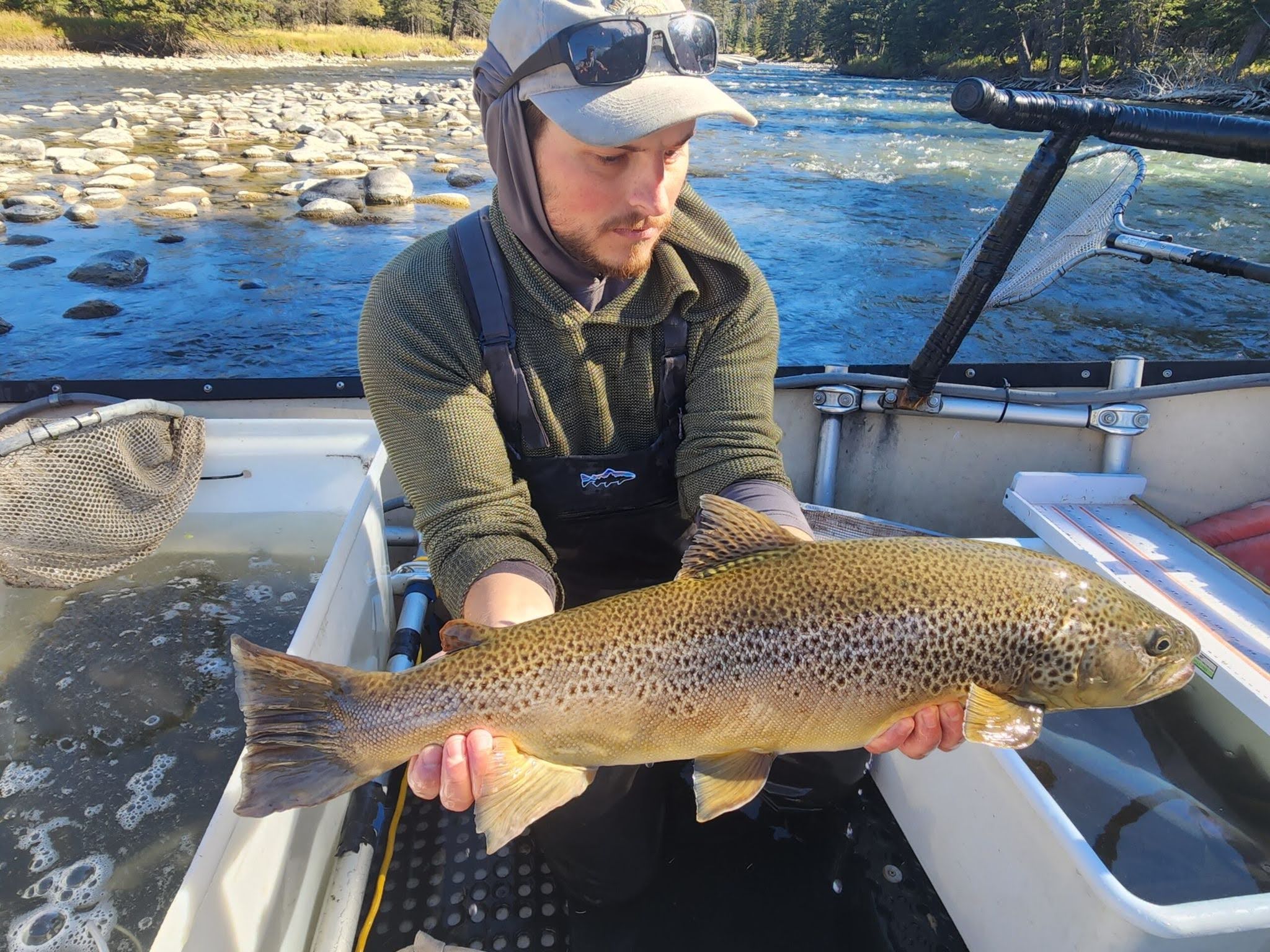
We know that we need science to help us identify what we can’t always see with the plain eye. We need data and reports and numbers to help us decipher more than what we experience in a day on the river catching, or observing, fish behavior and the river’s environment. Determining the size of a population is sometimes difficult, especially for a population of highly mobile organisms like trout. To determine a rough estimate of the total population size, FWP uses a data collection method called mark-recapture.
This method studies the proportion of fish that are captured during a series of two sampling occasions to estimate the size of the full population. Here’s how it works: first, a population sample is captured, and the individual fish are counted and marked before they are released back into the river.
After allowing enough time to elapse for the marked individuals to mix back into the total population—but not so much time that significant births, deaths, immigration or emigration occurs—scientists take a second sample. Since the number of marked individuals represent a certain proportion of the total population, the number of marked fish that are captured again in the second sampling event represent the same proportion in relation to the total population size. This provides a clue for scientists when they make decisions, like conservation measures, based off of the total population size.
Gallatin fish are thriving
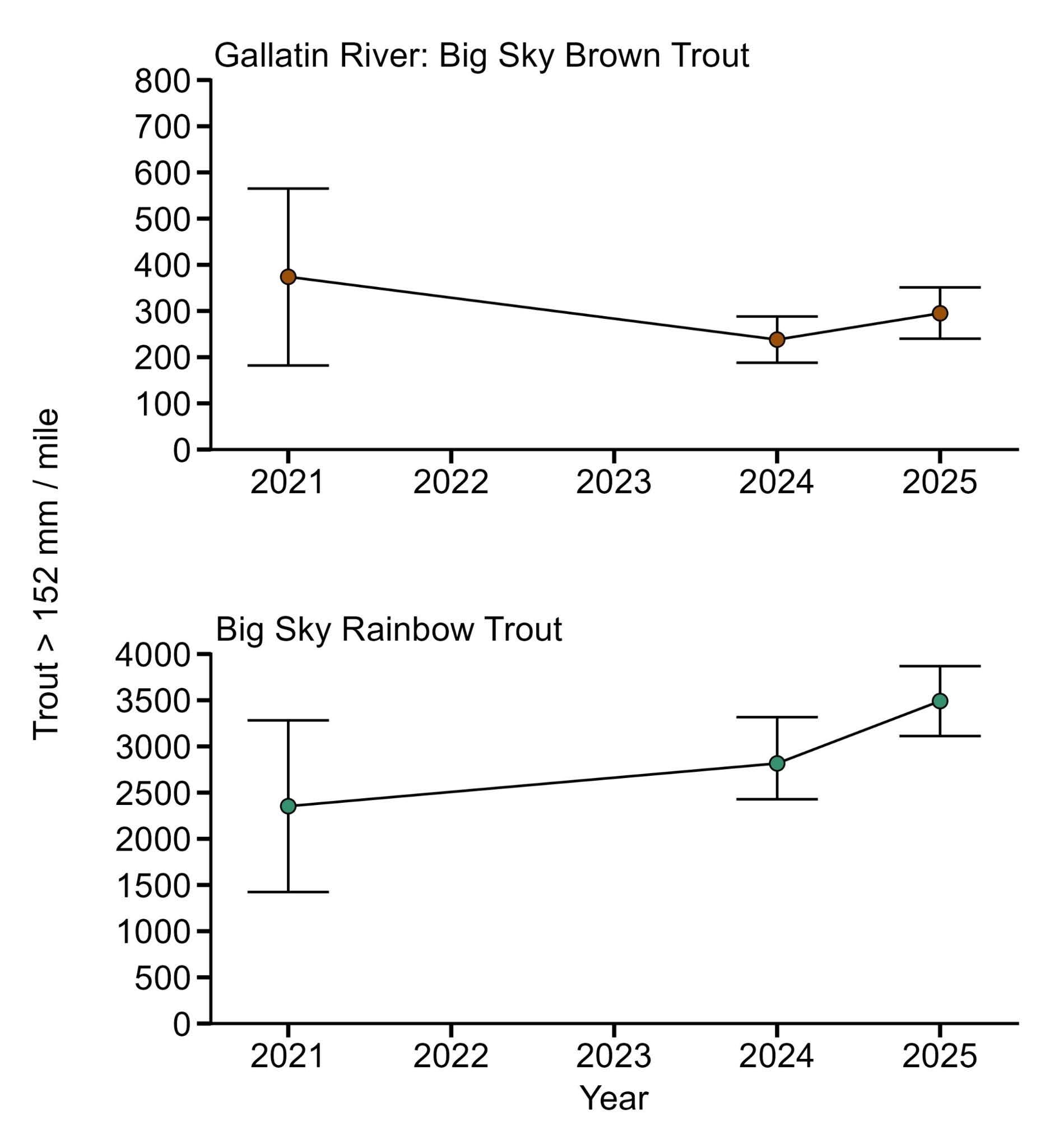
What the recent FWP data and report tells us is that the Upper Gallatin River’s fish population is thriving. In fact, the summary of the significant findings shows us that the Gallatin has an average of over almost 3,800 trout per mile, with the largest recorded brown trout at 26.5 inches and the average rainbow between 12-18 inches. This population count is a slight increase from previous years, but numbers are only compared as far back as 2021, as FWP builds a dataset over time.
The 3,785 total number breaks down into 3,491 rainbow trout per mile, and 295 brown trout. With data this close together it’s hard to tell what that says about the condition of the river, though it is worth noting that these are very high concentrations of trout compared to other stretches of the Gallatin. For example, at a Logan sampling site along the Gallatin, there are only 1,020 trout per mile. Because we know that healthy trout fisheries possess cold, clean water, connected habitat and a diverse array of habitat requirements, we can connect the dots to tell us that a healthy fish population tends towards a healthy environment for those fish.
What makes the Gallatin unique?
Unfortunately, other Montana rivers are not faring quite as well, as we’ve all seen over several years’ worth of hot, dry summers that instill hoot owl and other fishing restrictions on beloved rivers like the Big Hole, the Jefferson and even the Madison. The Gallatin, however, has skirted some of the degradation suffered by other area waterways, and in fact, in its own studies, FWP has even documented a measurable increase in brown and rainbow trout populations over the last four years; a fair indicator of a healthy fishery, and—as of today—a healthy river.
The Gallatin’s resilience can be partially attributed to its headwaters in Yellowstone National Park, which provides cold clean water and an intact ecosystem that supports healthy wild trout populations. But having a pristine headwater source does not come without obligations, fulfilled in large part by the Gallatin River Task Force. As noted in board member Todd Shaw’s recent opinion piece, “water quality monitoring and riparian habitat restoration is critical to ensuring the Gallatin River fisheries remain healthy and sustainable.” The Task Force employs these techniques everyday in ongoing and seasonal work.
If the high-temperature, low-precipitation weather pattern that characterized the winter continues into the spring and summer, however, today’s healthy fish populations could face future impairments, as water quality, air temperature and rising water temperatures come more and more into play. These things have the cumulative ability to negatively impact fishery health even in waterways like the Gallatin.
Listening to the science is key
According to Guy Alsentzer, executive director of Upper Missouri Waterkeeper, “trout are the canary in the coal mines of river health.” He reaffirms what we know: that listening to science is the key to building resiliency for our fish, and for the Gallatin.

Advocating for river health is just one piece of how we make a difference, in combination with a science-based plan for restoration, adequate means of funding research and data and applying what we find to our practices for the river. As our rivers face water quality and quantity challenges, pressures from community growth, climate change and increased recreation, it’s critical that we continue to lean on science. Studies like the FWP fish count report can guide our vision and work for a healthy and resilient Gallatin River and the fish who call it home.
Jack Buban is the community engagement manager at Gallatin River Task Force. Buban studied wildlife biology at the University of Georgia and spent time tackling water issues in Alaska and South Carolina before moving to Montana and joining GRTF as a Big Sky Watershed Corps member.