

Outstanding in the Field returns to North Bridger Bison
By Fischer Genau DIGITAL MEDIA
Traces of bison surround us on this dry July day in Wilsall, Montana. Buffalo chips littered amidst the sagebrush crunch under our feet, and we follow dirt paths that have been pounded into the landscape over time by thousands of hooves. When it rains here, the bison wallow in the mud, displacing tons of soil with their enormous bodies and generally making a mess of the place. They are its sloppy landscapers. In fact, everything here, from the sage to the birds nesting in the grass, coevolved with bison over thousands of years. The bison are in this place’s DNA.
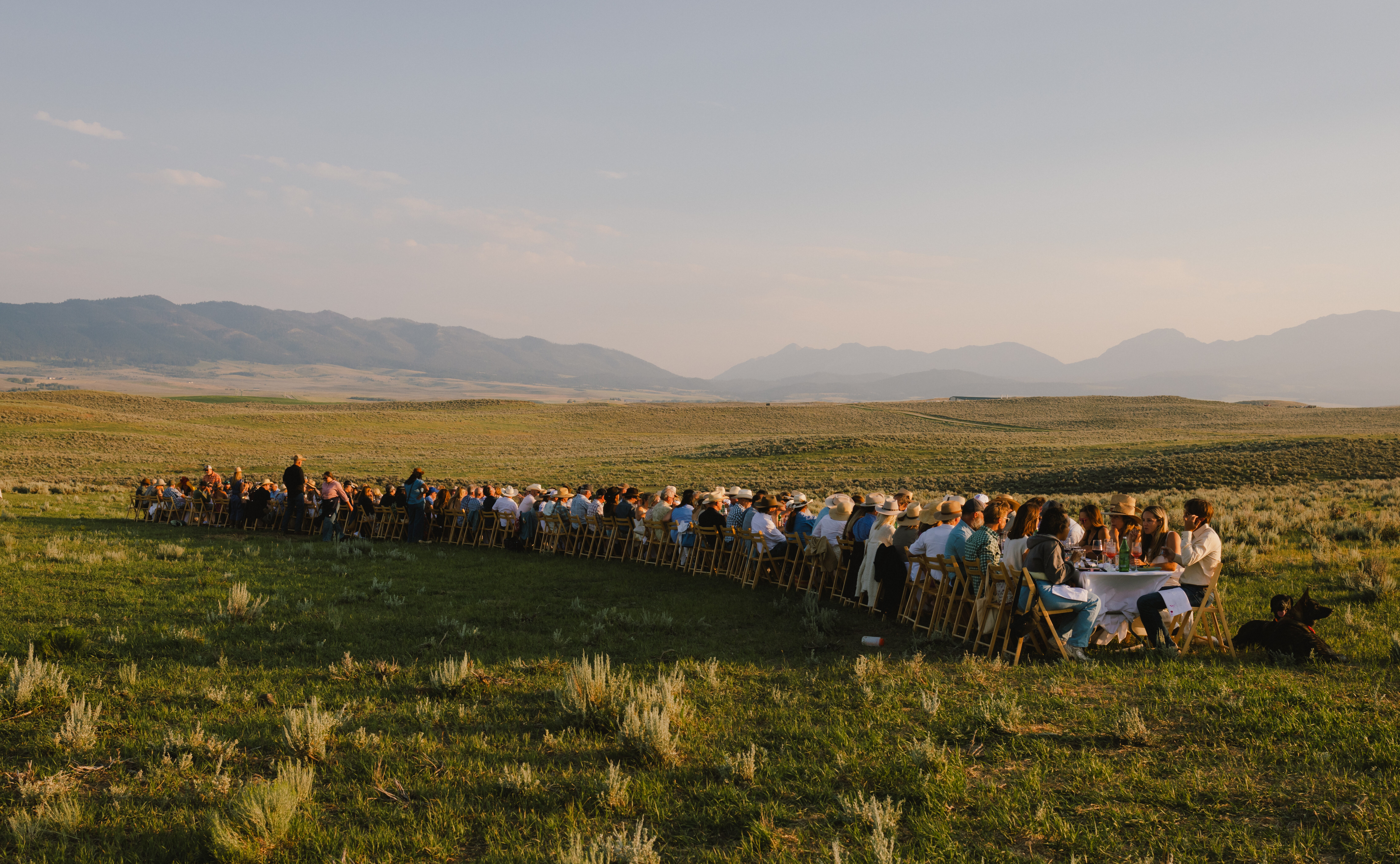
This is what Matt Skoglund, who founded North Bridger Bison in 2018 with his wife, Sarah, tells my group as we walk the ranch, making our way towards one long table with 148 seats where we’re going to eat our dinner. I’m at the 1,700th meal, give or take, hosted by Outstanding in the Field, a roving restaurant that travels the country setting incredibly long tables with extravagant dinners. They dine at farms, ranches, vineyards and greenhouses, and their goal is to educate guests on the food they’re eating and the place they’re eating it in. Already today I’ve had my appetite whet by several culinary delights: troutlette sardines on potato flat bread, fingerling summer squash topped with fresh pesto, and a miraculous mouthful of cherry gazpacho garnished with crème fraiche and an edible flower, served inside a hollowed-out eggshell. But we’re just getting started.

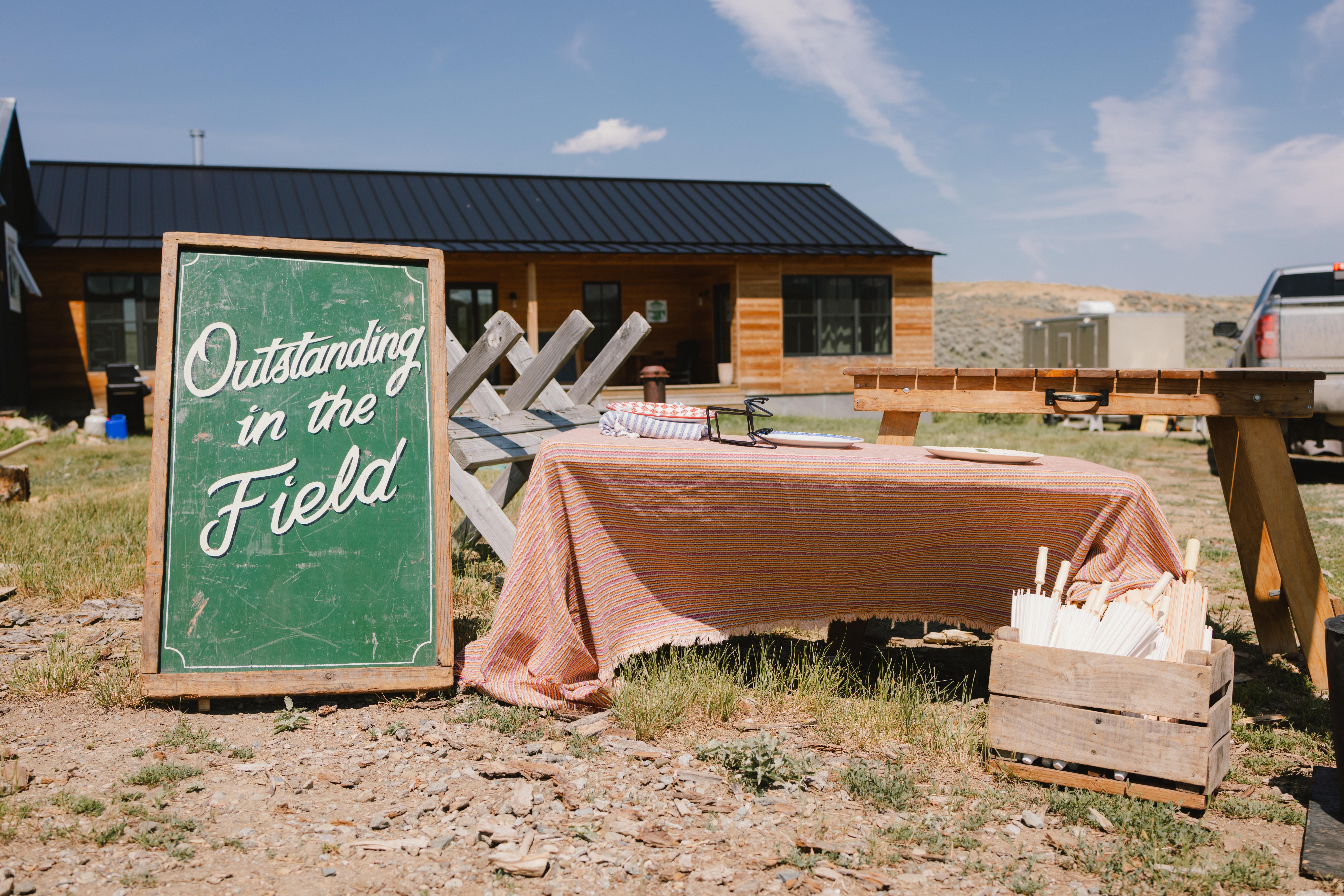
The welcome table. OITF encourages guests to bring their own plates to eat off of for dinner. PHOTO BY FISCHER GENAU 
A server carries a platter of cherry gazpacho served in an open egg shell. PHOTO BY FISCHER GENAU 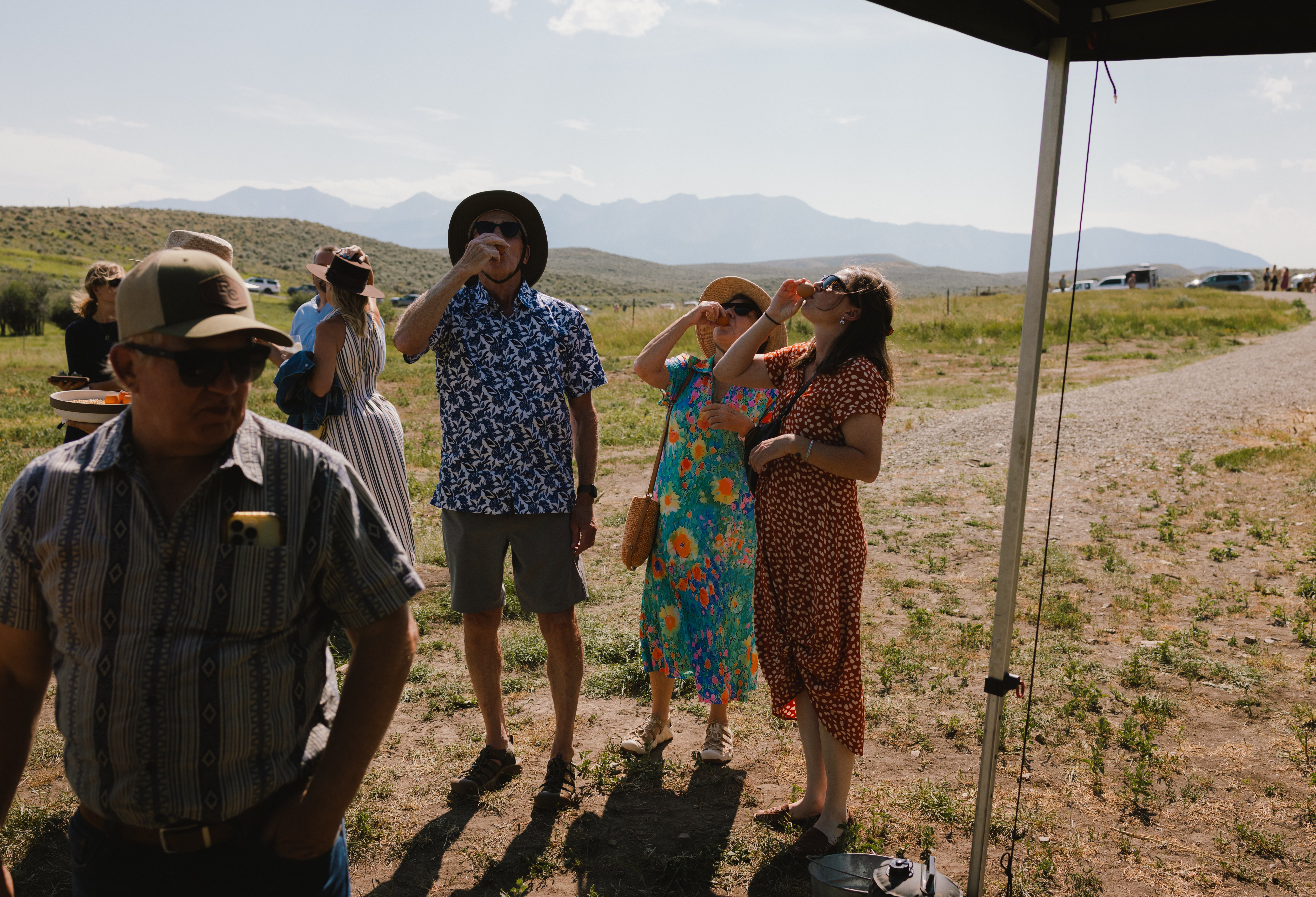
Dinner guests slurp down mouthfuls of cherry gazpacho. PHOTO BY FISCHER GENAU 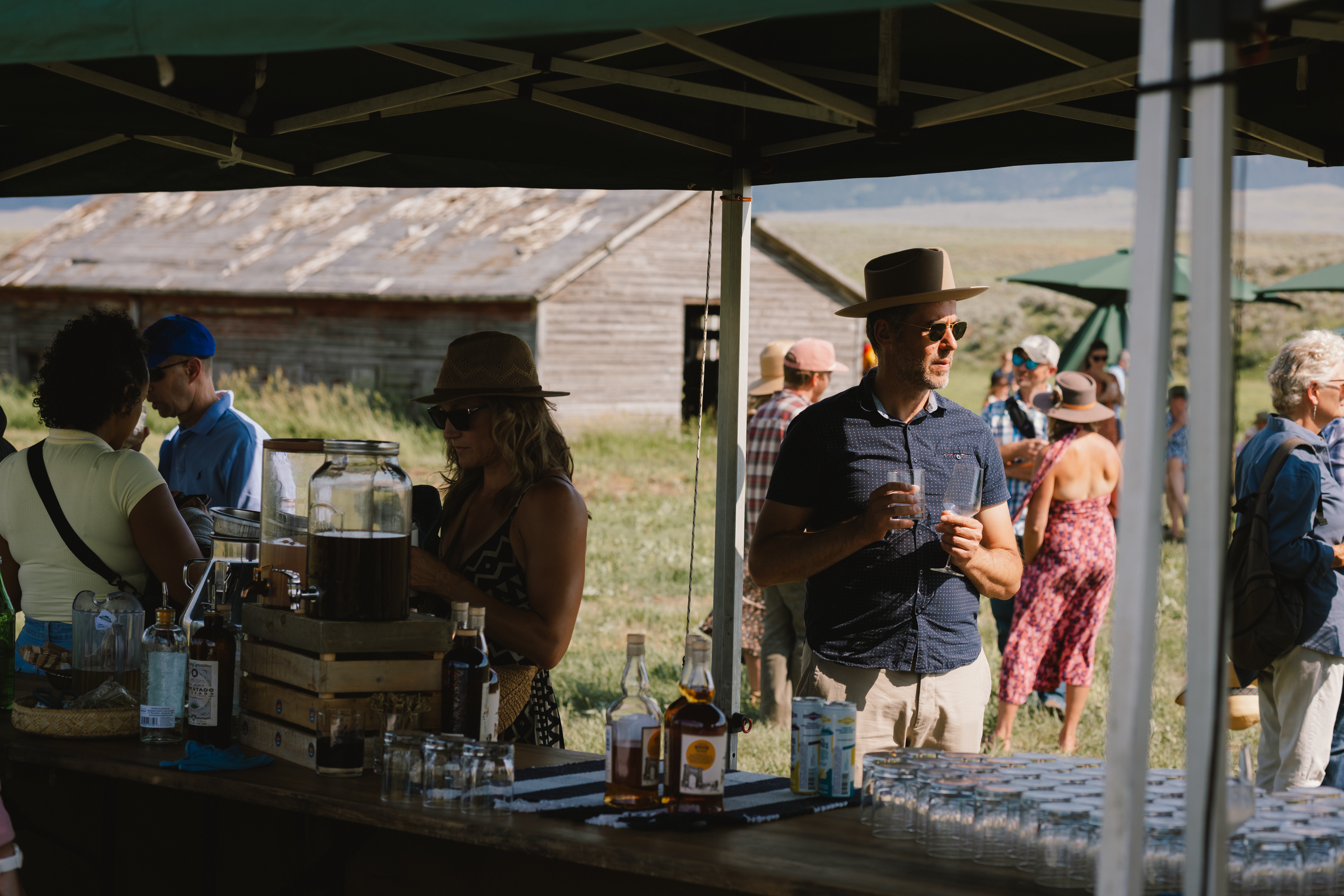
A guest holds a drink in the reception area. Gros Ventre Cellars, Bridger Brewing, and Bozeman Spirits Distillery provided libations for the night. PHOTO BY FISCHER GENAU 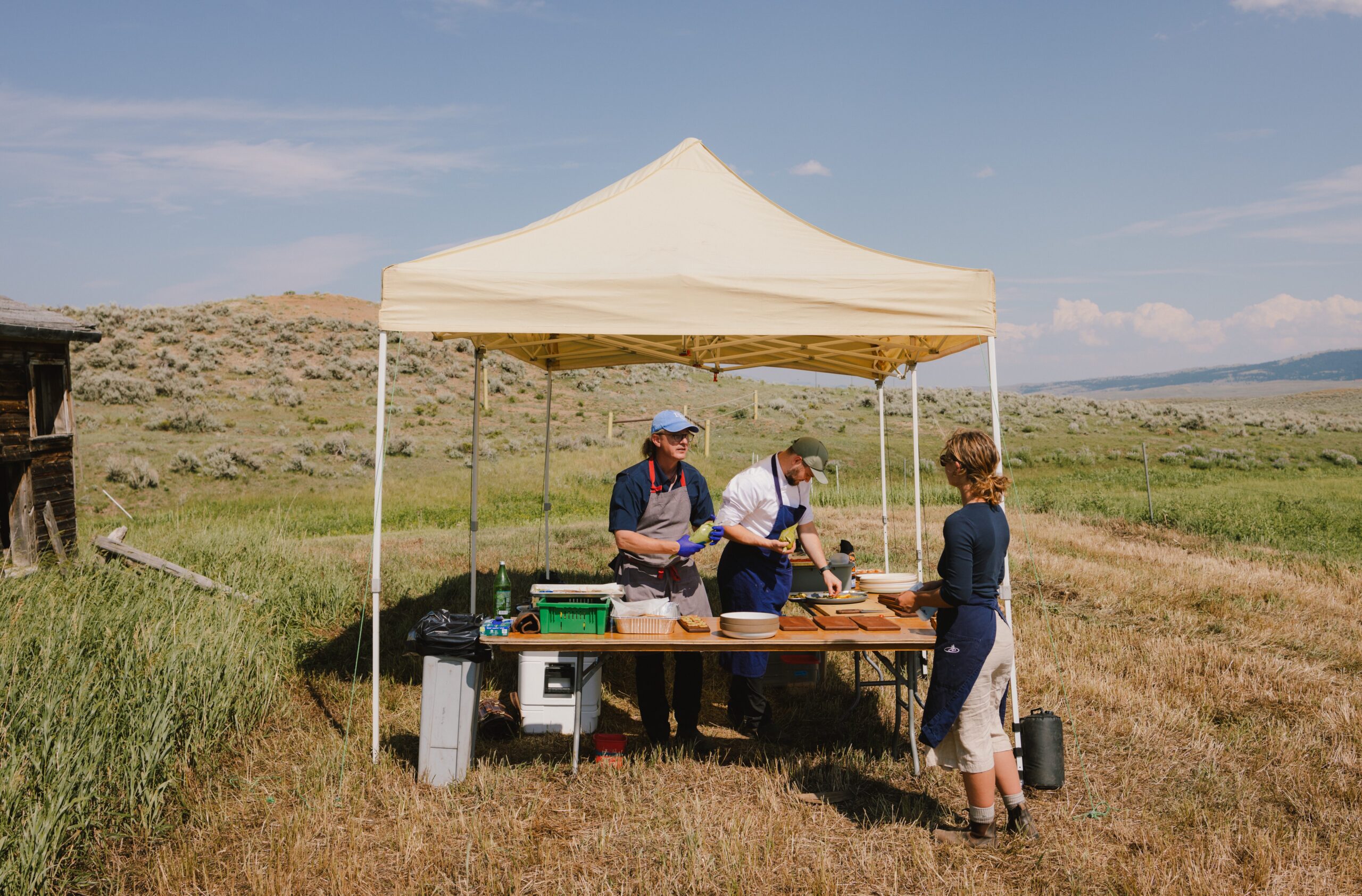
Chef Zachary Ladwig from the Ranch at Rock Creek prepares appetizers. PHOTO BY FISCHER GENAU 
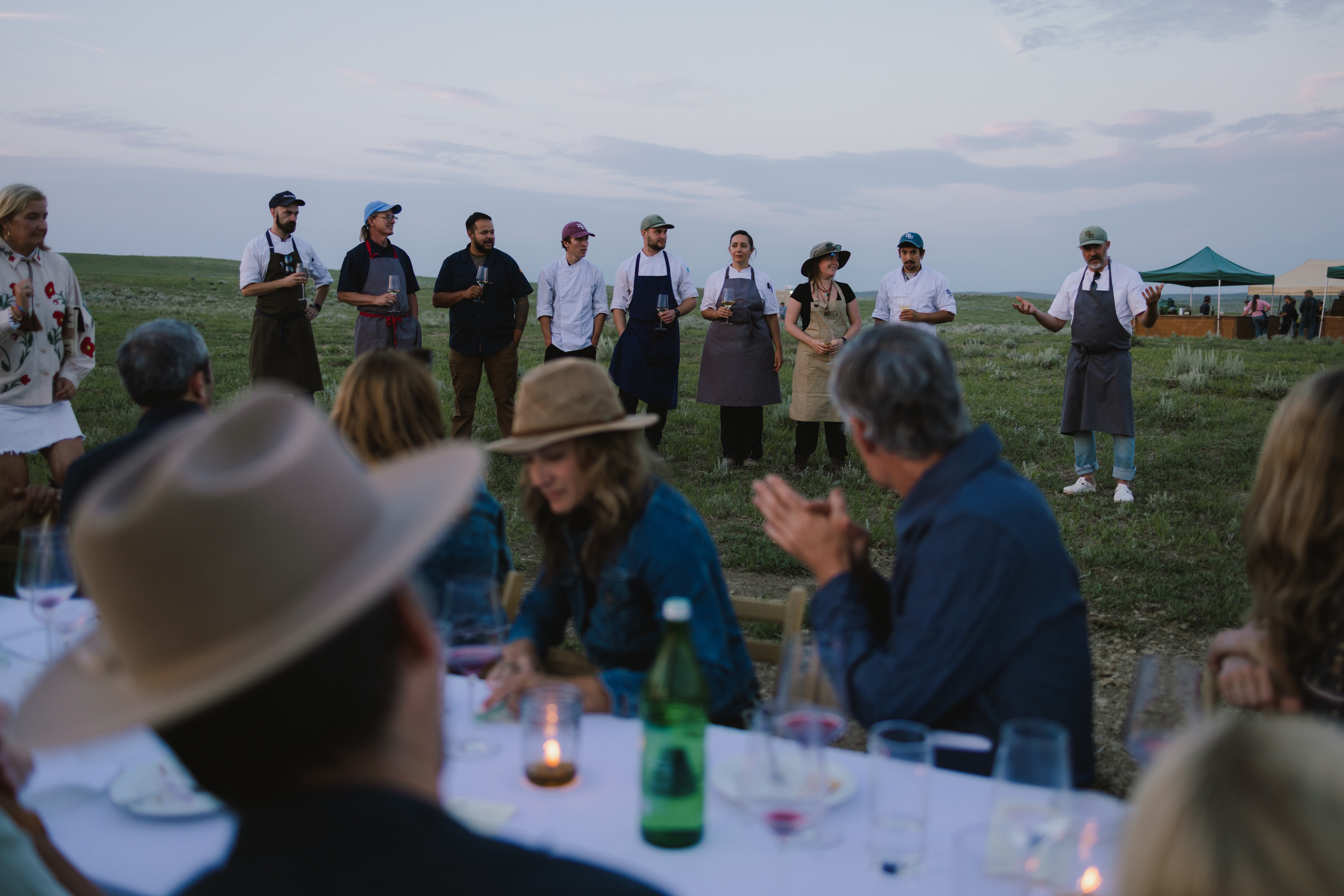
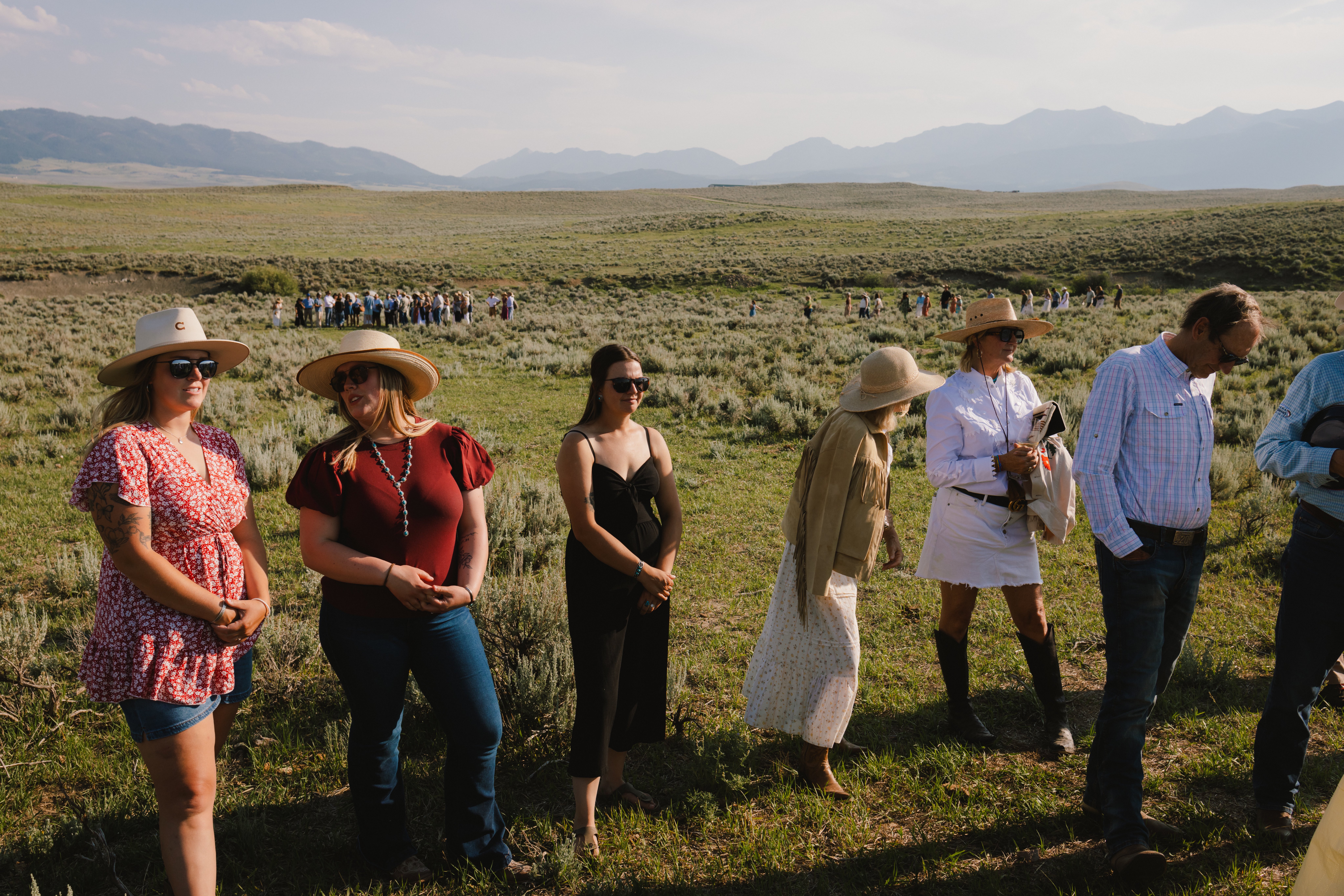
Dinner guests gather in the shade to listen to their host’s introductory remarks. PHOTO BY FISCHER GENAU
Matt stops at the base of a gradual incline, atop which our table awaits, to answer questions from the 50 or so people who’ve been following him like ducklings. The other hundred-ish dinner guests are split up between his wife, Sarah, and their two kids, Otto and Greta, who are also giving tours.
Matt tells us about bison’s powerful herd instinct, programmed by hundreds of thousands of years of evolution, that tells them that safety and security exist in big groups. He explains how bison grazing patterns create a kind of goldilocks mosaic for bird habitat, with ideal conditions for grassland species whether they’re nesting or raising chicks. He talks about how he and his family make the ranch wildlife-friendly for the antelope, coyotes, elk and even bears they’ve spotted on the property.
Finally, Matt talks about field harvesting bison. Every time a bison is killed on the ranch, Matt is the one to do it, walking out into the field with his rifle and personally delivering one copper bullet into the animal’s head. He tells us the benefits of this kind of harvest are twofold. For one, the bison’s last earthly sight is of the caretaker it’s known all its life, rather than the alien interior of a factory. For another, this method of harvesting doesn’t spike the bison’s stress levels, leading to tastier, more tender meat. That meat will be on full display during tonight’s meal, and Matt tells us we’ll be eating a two-year-old bison that he recently field harvested.
Eventually, the Q&A concludes and we’re led up the hill to our table that’s sprawled out in front of a magnificent view of the North Bridgers.


After a brief hubbub of milling bodies and confusion and scuffling chairs, we’re all seated, many of us beside or across from complete strangers. I came alone, but the nature of our seating arrangements quickly banishes any feeling of isolation. My neighbors’ elbows are just inches away, and we have no choice but to get to know each other—so we do. To my right sits the former president of Carroll College in Helena, and across from him sits his wife, who used to serve as executive director of the Montana Health Research and Education Foundation. A few seats down, a woman wearing an enormous yellow sunhat and flowing red dress tells me she’s been to hundreds of Outstanding in the Field dinners—apparently she’s sort of a farm-to-table deadhead—and she has me take a picture of her in her outfit, telling me that she’s wearing red and yellow in honor of Spain’s appearance in the World Cup finals. My other tablemates are a couple from Wilsall on a date, and, after the first glass of wine, we’re all feeling pretty chummy. Right before the first course is served, the founder of Outstanding in the Field takes the empty seat next to me for our interview.
Facing the weather, and the skeptics
Jim Denevan is tall, a bit weatherbeaten, and he wears a felt cowboy hat that adds to his already considerable stature. He doesn’t have to speak loudly to command attention. As soon as he sits down, it becomes a collective interview, the other guests falling silent to listen and pose questions of their own.
Jim started Outstanding in the Field back in 1999, and he tells me that, for the first few years, he was losing money.
“We were on the bleeding edge of a concept, meaning there was no customers. Every event was like a placeholder for a time when it would be popular. It took about seven to 10 years, and I thought it would take like three to five years. If I knew how hard it would be, I never would have started it,” Jim said.
Fortunately, Jim didn’t start OITF to make money. When he was a teenager, his oldest brother Bill roped him into helping launch an organic farm and orchard in California’s Happy Valley. Jim cites his brother as an inspiration, and he says he launched Outstanding in the Field to bring farmers like him to the attention of the general public. Even though it wasn’t an instant hit, he kept going because saw how much the farmers enjoyed it.
Still, in the early years, it didn’t look promising. Jim padded tables with friends and families to boost headcount, and when he was crossing into Canada for Outstanding’s first international meal at the University of British Columbia, the man at the border told him that his field dinners were the dumbest idea he’d ever heard. “He’s like, ‘It’s going to be hot, there’s gonna be bugs, it might rain… Why would you want to do that?’”
Our conversation is interrupted when one of Jim’s crew sets down the first course: bison heart tartare with heirloom tomatoes, strawberries and flowering herbs on top. Tonight’s chef is Zachary Ludwig from the Ranch at Rock Creek, and so far, no complaints from me. The tartare melts in my mouth, complemented by the brightness of the strawberries and tomatoes, and I wolf it down while I listen to Jim speak.

The first course: bison tartare with heirloom tomatoes, strawberries, and flowering herbs. PHOTO BY FISCHER GENAU 
The second course: a sous chef salad with beets from the Rocky Mountains, bright pink beet hummus, sorrel, fresh radishes, and confit bison tongue. PHOTO BY FISCHER GENAU 
Hunks of bison cook over the open grill. PHOTO BY FISCHER GENAU 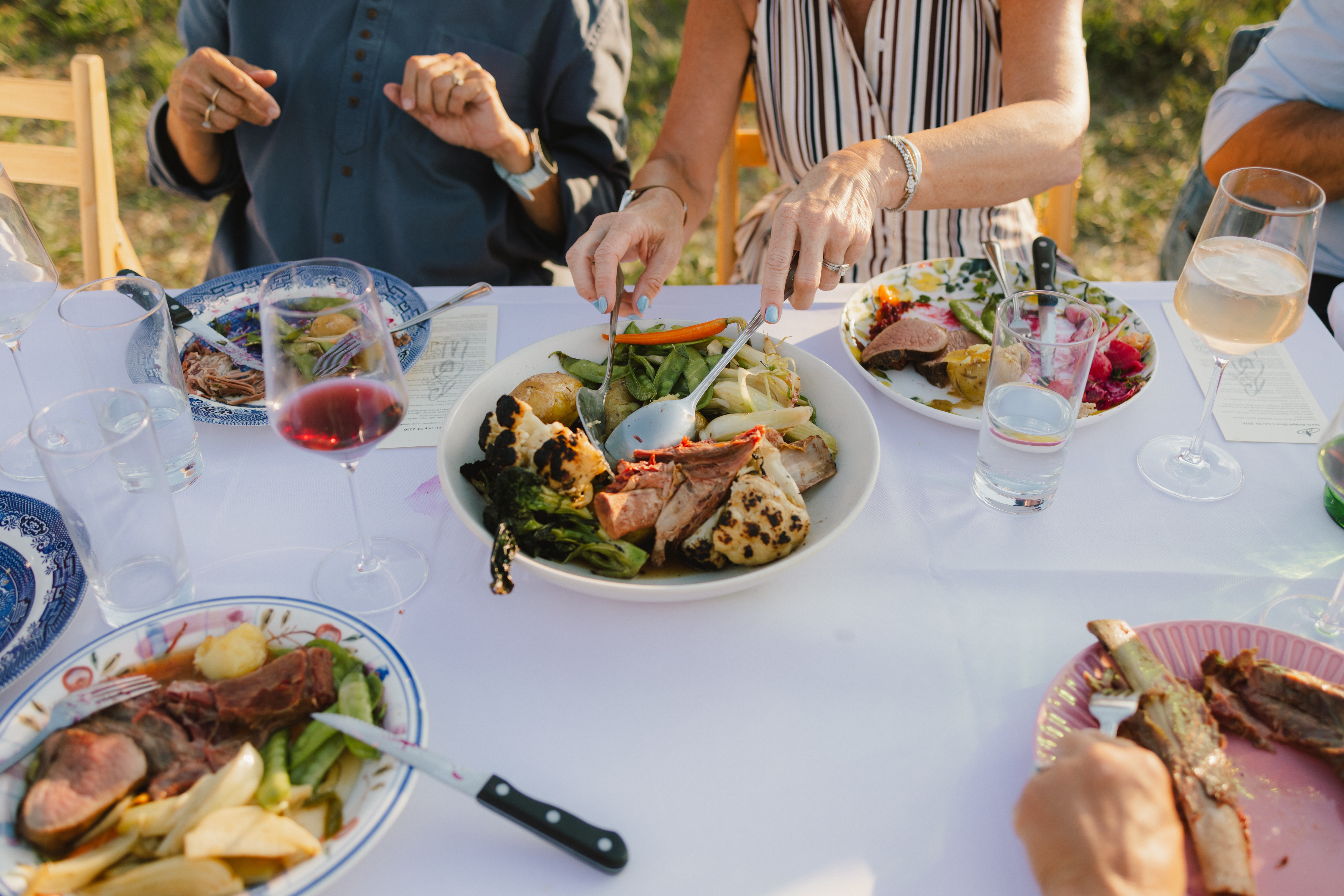
The main course: bison set snugly in a bed of locally grown potatoes, onions, fennel, scapes and brassicas. PHOTO BY FISCHER GENAU 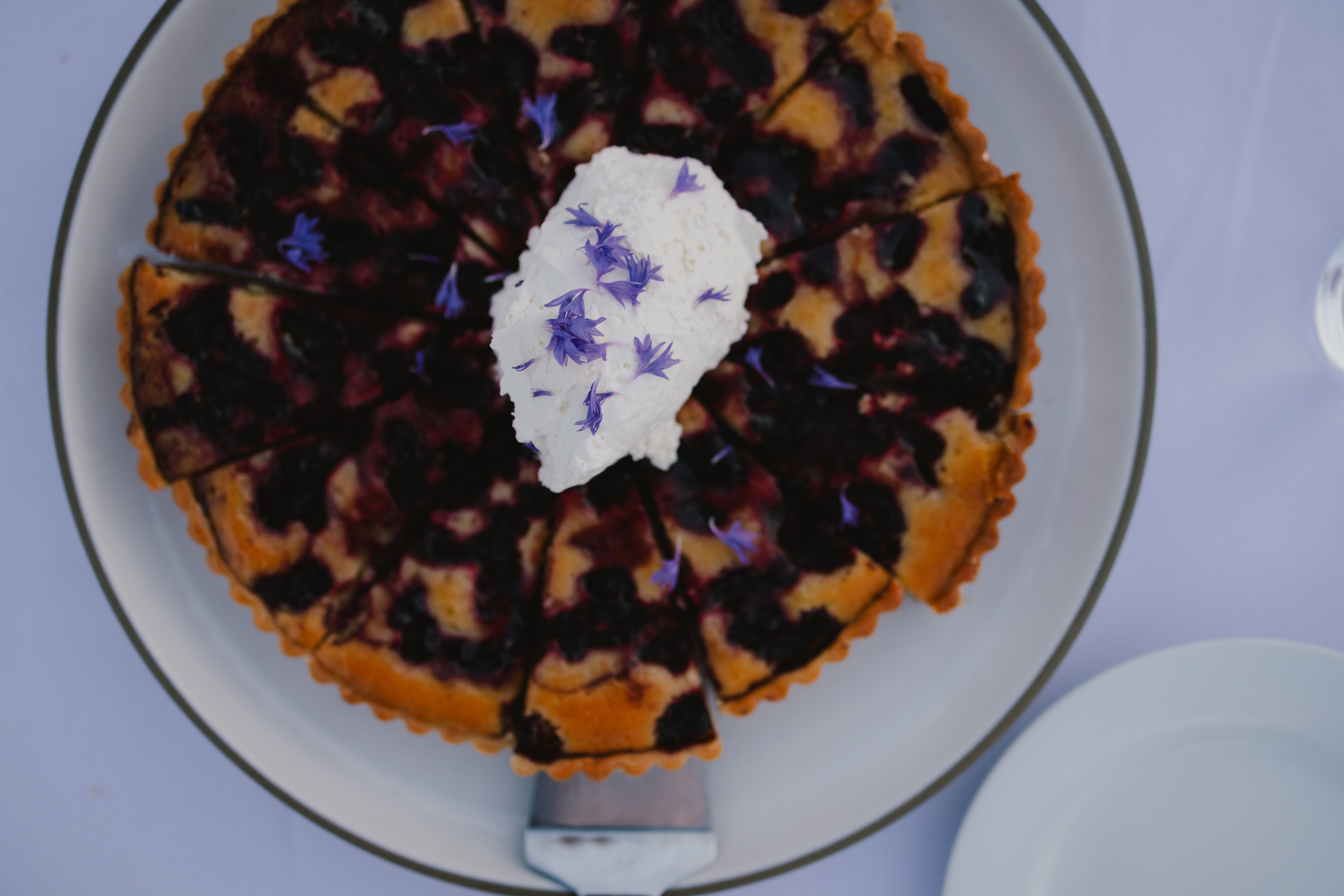
Dessert, a honeyberry custard tart with sprouted emmer wheat crust. PHOTO BY FISCHER GENAU
In 2007, Jim’s fortunes turned around. CBS News Sunday Morning ran a segment on him, his dinners, and his work as an artist, and after that, the popularity of OITF exploded. Since then, his traveling culinary circus, comprised of a small full-time staff and satellite crews that join based on region, has been to all 50 states and 26 countries, and their events frequently sell out. Outstanding in the Field has set up tables on the slopes of Mount Fuji and the cliffs of Big Sur, and they’ve served everything from thinly sliced pig snout to beef jerky ice cream. As OITF was growing in popularity, Jim’s career as an artist was taking off too.
Jim started drawing in the sand before he launched OITF, but he tells me that at first, he avoided publicity to work on the craft. “At the time, there was no such thing as people devoting themselves to scratching the sand with a stick,” he says. Twenty some years later, Jim’s career as an artist has become more lucrative than the wildly popular dinner series. His art installations, many of which he’s made with little more than a rake, are massive, and his 2024 piece “Self Similar,” commissioned by Abu Dhabi’s department of culture and tourism, looks like a city out of Frank Herbert’s “Dune.”
I ask Jim if he sees any similarity between the sweeping images he conjures on the land and the long tables he places outdoors.
“It’s composition within the environment,” he says. “For me, I absolutely love it, the question of where we’re putting the table.”

For tonight’s dinner at North Bridger Bison, Jim and his staff considered a spot in a nearby gully that would protect the table from wind. But in the end, Jim opted for somewhere more dramatic. Our table sits on a gentle rise commanding a 360-degree view of the plains. It’s also totally at the mercy of the elements, but so far, that hasn’t posed a problem for us. Last night was a different story. OITF hosted two meals at the ranch—I came for night two—and during the first, a storm cell passing to the north whipped up strong winds that tore down umbrellas and briefly wreaked havoc on the dinner table. But Jim doesn’t mind a little weather. When he was a kid, he wanted to be a weatherman, and although he gave up that dream after a few years, his fascination with meteorological events persisted.
“I’m literally a weather obsessive,” he says. As we eat, Jim tells me weather stories: an atmospheric river dousing a dinner in San Diego; a panoramic view of thunderstorms on Governor’s Island in New York City; a dense fog bank in Big Sur that shrouded the entire coastline and made a short walk along a cliff edge treacherous for guests. Jim lights up when he talks about the unpredictable and unexpected—“It’s way more fun when there’s potentially interesting weather.”
Jim studies multiple different weather models before hosting a dinner like this one, and he says that whenever the models agree, he struts around like a fortuneteller. After the excitement on Saturday, Jim’s staff was concerned about tonight’s weather, and he tried again and again to tell them there was nothing to worry about. Yesterday’s thunderstorms had all blown themselves out, and Jim kept telling his staff, “What you’ll experience today has nothing to do with yesterday.”
Our second course is a sous chef salad with beets from the Rocky Mountains, bright pink beet hummus, sorrel, fresh radishes and, to top it all off, pieces of confit bison cow tongue. Everyone at the table digs in.
“If they just threw pizza out here, it’d still be a nice time,” Jim says as we eat. But he’s after something different. “The chefs, they give attention to the ingredients. And if they give such deep attention to the ingredients, that comes through with the potential for us to think about them.” Jim’s favorite part of OITF dinners is the farm tour and listening to people like the Skoglunds educate guests on topics like regenerative ranching. But he enjoys the meal too.
“Just as anyone does, I enjoy a large group of people gathering, cooking for people, all that kind of stuff,” Jim says. “OITF, it’s almost like a stealth way to get strangers to sit together and talk to each other.”
I ask him if sees himself continuing to host these dinners.
“At least a few more months,” he replies, getting a laugh from the table. “I was going to get more deep into the artwork, because the artwork is getting so much attention, and it provides a little better income honestly. But this is too hard to give up.”

The cycle repeats
Jim leaves to visit with the rest of the table, and soon after, a member of his wandering band swoops in with our main course: a heaping platter of bison, cooked all day over an open-air grill and set snugly in a bed of locally grown potatoes, onions, fennel, scapes and brassicas. I opt for a short rib, and it is, without question, the best short rib I’ve ever had in my life.
As plates empty, people start to get up from the table to wander around, so I decide to walk up the rise another hundred yards with my camera to take some photographs. As I get further and further away, the enormous table shrinks. When I stop, the table is just a white line dashed upon the sagebrush, running parallel to the mountain range behind it. A hundred dots, each one a different color, are gathered around it, some sitting, some standing, others walking aimlessly out into the field. I kneel down to snap a couple pictures, and the sage smells as good as anything I ate tonight tasted.
As I return to the table, the sun drops below the plain’s edge. Someone keeps offering to refill my wine. Eventually, the servers trot out dessert, a honeyberry custard tart with sprouted emmer wheat crust, and when that’s finished, the OITF crew gather in front of the table to make their final remarks. They thank North Bridger Bison for opening up their home and sharing their harvest, the chefs from the Ranch at Rock Creek for preparing the food, Gros Ventre Cellars for plying us with wine, and all of the other local growers, brewers and distillers for filling our bellies. Everyone cheers.
Plates are cleared and the table slowly empties. Guests walk back down the hill in threes and fours, and a chill enters the air. By the time I make it back to my car, down the hill and past the barn and the Skoglund’s farmhouse, a rosy blush is blossoming across the clouds to bid us goodnight.
Nothing Jim creates is made to last. By tomorrow, the field kitchen, the food and the table will all be gone, leaving behind a field of sage waiting patiently for bison’s return. Eventually, the herd will come back to graze, urinate, defecate, wallow and kick up the dirt, reenacting the thousand-year-old cycle of regeneration that the Skoglunds have resurrected on their property. Meanwhile, elsewhere, Jim and his crew will be eating a new meal in a new place with a totally different group of people, creating another sketch that will be swept away in a few hours. I doubt that he’d want it any other way.