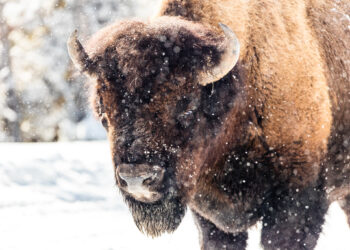



Proponents of the shift estimate it will bring another $55 million to Yellowstone annually.
By Amanda Eggert MONTANA FREE PRESS
Visitation fees for international visitors to Yellowstone and Glacier national parks are slated to increase substantially in 2026.
On Tuesday, the Interior Department announced that the National Park Service will levy a $100 surcharge on international visitors to 11 of the country’s most popular national parks starting on Jan. 1.
According to an agency press release, the threefold increase in entrance fees is a “resident-focused fee structure that puts American families first.”
The $100 fee will be added to the standard entrance fee in the New Year. Revenue from collections will be “invested directly back into America’s national parks, supporting upgrades to visitor facilities, essential maintenance, and improved services nationwide,” according to the interior department’s release.
The Interior Department’s communications team wrote in an email to Montana Free Press on Wednesday that revenue from the annual “America the Beautiful” passes, which will increase from $80 to $250 for international visitors, will benefit the entire Park Service system. Those passes allow entry into all national parks for a year. Fees collected onsite at locations like Yellowstone and Glacier will “primarily benefit the park where they are sold,” the agency wrote.
Yellowstone, America’s first national park and one of its most visited, reported that nearly 15% of its visitors were from outside the country in 2024. That’s down from 30% in 2018, according to reporting by NBC News.
Those numbers track with observations made by Cara McGary, who launched a Gardiner-based wildlife-viewing company called In Our Nature in 2016. She said international visitation is “plummeting” in Yellowstone compared to recent years past. She attributes the shift to a change in attitudes about the U.S. after President Trump took office and the difficulty some tourism purveyors have encountered securing trip insurance.
Last year, for example, she was set to assist with a 21-day bird-viewing trip organized by a travel agency in Australia. The company McGary was coordinating with told her they were forced to cancel the trip after the insurance company they’d been working with declined to cover the trip due to concerns about gun violence in America.
McGary added that she appreciates the overall sentiment in the policy change given the value she personally places on national parks. She highlighted the boardwalk near Mammoth Hot Springs as an example of the type of infrastructure that requires regular investment to keep visitors safe — in this case, from the park’s scalding geothermal features.
“You have to move that boardwalk pretty often,” she said. “Imagine how much money, effort and personnel it takes to manage that and then extend it out to a park that’s the size of Delaware and Rhode Island together. It’s expensive.”
McGary added that she’s wary of a sticker-shock factor given the size of the increase.
“If I was going to a national park in Germany and I was paying twice what a German national was paying, I would be like, ‘OK,’” she said. “If I was paying three or five times what a German national was paying, there might be a little bit of a knee-jerk [effect].”
McGary said the Interior Department should examine the pricing structure for individuals, both domestic and international, who enter the park on a commercial bus if the agency’s goal is to shore up a funding gap. Those who enter Yellowstone on a bus are currently charged just $6 per head, she said, as compared to the $35-per-vehicle fee many visitors pay and the $20-per-head charge her clients must pay if they drive into the park in one of her company’s vehicles.
The Interior Department wrote in an email to MTFP that the $100 nonresident charge will apply to international visitors age 16 and older who enter the 11 affected parks in a personal vehicle, in a commercial bus or on foot.
Diane Medler, executive director of Discover Kalispell, told MTFP in a Wednesday afternoon phone conversation that she’s tracking down more detail on the proposal before she feels comfortable weighing in on it.
“I’m looking into it more and asking for some clarification from our federal delegation,” Medler said.
She added that the proposal would impact visitation to Glacier National Park, about 40 minutes from Kalispell. How much remains unclear because there are no databases that track international versus domestic visitation to Glacier, she said.
Mark Howser with the Whistling Swan Motel outside Glacier told the Associated Press that the charge for foreign visitors is a “sure-fire way of discouraging people from visiting Glacier” and would hurt businesses like his.
In a press release, U.S. Rep. Ryan Zinke, a Republican, celebrated the change, saying it would ask foreign visitors to “pay their fair share while holding entrance fees steady for the American people.”
“This policy ensures that our beautiful national heritage is preserved and the critical maintenance backlog is addressed so that America’s national parks will remain affordable, well-maintained and financially sustainable for generations to come,” Zinke said.
Zinke also took the opportunity to stump for a piece of legislation he’s co-sponsoring that gives individual national park superintendents’ discretion to levy a surcharge of their choosing on international visitors. It is currently awaiting action by the House Natural Resources Committee.
Brian Yablonski, CEO of the Property and Environment Research Center, which proposes market-centric fixes to natural resource issues, also cheered the news.
“A $100 international visitor surcharge could generate $55 million annually at Yellowstone National Park alone, more than quadrupling that park’s revenue to address deteriorating trails, failing wastewater systems and crumbling bridges. PERC has long led an effort to adopt this smart pricing approach, already common abroad, as a way to steward America’s best idea,” Yablonski said in a press release.
The Sierra Club offered a different take, though, describing the plan as “gouging foreign tourists at the entrance gate” in a press release.
“Donald Trump is setting the Park Service up to fail,” wrote Gerry Seavo James, the deputy campaign director for the Sierra Club’s Outdoors for All initiative in a press release. “For nearly a year, the Trump administration has worked to undermine the National Park Service, slashing its budget and firing its dedicated staff.”
The Interior Department also announced in its Tuesday release that the America the Beautiful pass will be digital and available on Recreation.gov, thereby ensuring “faster entry and a smoother visitor experience across the National Park Fee System” for those who purchase an annual pass. For domestic visitors, the America the Beautiful pass price will remain unchanged at $80.
The $100 surcharge codified in the Interior Department’s directive will also apply to Acadia, Bryce Canyon, Everglades, Grand Teton, Rocky Mountain, Sequoia & Kings Canyon, Yosemite and Zion national parks.