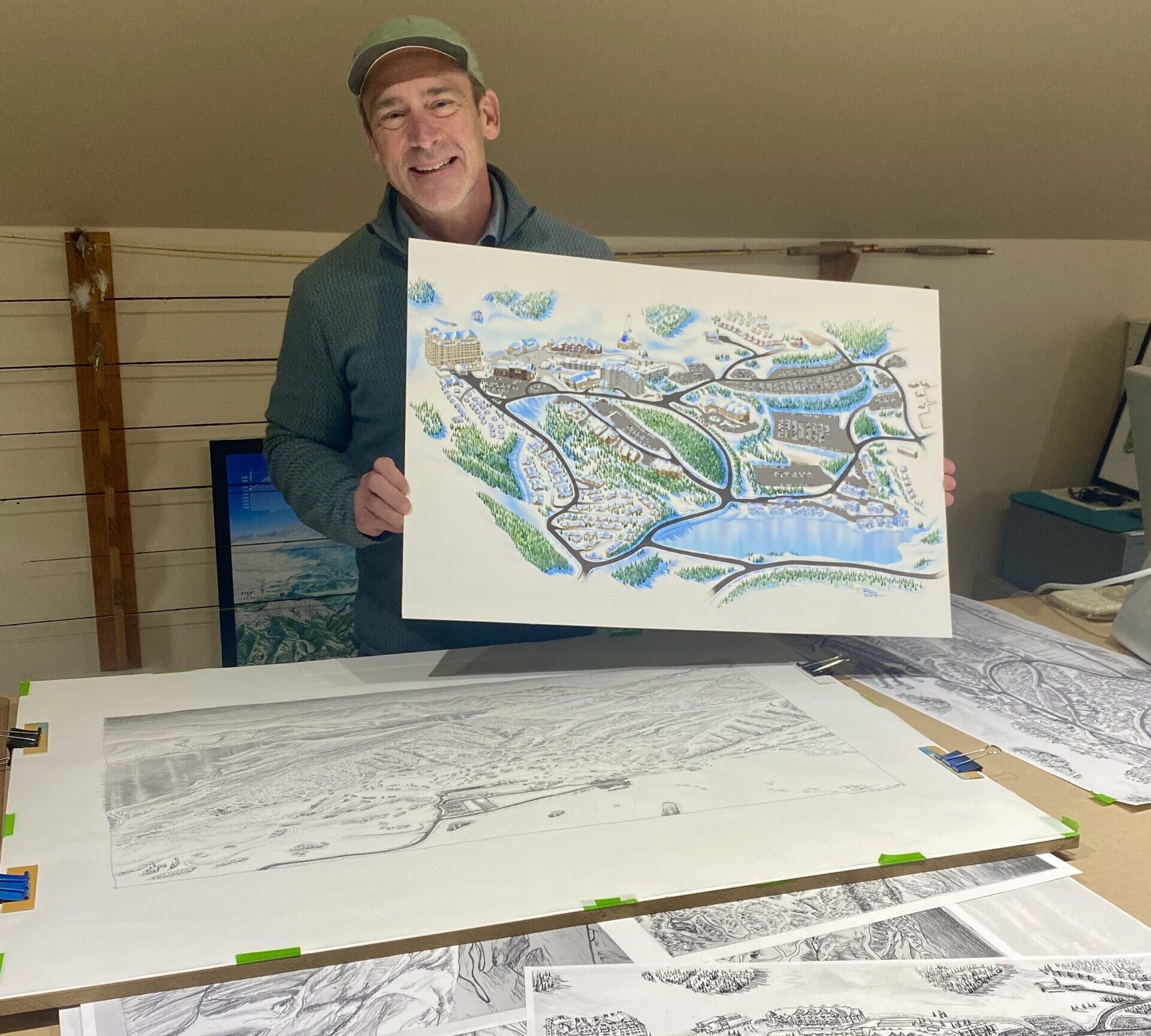

Bozeman artist Rad Smith carries tradition of hand-painted mountain maps
By Mira Brody VP MEDIA
A balance of function, art and nostalgia, Bozeman artist Rad Smith likens his work to a treasure map.
Following the retirement of James Niehues, who has hand-painted over 430 maps, including some of the world’s most iconic ski resort maps with Big Sky Resort on the long list, Smith has embraced the veteran’s form, most recently—and locally—in the new Big Sky Resort base area map. While beautiful and intricate, with multi-colored vehicles in parking lots and sweeping snow-capped peaks in familiar visage, the painting is also an important tool this winter’s visitors will use to navigate.

“It’s a wayfinding tool, but it’s an important marketing tool,” Smith said of resort maps. “James would often say it’s maybe the single most important image a ski area can show. And I think there’s some truth to that.”
Niehues retired in 2021, leaving behind a legacy in those familiar brushstrokes, one that Smith has embraced, taking on Niehues’ infamous style as well as many of the retiree’s clients. In addition to Big Sky, he’s currently working on projects for Mount Jamieson in Ontario, Sundance Mountain Resort in Utah, Soldier Hollow Nordic Center in Utah, and a climbing route map for Jackson Hole Mountain Resort.
Smith’s start as a professional map illustrator began while working for a Bay Area-based environmental consulting firm, Garcia and Associates, where he had the opportunity to work on mapping projects with the U.S. Forest Service and National Oceanic and Atmospheric Administration. While mapping data improved on the digital front, he remained drawn to the artistic side of the work. He eventually left the company in 2020 to pursue fine art full time.

Smith’s first brush with mountain resorts was a job he did for Moonlight Basin, ahead of Big Sky Resort’s purchase of the once-separate ski area. While that particular project was created digitally in Adobe, it opened his eye to the intimacy of ski area map design, and the door to work with the resort in the future.
He’d been a fan of Niehues for decades, noting the legacy he’s left.
“I came across a summer map [of Niehues’] for Indian Peaks Wilderness and Rocky Mountain National Park,” Smith said. “He just paints all this terrain. And I just kind of fell in love with that.”
Upon hearing news of his retirement, Smith reached out to Niehues and the pair bonded over their shared love for the medium. Niehues offered feedback on Smith’s work, and ultimately started passing work requests over to him—Smith’s first big Niehues project was a painting for Thaiwoo Ski Resort in China, which features details of remnants from the Great Wall along the painting’s left side.
“It was a weird and wonderful project,” Smith said.
Together Smith, Niehues and his marketing team have built a solid relationship. Being able to pass along his work, Smith said, is “immeasurable.”
“The time and person was right, Rad wanted to return to hand-painted maps and my retirement was on the horizon,” Niehues explained in an email to EBS. “By combining Rad’s computer background it seemed to me an assurance hand painted images would continue to be an important influence in the ski Industry.”


Passing down the artform, too is tradition–Neihues remarked that he himself learned to paint ski maps from mentors Hal Shelton and Bill Brown.
“Just as my mentors had helped me into an exciting new career I welcomed Rad, an exceptional artist with a passion for skiing and expressing those experiences,” Niehues said.
Smith uses Gouache paint and a variety of paintbrush widths and textures; these tools are spread plentifully out on a table at his Bozeman studio. The process of map painting is involved with reference material ranging from Google Maps, digital renderings and aerial photographs—Smith recalls the nerve-wracking experience of accompanying a small plane pilot in a flight over the Bridger Range in order to get photographs for a painting he did for the Ed Anacker Bridger Ridge Run.
Armed with his source material, Smith then sketches the landscape in a rough pencil wireframe, noting patches of trees, a lake, structures. He’ll then project the wireframe onto a large sheet of vellum, or tracing paper, where additional layers of detail are added until the landscape is ready to be brought to life in color on illustration board. He calls Gouache—an opaque type of watercolor—a “challenging medium” but quick to work with. It’s adaptable to change, bright and lends itself to detail.
“It really is kind of like a treasure map,” Smith said of his map work. “I think there’s just a timeless aspect to them.”

When it came to working with Big Sky Resort, Margaret Siberell, the resort’s senior graphic designer, was a huge supporter of his work, Smith said. Working with Siberell to fill Niehues’ shoes was an exciting challenge. He’ll next work on a new Madison Base Area map.
In addition to Siberell, Niehues, and his former colleagues at Garcia and Associates, Smith commends his parents and wife for supporting his artistic talents over his lifetime.
“And my daughters think it’s kind of cool sometimes,” he added with a laugh. His canine companion Bindi, too, watches over his studio in solidarity while he’s working.
“Most skiers do not know who produced the mountain signage,” Niehues said. “But I am very grateful, and proud, I had an opportunity to provide a stunning and informative guide to get them down the slopes.”
Whether they know the artist or not, families will crest the tops of ski lifts across the country this winter, including at Big Sky Resort, and be greeted at the top by a legacy of map painting, usually marked by a small crowd gathered as they point their ski poles toward their next run. Smith is happy to take on that work and keep the tradition alive for generations to come.
“I think there’s something that’s fairly organic about skiing as an outdoor activity and I think a lot of people ski to be in nature and to get away from the hustle and bustle of the digital world,” Smith said. “It’s just kind of steeped in tradition.”