

By Paul Swenson EBS COLUMNIST
I was first introduced to the idea of “noxious weeds” when I visited the Bitterroot Valley south of Missoula in the late 1970’s. I was going to a training camp for Nordic skiing with my coach and some friends. Along the highway were fields filled with 3-foot-tall plants covered in purple flowers. My first thought was they were some type of crop that I was unfamiliar with so I enquired—I was told that the plant was in fact spotted knapweed, and that it was displacing all the native vegetation in the valley. ‘That sucks,’ was my initial thought.
Then in the early 1990’s the Montana Department of Tourism had a television ad campaign to draw people to the state. “Come to Montana to see its beauty,” it boasted, with pictures of Glacier National Park and Yellowstone National Park (mostly Wyoming), then a full ten seconds of the wildflowers, all knapweed. I figured the producer was either laughing at the irony, or actually found knapweed pretty. I guess it’s in the eye of the beholder.

Knapweed is ubiquitous along all roadways in Montana now. It was brought to North America sometime in the 1880s via crop seed from central Europe, its native range. It may also have been part of the gravel used as ballast in ships arriving on the West Coast. Either way, the first identified knapweed was in Victoria, B.C., around 1883 and soon afterwards in Washington state. It moved slowly eastward until the building of the interstate highway system which became a superhighway for seed distribution.
Big Sky certainly has its own noxious weed problems. Most of the weeds grow best in disturbed soil and are transported via imported gravel, soil, cars, trucks, horses, ATV’s, wind, rivers, etc. You get the point. Once we move into an area, weeds will follow.
If you ask anyone that knows me, or has taken a tour with me, they will tell you I am passionate about my weeds. I point them out as I drive by, shaking my fist. Or I pull them up by the roots when I’m out fishing or hiking. And there are a lot to find. I have already mentioned knapweed, but since it is not flowering yet, I encourage you to do some research to see what it looks like. It will be in bloom starting the last week of July through August.
Oxeye Daisy, Leucanthemum vulgare, is another noxious weed that EBS readers and Big Sky residents should know about. Most people love the sight of these plants—they have a beautiful flower and are easy to take care of. And that’s the problem. Once released out into the wild, these plants easily outcompete the native plants.
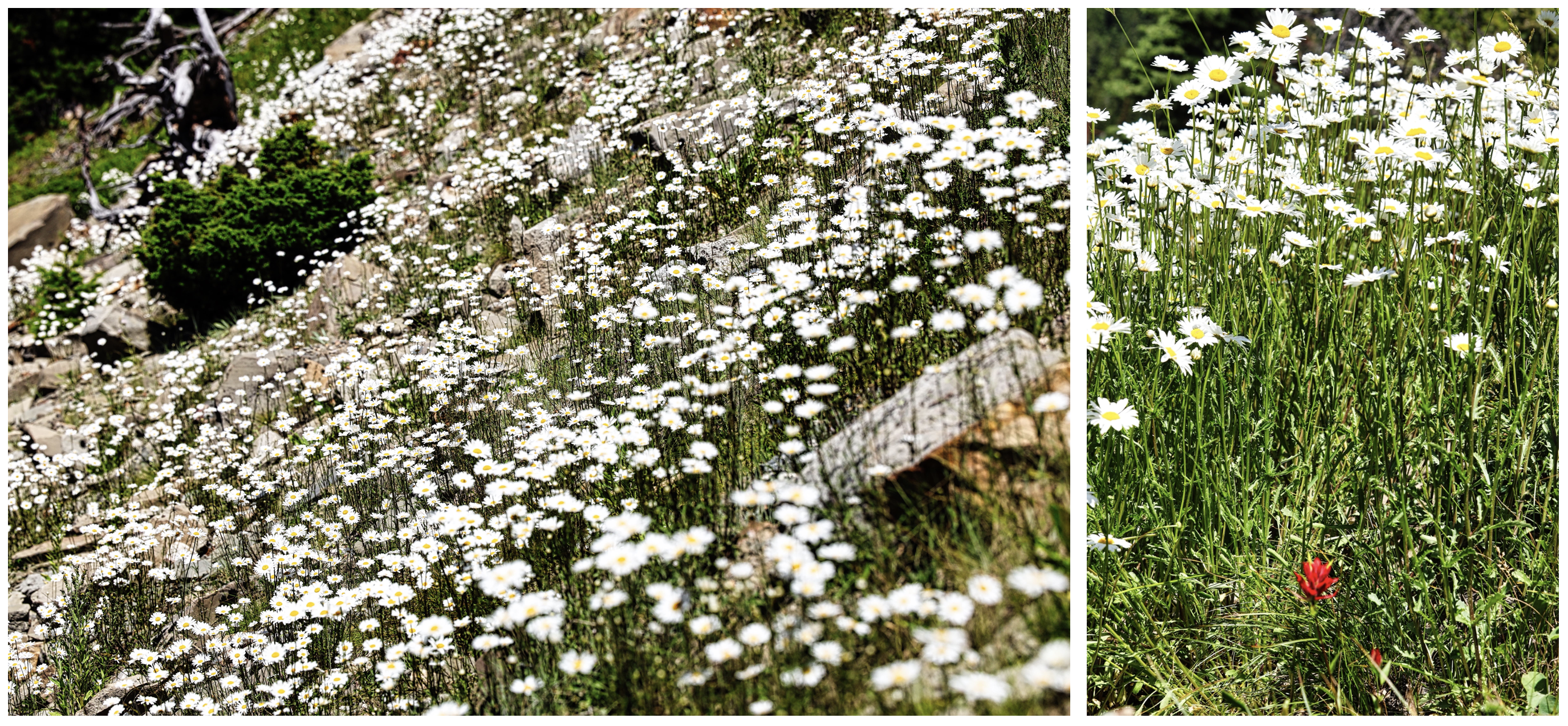
Take a drive anywhere around Big Sky and you will see daisies pretty much wherever you look. In some cases there are thousands of plants taking over the range. While I was out taking photographs for this article I quickly surveyed a hundred-square-foot daisy patch and found only two species of native plants, whereas next to it the same size area without daisies contained more than 20 species of native plants. That’s a huge difference when considering that wildlife will not eat daisies.
The saving grace, unlike knapweed, daisies are easy to control using herbicides. The problem is that they are way ahead of us and people don’t like getting rid of pretty flowers. Eye of the beholder, I guess.

Toadflax propagates by seed, but also by creeping rhizomes which are its root system. Pulling a plant up by the roots still leaves rhizomes in the soil which will come back as plants the next season. Each plant produces 30,000 small, wispy seeds that are dispersed by wind, animals and streams. I found a patch of toadflax next to the trail six miles up middle basin 10 years ago that is now close to one quarter of an acre in size. And to add insult to injury, the seeds stay viable in the soil for eight years. It’s not a fair fight.
Next is Yellow Toadflax, Linaria vulgaris. This is my nemesis. I try every year to pull, spray, mow, dig, and whatever I can do to get rid of it, and it never seems to work. The toadflax in my yard and surrounding range keeps increasing in numbers and size. It is exhausting since it has only grown in my yard for 5 years. Why?
So how did they get here? Again, it’s the flowers. They were imported from Eurasia in the 1600’s as a landscaping plant, and have been used ever since. They were sold under the name “butter and eggs” or “false snapdragon.” Hopefully no one around here is transplanting them because they take over the range.
I could keep going and going. We have so many species of noxious weeds, every reader should become knowledgeable. Thankfully, Grow Wild is a Gallatin Valley organization focused on education and invasive species reduction. Please visit their website to learn more about what you can do.