


Eggs and Issues provides breakfast and education before Madison-Gallatin Joint County Commission Meeting
Wednesday started bright and early, with coffee, quiche and croissants.
As is tradition, the Big Sky Chamber of Commerce hosted Eggs and Issues, an education- and awareness-focused breakfast, as a prelude to the bi-annual Madison-Gallatin Joint County Commission Meeting. Big Sky leaders from nonprofits and government service districts presented recent happenings and upcoming priorities to county commissioners from both Madison and Gallatin counties. For Gallatin County, Zach Brown, Jennifer Boyer and Scott MacFarlane attended. Madison County Commissioner Bill Todd, whose jurisdiction overlaps Big Sky, also joined. The meeting was moderated by the Big Sky Resort Area District board.
Discussions included upcoming TIGER Grant road work, an update for the Big Sky Post Office, a long-awaited Madison County polling station in Big Sky, funding for the Big Sky Trails and Parks District, an update on the Gallatin River’s impairment status and related talk about the Gallatin Canyon County Water and Sewer District, and the future of the Big Sky Transportation District and Skyline Bus.
Transportation topics
The meeting opened with a brief TIGER Grant update from Kristine Fife, public relations representative for the Montana Highway 64 construction project.
After speaking with the construction crew, Fife said the anticipated mid-May start date might look more like early June—a two-week setback to the projected timeline for summer work.
Commissioner Brown noted that this project has required “all hands on deck” due to inflation, and it’s exciting to finally see construction season here, “although that will come with some pain.”
The project is expected to create daily delays of up to 20 minutes at peak times.
BSRAD board member Kevin Germain added that Montana Department of Transportation is launching a feasibility study to improve traffic flow between U.S. Highway 191 and Montana Highway 64.
“I think everybody in this room is aware of the traffic issues we had this winter specifically,” Germain said.
Later in the meeting, Big Sky Transportation District Executive Director Darren Brugmann shared information about efforts to improve Skyline Bus service.
Brugmann also announced his healthy return from medical leave, met with hearty applause.
He said that as early as August, Skyline should receive its new coach-style buses funded by the TIGER Grant.
BSTD’s upcoming priorities include transition to an electric fleet, investment in a transit facility and doubling bus frequency to a 15-minute circuit between mountain and meadow. That would mark a four-fold increase in bus frequency along Big Sky’s mountain-meadow corridor in two years.
Toward the meeting’s end, Big Sky Community Organization CEO Whitney Montgomery summarized the final transportation topic: in partnership with Montana State University’s Western Transportation Institute, the BSCO will soon implement traffic calming measures on Ousel Falls Road.
Gallatin River health, canyon development
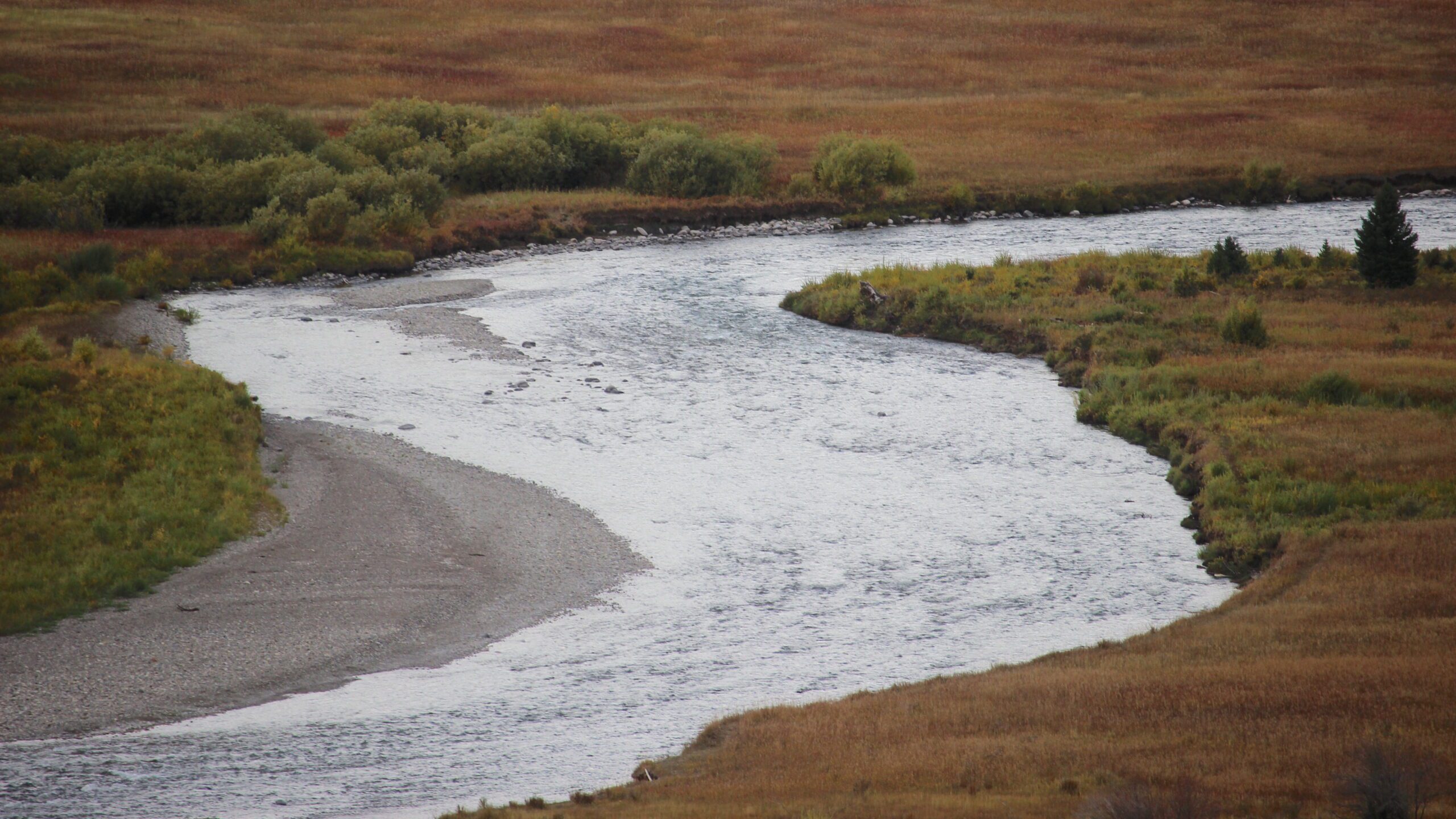
Signs point to the possibility of a healthier river flowing past Big Sky in years to come.
Montana Department of Environmental Quality recently moved to list the middle section of the Gallatin River as “impaired.” Andy Ulven, DEQ water quality planning bureau chief, provided an update.
“Really this initiates a more than five-year study the DEQ will be conducting on the Gallatin River, which as you all know, is an important recreational, ecological and cultural resource,” Ulven said.
The Environmental Protection Agency is required to respond within 30 days of the April 13 DEQ proposal. Ulven said the EPA has been tracking DEQ’s Gallatin River study and expects the EPA to use its approval power to confirm impairment and “give us the green light to go ahead with our study.”
Ulven cited increased development and regional pressure seen in Gallatin Canyon.
“We heard the concern from the community, most notably in the form of a petition, but also from visual observations of algae growth that have been more recurrent and more of a nuisance over the last five years,” Ulven said.
He said that DEQ will maintain 19 monitoring sites to track nutrients, temperature, pH and oxygen starting this summer.
“We’re going to be throwing a lot at the Gallatin River the next three-plus years with our field efforts,” Ulven said.
Kristin Gardner, chief executive and science officer with the Gallatin River Task Force, said during public comment that GRTF is looking for volunteers to help with water quality monitoring this summer.
The Gallatin Canyon County Water and Sewer District has begun annexing willing property owners, according to project engineer Mace Mangold. The new district aims to reduce the impact of existing and future development beside the Gallatin River, by bringing septic systems online with Big Sky’s upgraded treatment plant.
Mangold said, “the leading source of potential algae impact, my gut says, it’s septic based.”
When prompted, Ulven added support: “I’ve heard Mace’s presentation previously, and I think the work you’re doing down there is incredible and really will be one of the solutions that can help us out.”
The new district plans to improve the canyon’s standard for wastewater treatment.
As Mangold described the project, he estimated minimum total cost at $30 million, and said the current priority is making it affordable. If the district reaches as far south as the Big Sky School District, it may cost $50 million.
“To pull off that scale of project, we need to tap every financial mechanism we can,” Mangold said. “Re-development is fundamentally going to carry a large capital burden, and also going to set up the base infrastructure for [a community sewer system] that, say, Bozeman has been operating for 50-100 years. We’re trying to build that from scratch—that’s not cheap.”
Mangold also said existing infrastructure poses some threat to public health, as poorly treated sewage interacts with drinking water sources.
“I don’t want to alarm people… It’s not a good situation when you’re mixing wastewater and private wells,” he said.
Commissioner Brown said this project’s need is compelling and will benefit both Gallatin County at large, and Big Sky’s canyon residents.
“A lot of our decision to prioritize this project and give it a maximum [ARPA] award was based on the human health concerns, frankly,” Brown said. “So I don’t think you’re being alarmist to point that out to folks.”
He added that a short-term cost will provide long-term payoff in septage management, which will become “a rising issue for this community, period.”
Post office and Big Sky-Madison polling station celebrate progress
Six months after the Big Sky Post Office made headlines at the previous joint county commissioner meeting, a solution is continuing to take shape.

Al Malinowski, vice president of Gallatin Partners which has operated the Big Sky Post Office on a contract basis for two decades, gave the news: “The USPS is investigating the process of a larger post office [and] it looks like that post office will be run by the United States Postal Service,” Malinowski said.
Since October when Malinowski announced the termination of Gallatin Partners contract, the motive has remained clear and consistent: engage USPS on Big Sky’s need to upgrade from an undersized contract postal unit to a federally operated USPS post office.
“I’m hopeful that in the next couple of weeks… we will have more information that we can share with the community… as to when we believe that transition will take place,” Malinowski said. “At this point, I’m confident enough to say to you, I think I transition is going to happen.”
Malinowski reiterated his past message that Gallatin Partners will continue to extend its contract and continue postal service, as long as the USPS continues to make progress.
Another topic came full circle since the October joint county commissioner meeting.
“Those of you who are residents up here but live in Madison County will now have polling places up here in Big Sky, and you won’t have to drive down to Ennis any longer,” Madison County Commissioner Bill Todd said. “I know it’s been clamored for for a long time, so we’re happy to deliver on that front.”
Todd said the fire station near Big Sky Resort will be the likely site. At the October meeting, Big Sky Fire Department Chief Greg Megaard offered that space.
Funding what ‘makes this place special’
Malinowski returned to the podium five minutes later, wearing a different hat.
The Big Sky Trails, Recreation and Parks District was formed one decade ago, Malinowski said, and he’s a Gallatin County appointee. For many of those years, “the Big Sky Community Organization has continued to flourish and grow our trails, recreation and parks.”
Malinowski said surveys show that parks and trails are “something that makes this place special,” but a sustainable and responsible plan is needed for long-term funding of BSCO’s maintenance and operations.
Starting this year, BSTRPD is making the request for annual trail maintenance and operations of BSCO. After this year, those needs would be funded on a three-year cycle, “[enabling] our funding to be more consistent and more reliable,” Malinowski explained.
Finally, Malinowski added that BSTRPD is requesting an assessment added to Big Sky tax burden, to help fund annual park and trail work—currently, that entire cost is funded by Resort Tax grants, which Malinowski said is not sustainable as those costs continue to rise with the expansion of Big Sky’s parks and trails.
BSRAD board chair Sarah Blechta said it makes “a ton of sense” from a resort tax perspective. Blechta and board member Grace Young formed a BSRAD subcommittee.
“From our perspective, we want to hear from the taxpayers before we make any concrete decisions,” Commissioner Brown said, and Commissioner Todd agreed.
Belonging in Big Sky
Community members enjoyed breakfast plates and coffee in exchange for four hours of attention. Before the government meeting, four speakers spoke to diversity, equity and inclusion in Big Sky during “Eggs and Issues,” presented by the Big Sky Chamber of Commerce.

Montana-based racial equity consultant Meshayla Cox introduced her “Diversity Dictionary,” explaining terms common in the belonging space.
Hannah Bratterud followed, hypothesizing a scenario about a stranger being invited to a party. The stranger nearly leaves before another kind individual invites them to dance.
“If diversity is inviting someone new and different to the party, inclusion is asking them to dance. Belonging is when they feel accepted—for who they are, and for their unique contribution,” concluded Bratterud, an immigrant from Norway who now lives in Big Sky.
Belonging in Bozeman is an initiative which happens to share its name and general goals with the new “Belonging in Big Sky” initiative launched by the Big Sky Chamber of Commerce.
Dani Hess and Nakeisha Lyon, both City of Bozeman employees who head the initiative, spoke during Eggs and Issues.
Hess and Lyon have hired a variety of community liaisons to improve representation, trained 180 city staff, and created an internal Belonging in Bozeman team.
Finally, outdoor-industry focused DEI consultant Dylan Thornton summarized the need for Belonging in Big Sky.
He said that by addressing systems in a forward-thinking way, the Big Sky initiative will maintain a community environment that promotes respect and understanding for the many facets of identity, diversity and accessibility.
“This is not about going out there and trying to save people or change peoples’ minds. This is about creating connections and creating more effective systems to support individuals and communities,” Thornton said.