


Plans to develop a data center in Bonner are advancing, but details still obscure.
By Katie Fairbanks MONTANA FREE PRESS
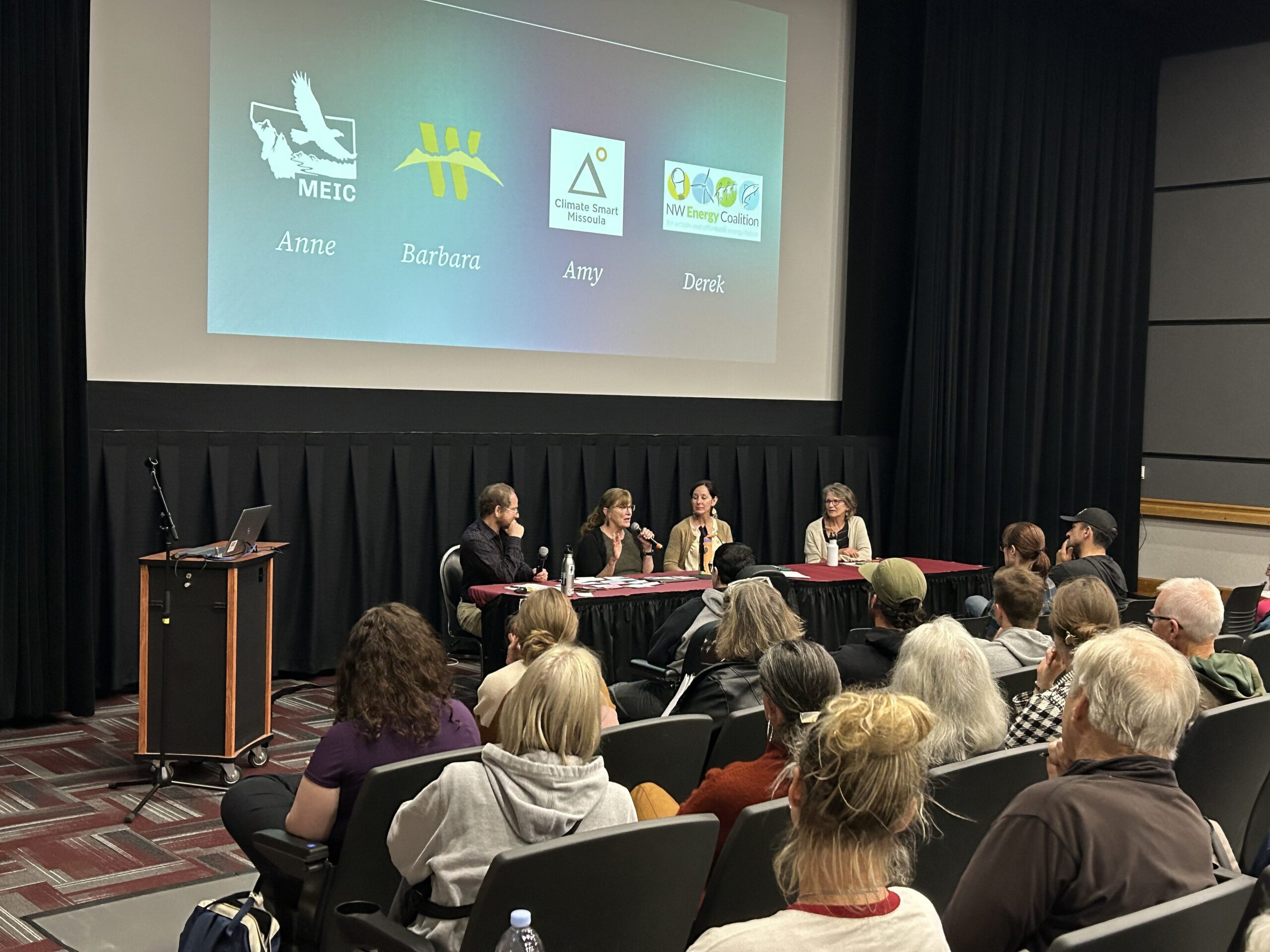
As nationwide opposition to the increasing number of data centers grows, a crowd of more than 100 people gathered at the University of Montana Tuesday for a panel discussion about the facilities proposed in the state, including one in Missoula’s backyard.
Panelists from environmental groups detailed the potential effects on state and local resources and answered questions that have proliferated nationwide about data centers’ impacts on communities.

“If we aren’t diligent and firm and seeking strong sideboards around data centers, we could end up paying the financial and environmental cost, with the economic benefits largely accruing to out-of-state tech billionaires,” said Derek Goldman, with the North West Energy Coalition, while introducing the panel. “The time to do that is now, before they’re built and operational.”
The event was one of several discussions on data centers the Montana Environmental Information Center has held statewide this year. But the Missoula discussion on Tuesday had a particularly relevant dimension: a data center proposed for Bonner, a community of about 1,600 just east of Missoula.
Asked by panelists if they had attended because of interests about the Bonner proposal, about half of the audience raised their hands.
The facility would be located in the former UFP Edge building, located in Bonner Industrial Park, where a cryptocurrency mine operated from 2017 to 2020. Missoula County is currently reviewing an application for the facility submitted by Krambu, an Idaho-based data center company. Because it is within 500 feet of a residential property boundary, the project will be reviewed by the Missoula County Consolidated Land Use Board before the company applies for permits.
According to Krambu’s application, the data center would run 24/7 but would not require regular staffing. The company plans to add an unspecified number of 15-to-17-foot high cooling towers outside the building, but most new construction would be inside. Trees and landscaping would be planted along Highway 200 as a visual buffer.
The facility is expected to use about 7 megawatts of power initially, with the potential to expand to 29 MW, the estimated capacity of the site, according to the county. That amount is far less than the estimated power for other proposed data centers in Montana. The Bonner application said that full build out of the site may take two to three years and, depending on the “ultimate amount of power available to the site,” possibly ramp up to using 100 MW depending on market demand. The company does not plan to use backup generators.
Under county zoning regulations, power for the facility would have to come from a new renewable source. But that’s not the case for the rest of the state. During the panel Tuesday, Anne Hedges, executive director of the Montana Environmental Information Center, raised concerns about data centers straining the electrical grid and increasing rates for residents.
NorthWestern Energy has signed preliminary agreements with companies proposing three data centers in Butte-Silver Bow, Cascade and Yellowstone counties. At their full buildout, the facilities are seeking a total of 1,400 megawatts by 2030. That would more than double Montana’s electricity demand on NorthWestern Energy, which currently provides about 760 megawatts of power to existing customers in the state on a typical day.
“It’s mind-numbing to think that we would have to provide that much power to these companies,” Hedges said. “We simply cannot supply this amount of energy.”
Quantica, the company planning to build a data center near Broadview, north of Billings, plans to use its own gas plants to power the facility, the Billings Gazette reported Wednesday. The proposed plants would generate more power than NorthWestern Energy does statewide.
While NorthWestern Energy has proposed a large-load tariff requiring agreements intended to ensure high-demand customers like data centers are responsible for their costs, Hedges argued the proposal does not do enough to protect other customers. She argued the tariff should go further by creating a separate rate class for data centers like the utility has for residential or industrial customers.
The difference, she said, would allow the combined costs of the data centers to be charged to them, rather than other customers paying for them.
“Because who here wants to subsidize the richest men in the world?” Hedges asked the audience. “Anyone?”
Several people in the crowd audibly responded “no.”
One of the larger unresolved questions Hedges and other panelists deliberated on was about the amount of water that data centers may use — including the proposal in Bonner.
Krambu plans to use a closed loop cooling system with evaporative and dry cooling towers at the Bonner facility, according to its application. Each tower cools the equivalent of 4 to 5 MW of server power, the company said, so the total number of towers needed will depend on the amount of power used. According to the application, 29 MW would use up to 10 towers, including redundant towers for backup.
The dry cooling towers use fans and not water, the application explains. Evaporative cooling towers use water from the existing fire suppression system, which has “ample” capacity, the application said. The company has said those towers would initially use about 500 gallons to fill up and be recharged three to four times per year. It’s unclear how many of each type of tower would be used at the center.
As the proposal advances, Missoula land use officials will be vetting the facility on a number of factors. The Missoula County Consolidated Land Use Board will consider how the Bonner facility could impact nearby residential areas, including traffic, noise, vibration, lighting, frequency of use and hours of operations. Those factors are scheduled to be debated during a July 1 hearing.
Krambu will also have to show compliance with the county zoning regulations. The proposal is the first to be considered under the county’s regulations on data centers, adopted in 2021 in response to problems with the former cryptocurrency facility. That includes limiting the facilities to industrial zones, requiring a special exception for facilities adjacent to residential areas, requiring verification that electronic waste will be recycled and requiring the site to use new renewable energy that would not have otherwise been brought onto the electrical grid.
Krambu has not submitted information to the county about how it plans to meet that renewable energy requirement, Jennie Dixon, a county planner, told Montana Free Press in an email. That would come when the company applies for a zoning compliance permit, after the special exception public hearing in July, she said.

During the panel discussion Tuesday, Hedges said Missoula County has the best data center regulations in the state, but local zoning is not enough to address all the concerns that come with the facilities.
Dixon, called upon during the panel, said the two issues the county’s regulations don’t fully address are heat generation and water quality and quantity. The facility’s water use and wastewater discharge would be regulated by the state Department of Environmental Quality and the Department of Natural Resources and Conservation, she said.
The volume of data centers’ water use nationwide is more murky than energy use, but individual centers use millions of gallons per year, said Barbara Chillcott, senior attorney with the Western Environmental Law Center, during the panel.
The overall use of water is not just that used for cooling in the facility, but also water used to generate electricity needed to power the site and water used in the supply chain, Chillcott said. Research has shown that data centers consume more water over time as they expand, as water use is tied to the amount of megawatts, she said.
Air-cooled data centers use more water on-site than closed-loop systems like the one proposed in Bonner, Chillcott said. However, those use more electricity, which can use more water depending on the source of that power, she said.
One of the primary pollutants in wastewater from data centers is thermal pollution, Chillcott said. That is concerning because Montana often sees low river flows and warm rivers during the summer, she said.
“Data centers are primarily driven by cheap power, high-speed fiber, and then favorable tax treatment, not water,” Chillcott said. “We’ve seen that water has been an afterthought for a lot of these. … It doesn’t have to be. And I think that’s the goal, should be our goal as a state and community is to really get out in front of this issue so we’re prepared.”
Hedges noted that there is a national concern about transparency when it comes to data center projects. The proposals in Montana, she said, are no different. In one part of her presentation, she showed a slide of photos of heavily redacted agreements between NorthWestern Energy and data center companies. Many in the crowd laughed.
“So what do we know? That’s what we know,” Hedges said.
“Transparency is something I think we should be beating the drum on because if we don’t know what they’re doing, we cannot help solve the problems they create,” Hedges said.