

House candidates talked voting access, affordable housing, health care, climate and immigration enforcement in Bozeman forum
By Jen Clancey and Carli Johnson
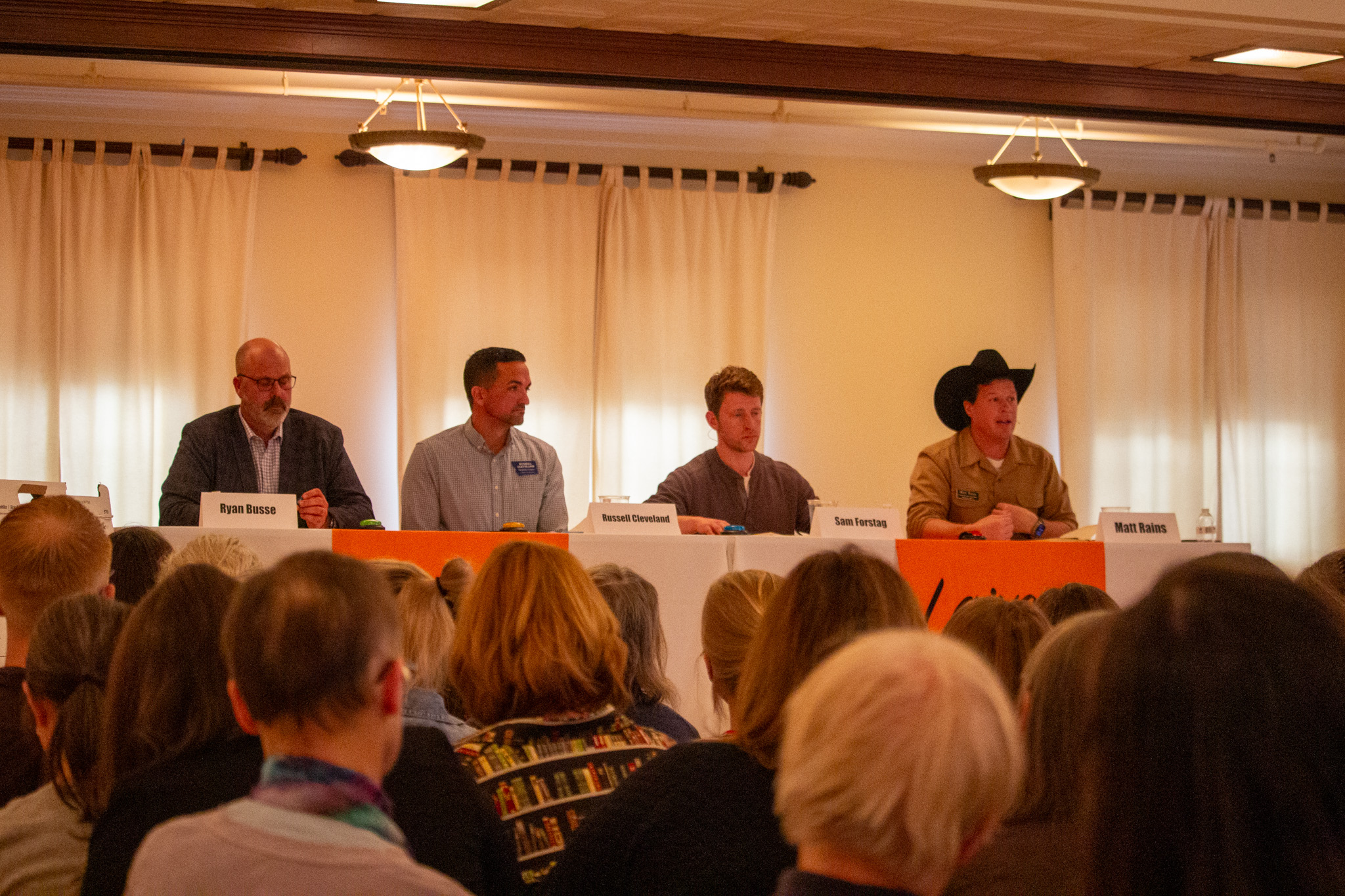
Over 130 people entered the foyer of the Baxter Hotel in Bozeman and walked up the steps to a candidate forum for Montana’s First Congressional District. Volunteers from Forward Montana, a nonpartisan civic engagement organization checked attendees into the Grand Ballroom.
Eight candidates are running in the congressional primaries—four democrats and four republicans. The race opened up after incumbent Rep. Ryan Zinke announced in early March that he would not seek reelection. All candidates were invited to the forum, although only the four democrats made an appearance.

Inside, a volunteer carried a bowl of kettle corn past rows of chairs to the back of the room, where attendees served themselves and went to their seats. The four candidates waited with their buzzers at a long table to answer not only pressing questions about U.S. and Montana issues, but also lighthearted trivia questions, like naming which pop star coined the term “hot girl summer.”
Lauren Myli of Forward Montana opened the evening alongside emcee Missy O’Malley. The pair worked together to keep candidates within their 90-second limit.
“We’re so excited to hear from our candidates who showed up tonight about their vision for their time in congress if they are elected,” Myli said in her opening remarks.
The four democratic candidates individually introduced themselves.
Former gubernatorial candidate Ryan Busse opened with a passionate stance against incumbent Ryan Zinke and emphasized working towards a future his kids and generations of Montanans can afford.
Navy veteran and born-Montanan Russell Cleveland shared his personal life experiences with the difficult and expensive U.S. health care system when his family lost his eldest daughter at just 13 years old. Cleveland stated his goal to bring strong leadership back into Montana.
Union leader, smokejumper and public lands advocate Samuel Forstag spoke on his efforts to continually defend and protect public lands and the people who work on them, deliberately fighting for putting a “working person in Congress.”
U.S. veteran and rancher Matt Rains leaned into his Montana values, having grown up in a family that’s lived in Montana for generations. He explained that he wants to represent agriculture producers in congress, and support Montanans in affording to live in their home state.
Voting: Candidates oppose SAVE Act, emphasize improving access instead
The forum opened with a question about voting rights and the SAVE Act. The Safeguard American Voter Eligibility Act was introduced in January 2025, and President Donald Trump has since pushed for its passage through Congress, despite criticism of the bill’s regulations that could make the process more difficult for voting Americans. If passed, voters would be required to present a valid ID before registering to vote. Proof of citizenship and mail-in ballots would be cut, except for people with disabilities, illnesses, in military service or travelling.
All four candidates expressed opposition to the SAVE Act and described what needs to happen at the federal level to improve voting access.
Cleveland emphasized the need for better investment in the United States Postal Service. Rural states rely on the federal mail service to cast votes in elections, Cleveland said. The USPS has had longstanding financial issues, which have recently resulted in the postmaster general announcing the agency may run out of money by 2027 without additional funds from Congress, NPR reported.
“Let’s actually fund programs like our post office so that they can staff accordingly and make sure that those ballots get out and back in a reasonable time,” Cleveland said. Matt Rains also noted the USPS’ role in Montana elections and communities.
“The mail-in ballots are essential. We have to protect those in every way, shape and form we can,” Rains said, adding that the USPS in rural communities “is really a lifeline.”
Busse listed the communities impacted negatively by the SAVE Act, including women, and rural populations and people living on reservations. Forstag criticized Montana Secretary of State—and congressional candidate—Christi Jacobsen’s tenure, saying she “made it her mission to roll back voting rights.” Forstag said he supports the John R. Lewis Voting Rights Act, which would require states to show they are providing voting access.
Housing: affordability is Montana’s key issue, candidates agree
Candidates recognized housing affordability as a key issue for Montana right now. According to the Montana Department of Labor and Industry, Montana is one of the least affordable states for homeownership, ranking 11th. Montana Public Radio also reported that the median prices for homes in the state rose 66% from 2020 to 2024.
“We have a whole generation of Montanans right now who cannot conceive of owning a home. And when you cannot conceive of owning a home, that has fundamental impacts for the way that you invest back in your community that you don’t see investing in you,” Forstag said. He noted that homelessness is also a problem in Montana’s major cities, reflecting on work he did with the Montana Coalition to Solve Homelessness. He named new tools like community land trusts and block grants as options to build upon his support for further investment in affordable housing.
Ryan Busse also noted the impact of housing costs on communities.
“We have people that service a community, that make a community go, but can’t live in it. They have to live an hour or two hours away to be able to afford to even own or rent a home,” Busse said. “That’s not a community. That’s something, but it’s not a community and it’s not the Montana that we want to live in.”
Busse recommended low-income tax credits, and investments in a variety of tools to support affordable housing, instead of federal dollars going toward conflicts in Iran and Venezuela.
Cleveland expressed support for better wages in the state with mindful implementation to preserve local businesses. He proposed a 50-to-one ratio in wages, which would limit an executive’s income to be only 50 times more than the company’s lowest-paid employee. Cleveland reflected that his veteran status helped him apply for a home loan and he wants to create similar opportunities.
“I don’t think you should have to serve in the military to have that same benefit,” Cleveland said.
Rains offered his approach to affordability struggles—improving and maintaining infrastructure to serve a growing population, and incentivizing contractors to build affordable housing. He also expressed wariness of corporations owning housing in Montana.
“We need to find legislation that puts Montana names on Montana homes,” Rains said.
Climate, health care, public safety and immigration enforcement
As a firefighter working on the front lines of the current climate crisis, Forstag made clear that, if elected, he would invest in a clean energy transition by creating jobs in rural clean energy. He repeatedly stressed his commitment to addressing the “downstream effects of Congress’ failures” — a reference to the current federal administration’s plans to restructure the U.S. Forest Service.
Rains approached the topic from an agricultural perspective, arguing that bringing a rancher into congress would give legislators the on-the-ground perspective Montanans need to properly protect climate and public lands.
“Out of the 435 people who sit in Congress, not many of them have rolled around in a boiler room covered in fly ash. I have—and I bring—a unique perspective of first-hand experience that I can bring to Congress,” Rains said.
Busse promised that, if elected, he would fight for resources to implement renewable energy. He argued that there has been too little action taken toward protecting our climate.
Cleveland took a broader approach, calling for the removal of money from politics and a reinvestment in education. “We need leaders who are not bought and paid for by big oil, big petroleum and big coal and it starts with getting money out of politics,” he said.
Candidates also answered questions regarding immigration enforcement funding and public safety. All candidates expressed their support to reduce funding for Immigration Customs and Enforcement. As of Friday, May 1, three days after the candidate forum, President Trump signed a homeland security funding bill, but those appropriations will exclude the Department of Homeland Security’s immigration enforcement branches, PBS reported, after weeks of debate over the inclusion of funds for immigration enforcement.
Rains described the need for better resources to address public safety.
“Law enforcement in Montana needs to be supported with quality individuals with the type of income and salaries that we can have officers … that can raise their families, can stay in the communities, can be there, can be integrated and involved,” Rains said. He also expressed support for more widespread training in emergency medical response for rural communities.
Busse said the situation with ICE is urgent and dire.
“Responsible law enforcement does not intimidate people to stay in their homes,” Busse said. Cleveland described the need for reform in the DHS.
“It’s not just ICE. We need major DHS reform, and it goes all the way back to the Patriot Act, post-9/11 legislation,” Cleveland said. Forstag described the need for legislation enforcing transparency from immigration enforcement officers.
“This is not a new fight. It is a fight that they have turned into something else, and we cannot stop now,” Forstag said.
When it comes to health care, all candidates agreed that more affordable access is important to Montanans. In the meantime, every candidate spoke in support of Medicaid.
Cleveland notably included dental, vision and mental health as necessary parts of our livelihood. “Health care is a human right. Stop letting companies profit off of our wellbeing,” he said.
As the event wrapped up, some attendees left with gift cards after answering trivia questions correctly, and all left with a bit more knowledge of the candidate’s stances on issues ahead of the June primary.