

By Zeke Lloyd MONTANA FREE PRESS
Montana’s 2026 primary election is Tuesday, June 2. We’ve compiled everything you need to know about the offices and candidates on the primary ballot, and how you can still cast yours.
Primary elections are an opportunity for voters to decide which candidates, from one of three qualified political parties, should appear on the ballot for the general election Nov. 3. Montana elections feature partially open primaries, which means Montanans can vote on either the Republican ballot, the Democratic ballot, or the Libertarian ballot — but only on one. During the general election in November, all Montanans will receive an identical ballot.

The 2026 election is a midterm election, meaning there is no race for U.S president on the ballot this year.
But Montana will be voting on three of its four seats in Congress: two in the U.S. House of Representatives, and one in the U.S. Senate. Two of those seats — the Western District House seat and the Senate seat, are open races. One — the Eastern District House seat — has an incumbent. Open federal seats are a relative rarity in Montana’s recent political history.
In early March, four-term Western Montana U.S. Rep. Ryan Zinke announced he would not seek reelection, citing health problems. Days after Zinke’s withdrawal, two-term U.S. Sen. Steve Daines withdrew his candidacy just minutes before the March 4 filing deadline. First-term Eastern Montana U.S. Rep. Troy Downing is running for reelection in his deep-red district. U.S. House seats have two-year terms. U.S. Senate seats have six-year terms.
First-term Sen. Tim Sheehy, who won his 2024 race against three-term Sen. Jon Tester, is not up for reelection until 2030.
Twenty-one primary candidates are on the ballot across Montana’s six contested primaries for federal office. You can find information and news about each of them in Montana Free Press’ 2026 Election Guide.
The election guide also features independent candidates like U.S. Senate candidate Seth Bodnar. Independent candidates do not appear on primary ballots, since they are not affiliated with a political party. If their signature petitions are certified this summer by the secretary of state, independent candidates will appear on the general election ballot in November.
In addition to federal races, there is a statewide primary election this year for an open seat on the Montana Supreme Court. Because state Supreme Court races are nonpartisan, the top two primary vote-getters are automatically forwarded to the general election ballot. This year’s race for the single open seat on the state’s high court features only two candidates, both of whom will appear on the general election ballot regardless of their primary results.
Montanans will also be voting for representatives and senators in the state Legislature. All 100 state representatives are up for election, along with half of the state’s 50 senators.
An intraparty rift emerged in the 2025 legislative session when hardline Republican senators tried to sideline more moderate members of the caucus, leading some Republicans to form a bipartisan majority with Democrats. In the 2026 primary, party-loyalist Republicans are looking to oust members they consider insufficiently aligned with the state party platform, like legislative power broker Llew Jones.
There are also two competitive Republican primaries for regional seats on the state Public Service Commission, which regulates the utilities that serve a majority of Montanans. Whether those races appear on your ballot depends on where you live.
Likewise, the appearance of local elections for sheriff or justice of the peace on your primary ballot depends on where you live.
Can I still register to vote?
Yes. If you’re in line by 8 p.m. on Tuesday, June 2, the polling station will stay open until you’ve registered and voted.
The state requires most local election officers to allow voter registration from 8 a.m. to 12 noon on Monday, June 1, and from 7 a.m. to 8 p.m. on primary election day, which is Tuesday, June 2. A polling place with fewer than 400 registered voters can open as late as noon on election day, according to Richie Melby, a spokesperson for Montana’s secretary of state. A polling place may also offer other times to register outside of those windows.
Bradley Seaman, the elections administrator in Missoula, told MTFP this week that a state policy mandating continuous counting, which disallows counties from taking breaks, can make for some late nights. In November 2024, Missoula County counted ballots for almost 35 consecutive hours.
“It’s don’t stop till you drop,” Seaman said.
Seaman said the policy has actually increased the time it takes to count ballots.
“But we’re going to follow the laws as they’re written,” Seaman said. “And we’re going to do the best we can to make sure that we’re really prioritizing that accuracy is paramount.”
The 2025 Legislature passed a law limiting voter registration on election day, but Lewis and Clark County District Court Judge Adam Larsen blocked it in May.
Even with the long hours, Seaman said, watching the last ballots get counted justifies the effort.
“There’s a cheer that goes out when that last box comes through,” Seaman said.
What do I need to vote in person?
You must provide a photo ID, like a driver’s license or tribal ID. A 2025 law amended the list of qualifying IDs to include a driver’s license, tribal ID, passport or student ID issued by a university that is a member of the National Association of Intercollegiate Athletics. If your photo ID isn’t on that list, you’ll additionally need to provide a utility bill, bank statement, paycheck or government document that confirms your name and current address.
Can I still mail in my ballot?
It’s probably too late for that, according to the U.S. Postal Service, which recommends mailing ballots a week before election day. Mailed ballots have to arrive at election offices by 8 p.m. on election day in order to be counted.
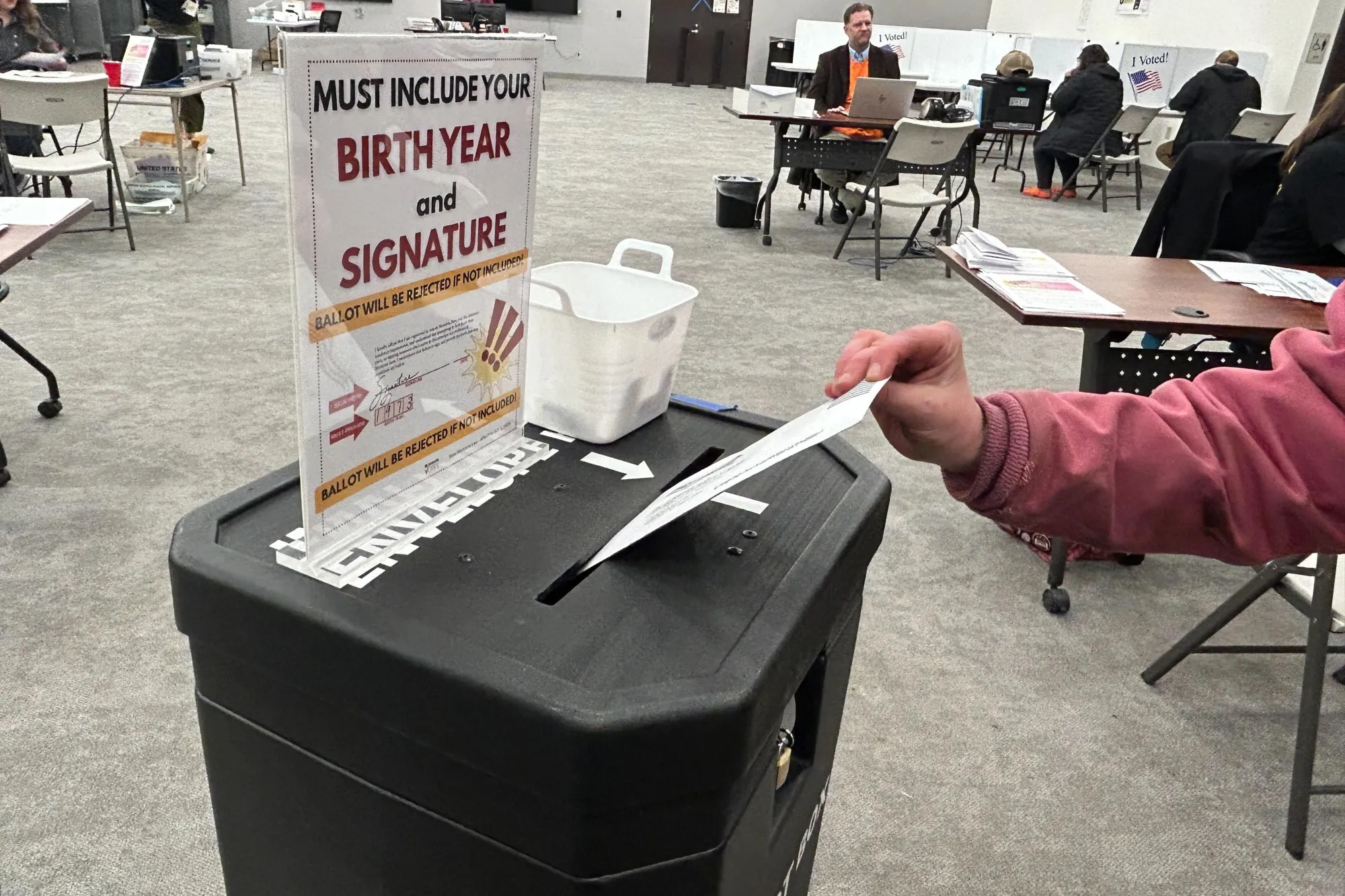
Absentee ballots can be dropped off in person anytime before 8 p.m. on election day.
What if I requested an absentee ballot, but it never came?
Don’t panic. You can go to your election office anytime before 8 p.m. on election day to get a valid ballot.
Also, it’s probably a good idea to visit myvoterpage.mt.gov to check the mailing address associated with your voter registration. It might be out of date. For instance, updating your mailing address with the U.S. Postal Service doesn’t update your registered voting address. Your local elections office can help you update your address for future elections.