
Radio-famous republican wants to continue Zinke’s knack for ‘conservation consensus’
By Jack Reaney SENIOR EDITOR
Editor’s note: This story describes a private meeting organized by Outlaw Partners, the publisher of Explore Big Sky. Outlaw Partners plans to conduct similar meetings with other candidates representing all political parties.
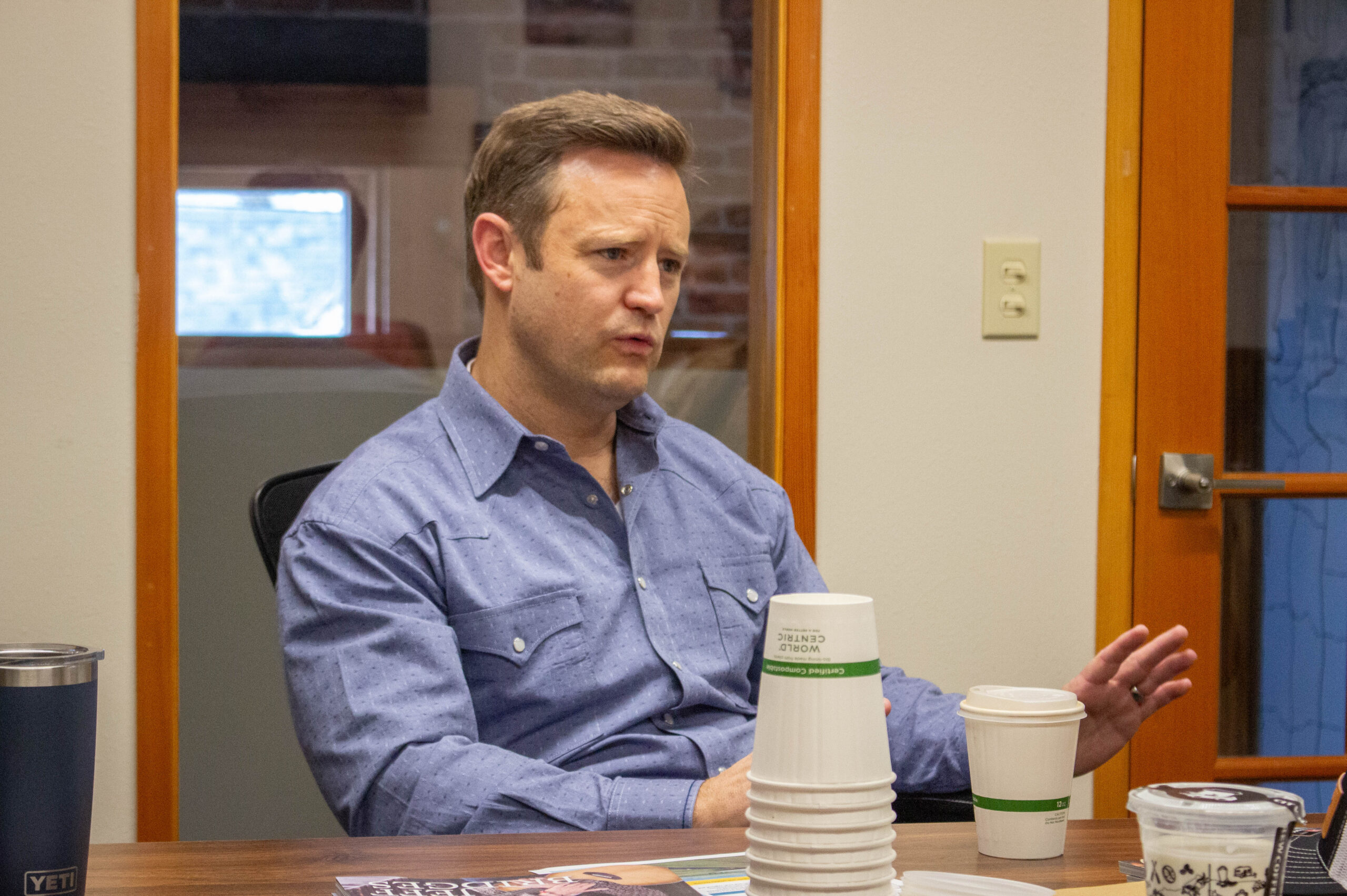
One of Montana’s candidates for U.S. Congress, Aaron Flint, believes he brings something unique to the table, forged by a long career as a talk radio host: his ability to listen, particularly to opposing views, and demonstrate respect.
Flint is running for Montana’s western congressional district as a republican, and aims to replace incumbent Rep. Ryan Zinke, who announced in early March that he will not seek re-election. Flint is endorsed by President Donald Trump, as well as Zinke and current Sen. Tim Sheehy. Montana’s primary election runs from May 4 to June 2, pitting Flint against Christi Jacobsen, Al Olszewski and Ray Curtis.
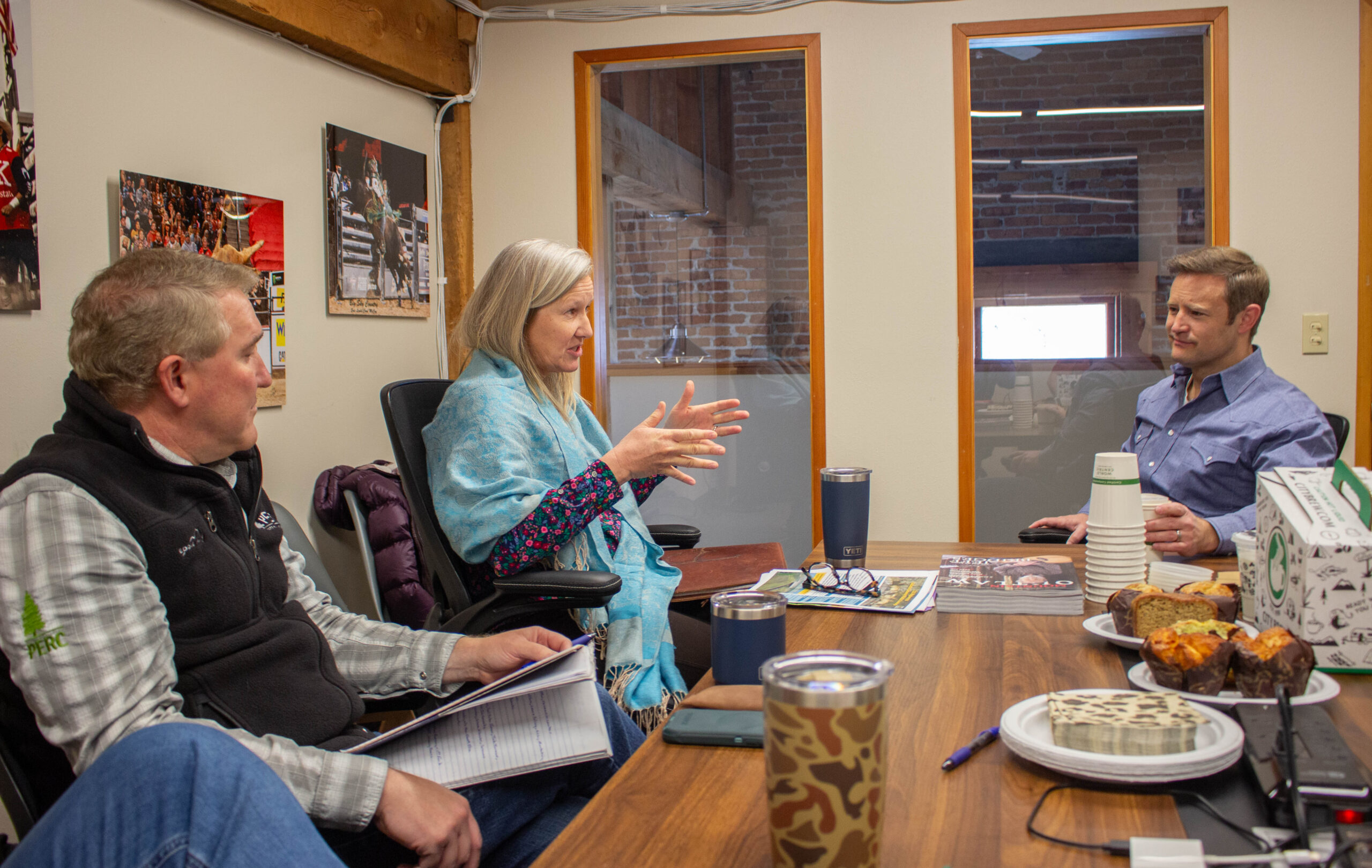
On April 30, Flint sat down with regional leaders of three conservation groups for a casual conversation in Bozeman. Hosted by Outlaw Partners CEO and Chairman Eric Ladd, the discussion featured American Rivers, Center for Large Landscape Conservation and the Property and Environment Research Center.
“I tried to get you a nice, diverse group today to give you some of the things that I think are really representative of what’s on the voters’ minds in this region,” Ladd said, opening the conversation in a small Bozeman conference room.
To begin, CLLLC Chief Strategy Officer Deb Davidson cited Montana’s two worst roads for vehicle-wildlife conflict—U.S. Highway 191 between Gallatin Gateway and West Yellowstone along the Gallatin Canyon, and U.S. Highway 89 from Livingston to Gardiner along the Paradise Valley—to underscore the importance of legislative support for wildlife crossings in Montana communities.
“Our rate for wildlife-vehicle collisions on 191 is 24% of accidents. The national average is only 5%. Montana’s statewide average is 10%,” Davidson said. “So for the animals that live in this region, particularly the elk… it’s a real problem. It’s also a huge human safety issue.”
Flint said that under Rep. Zinke’s leadership, preserving wildlife corridors through highway crossings has been “a big priority.” Hearing that CLLC and Montana Department of Transportation will plan to apply for the final round of the federal Wildlife Crossings Pilot Program, Flint said he’d like to emulate Zinke’s approach to public lands.
“It’s been so divisive and there’s been so many fights, especially in the Rocky Mountain West on these issues, but I really feel like Zinke’s done an incredible job creating this conservation consensus. And finding things that we all agree on, and working with people,” Flint said.
Davidson agreed. “Thank you for your continued support,” she said. “I mean, Zinke has been amazing around this.”
If elected, Flint plans to take on most of Zinke’s staff. He added, “That’s going to be the beauty of having his team in place, is we hit the ground running with this.”
Brian Yablonski, CEO of PERC, asked how conservationists can generate revenue without having to rely on Congress—he called attention to PERC’s backing of an increased entrance fee at national parks for foreign visitors, for example.
“I think conservation at its core is about caring about the thing you own,” Yablonski said. “And I think for 100 years we’ve been acquiring land that we can’t manage, and we’ve been talking about disposing of land we should manage… We can all agree, we should better manage what have.”
He suggested Montana’s delegation make a commitment to reauthorizing the 2020 Great American Outdoors Act. “I will say, if you’re a champion for public lands, that’s going to go far in the district,” Yablonski said.
Scott Bosse, Northern Rockies director for American Rivers, asked about Flint’s metrics to decide whether he’d support legislation protecting rivers and public lands.
“Rivers bring people together. It’s a totally nonpartisan issue,” Bosse said, pointing out a recent study showing dramatic support from both republicans and democrats for Rep. Zinke’s Greater Yellowstone Recreation Enhancement and Tourism Act. “… Rivers also support the two biggest sectors of our economy, which are agriculture and outdoor recreation. I mean, clean water coming from our headwaters sustains both those industries. So, super important economic issue as well.”
Flint re-emphasized the importance of finding “conservation consensus,” as he believes Zinke successfully accomplished.
“I think a lot of the metrics Zinke has been using are the same ones that I’d be looking to use as well,” Flint said, adding that he has not heard of any significant opposition to bills like the GYREAT Act.
Flint was also asked about data center construction and extractive industries—particularly in light of Zinke’s support for legislation impacting Minnesota’s Boundary Waters.
Flint responded that data centers need to be stopped if they’re going to jack up electricity rates, consume water or disturb Montanans’ way of life. However, he said it’s important for the U.S. to maintain its technological position, calling quantum computing “the next space race” and cautioning against rivals like China and Russia advancing to the point of controlling U.S. data and national security.
“We need them. Doesn’t mean we need them in Montana,” Flint said.
On mining, Flint said “slow is smooth, smooth is fast,” and that decisions must be taken very carefully. “There’s places where it’s right to say, ‘whoa.’”
‘We all agree more than we disagree’
Perhaps from his years on the radio, Flint’s smooth, casual style of talking feels comfortable and unguarded. Meeting most everyone in the room for the first time, he felt like an acquaintance.
EJ Daws, managing broker for Outlaw Realty, shifted the discussion away from policy-specific inquiry, asking Flint about his approach to modern, polarized government. Daws asked if there’s any issues that might compel Flint to break party lines.
Flint reminisced on his military background, where he served in the U.S. Army National Guard and Reserves for 20 years. He said members of U.S. armed forces learn the importance of working together regardless of each others’ background, and that he’d stand up for public lands and veterans’ issues.
Later on, Flint discussed whether Montana is politically purple, as it was long believed to be.
“I do think there is a lot of Montana that is still purple,” he said. “When I look at this race in particular, I think the folks that are running on the other side of the aisle are not our old-school democrats… These are very, very far left folks… [they] are so controlled by, kind of, this extremist stance and far-left position that they don’t even appeal to the purple anymore.”
By contrast, Flint believes Montana’s republican delegation does appeal to Montanans closer to the middle.
“And no one on these campaigns is speaking to that group,” Ladd said. “… Nobody’s speaking to everybody in between… It’s unfortunate.”
To bring Montanans and Americans together—regular folks, not policymakers—Flint said he’d start by listening, which he did four hours a day for the last eight years, as callers from across the state joined his “Montana Talks” radio show.
“I think the greatest advantage I have in this race is the fact that I wasn’t just talking to people, you know, for all these years on the radio. I was actually listening to people,” Flint said.
He said he enjoys listening to callers’ opposing views on his radio show, sometimes letting callers rant until they finally land on a point where they agree.
“When we all get around the table at Willie’s Distillery, or wherever else, we all agree more than we disagree,” Flint said. In Congress, he envisions a hunger for cooperation across the aisle.
Yablonski chimed in with his perspective that modern-day conservation CEOs are increasingly geared toward cooperation, instead of hard-line activism.
“We can all yell at each other, but there are ways we can really move the needle,” Yablonski said. “It would be nice if that was replicated in other [places].”
Explore Big Sky asked if Flint would bring this common-ground approach to a televised debate, in contrast to the heated 2024 debate between then-incumbent Sen. Jon Tester and challenger Tim Sheehy, for example.
He believes he stuck to his principles in an April 21 debate in Bozeman, beside candidate Al Olszewski—Christi Jacobsen and Ray Curtis did not attend.
“It was cordial, it was civil. And frankly, I think it’s more effective when you’re that way,” Flint said. “… You can be cordial and civil and still ask the much-needed questions.”
Flint joked that he’s able to keep his cool because whether he’s elected is not a crucial, make-or-break moment in his life, as it may be for some politicians. Instead, he’s running because he thinks he can make a positive difference for the country and western Montana.
“At the end of the day, if my campaign goes in the other direction, I’ve got my pontoon boat waiting for me,” the Kalispell resident said. “So, you don’t have to be grumpy and grouchy about the stinkin’ thing.”
Regarding common viewpoints, Ladd mentioned the national issue of mass-violence acts among citizens. He asked Flint how he’d take a stand against an epidemic of tragedy.
Flint proposed a beefed-up system of defense and covert security among gathering spaces, especially schools. Ladd challenged that his answer missed the point.
“What about violence … We need people, especially those who served our country, to stand up and say, ‘Violence is bad,’” Ladd said.
The question put Flint at a rare loss for words. He touched on the root cause: waves of hatrid infecting American society.
“This could be another topic altogether,” Flint said. “The reason why I think there’s so much division, is because I think there are groups who want to change this country into something else. And how do you do that? You create division at every turn, every single step of the way. And you tear down institutions… I think there are groups—foreign influenced groups, as well—that are trying to divide Americans along every single line: racial lines, ethnic lines, gender lines, you name it.”
Across more than 90 minutes, the popular Trump-endorsed candidate made clear his understanding that division can be toxic, and respectful dialogue a cure.
As the small roundtable came to a close, Daws described his roots as a fourth-generation Montanan. He made an appeal to Flint.
“If you are elected… Just don’t forget the things that make Montana great,” Daws said, pointing out the Treasure State’s unique lifestyle, and its politics that feel reasonable and neighborly. “Because it’s not name-calling and divisive politics. It’s not fringe ideas and theory. You know, for me that would be proud representation.”