



By Rachel Hergett EBS COLUMNIST
Recently, a friend mentioned that he is not a dessert person; He doesn’t love sweet things. I don’t think he understood the sly smile that crossed my face. These words have been a familiar refrain in my life. My late grandma Keiko also insisted that she didn’t like sweets, yet she wasn’t one to decline a lemon-lime soda, strawberry daiquiri, or the sugar bombs known as cordial cherries.
The more recent comment about not liking sweets was also a lie on two counts. One, because this is a friend who loves me and I am pretty damn sweet most of the time. And two, because I know he keeps a bag of the unwrapped mini Reese’s peanut butter cups on the top shelf of his kitchen cupboards. Even though it filled me with nostalgia and warmed my heart with memories of my grandmother, I couldn’t help but call the friend out about the sugar stash.

The discussion that followed prompted this column. We agreed that the mini Reese’s cups were superior to the normal sized counterparts, but had differing reasoning. The mini Reese’s cups are less sweet, he insisted. I believed them to have more chocolate, thus swaying the ratio of peanut butter to chocolate in favor of the latter. Further investigation was obviously needed. Are the mini cups less sweet, despite having more chocolate? Are they actually superior to the original?
So, here we are. A few weeks later, I found myself in a large chain grocery store, staring at a wall of Reese’s unmistakable orange packaging. Maybe I’m not spending enough time in a candy aisle, or in big enough candy aisles. The variety of Reese’s offerings was overwhelming. The company offers their peanut butter and chocolate candy combination in seemingly endless shapes and sizes. There were ET’s favorite Reese’s Pieces, breakable candy bars, seasonal Easter egg shapes and cups on cups on cups. Limits had to be imposed.
For the purpose of comparison, we’re sticking with Reese’s peanut butter cups in sizes that seem readily available. There are six such sizes. The unwrapped mini cups are the smallest, then there’s miniature, snack and thin, which seem like different shapes but similar volumes. These are followed by the regular peanut butter cups most seem to know and love and then the massive “big cups.”
Before the taste test, I dug into my inner geek and used numbers to make some comparisons. Skip the rest of this paragraph if you’re bored by scientific methodology. First, I loosely used a measuring tape to find the dimensions of each peanut butter cup, cut them in half and attempted to measure the peanut butter inside. It was an imperfect method, as the peanut butter was somewhere between a cylinder and a flattened sphere. Still, volume calculations were made. I then separated the chocolate and peanut butter and weighed each. This is also an imperfect method due to the capabilities of my kitchen scale, which rounds to the nearest gram. Another possible outlier in the data was the package of snack size cups. It seems to have sat on the shelf longer than the others; Its dryer, chalkier peanut butter retained less moisture, and thus weighed less.
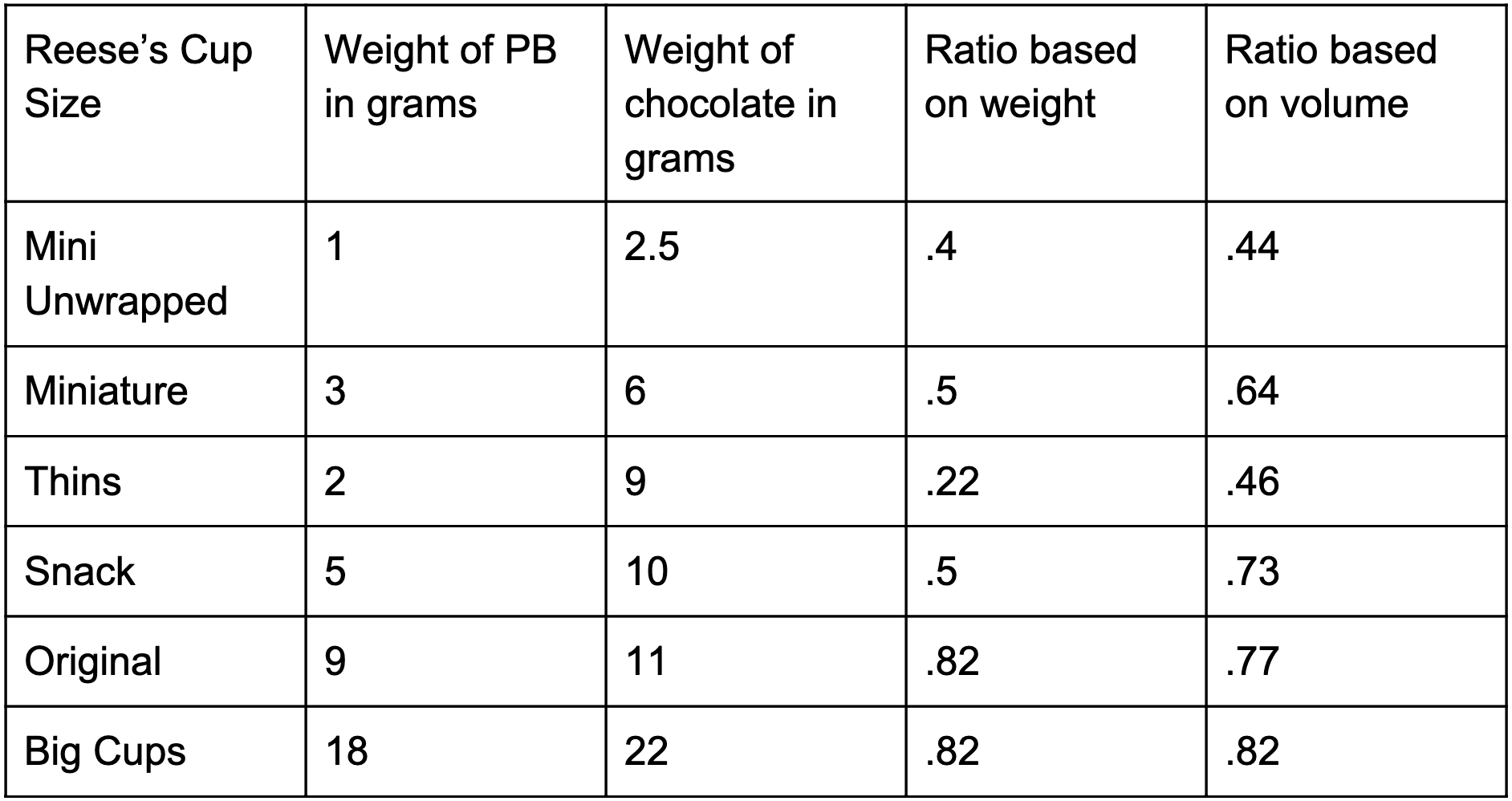
Some of the results were surprising. For example, the ratio of peanut butter to chocolate is roughly the same in the big cup as in the original size. The big cup has a thicker chocolate shell to compensate for the large hunk o’ peanut butter inside. The snack size and miniature cups have slightly less peanut butter. And the least amount of the peanut butter filling shows up in the minis and the thins.
So what does it all mean? Well, even starting with the same base ingredients, the ratio of chocolate to peanut butter filling and the shape of the cup itself change the experience of eating it. But it still feels very personal. My appreciation of peanut butter in sweet applications is a fairly recent development, and still pales in comparison to my appreciation for chocolate. It is natural that I would gravitate toward the versions with less peanut butter. The minis, in that sense, are still better than the original. However, I have a new favorite—the thins. These have a similar amount of chocolate and peanut butter as the minis, but there is a thin disc of peanut butter instead of a glob. It’s more satisfying to eat.
I also have to make note of the sweetness. I had assumed that the milk chocolate shell would carry the bulk of the sugar. I was wrong. The peanut butter itself is sweetened. Cups with more peanut butter add both more salt and more sweet.
In the end, my friend and I were both right. The mini peanut butter cups do taste less sweet—and it is because they have more chocolate. Now I know, and I got to eat a whole lot of chocolate in the process.
Rachel Hergett is a foodie and cook from Montana. She is arts editor emeritus at the Bozeman Daily Chronicle and has written for publications such as Food Network Magazine and Montana Quarterly. Rachel is also the host of the Magic Monday Show on KGLT-FM and teaches at Montana State University.