

Funding gap has canyon sewer initiative on stand-by; $50M project would offload nutrients from Gallatin River
By Jack Reaney SENIOR EDITOR
Anyone have $10 million lying around?
Big Sky is roughly that sum away from affirming itself as one of Montana’s leading communities with regards to its wastewater treatment, infrastructure leaders say.

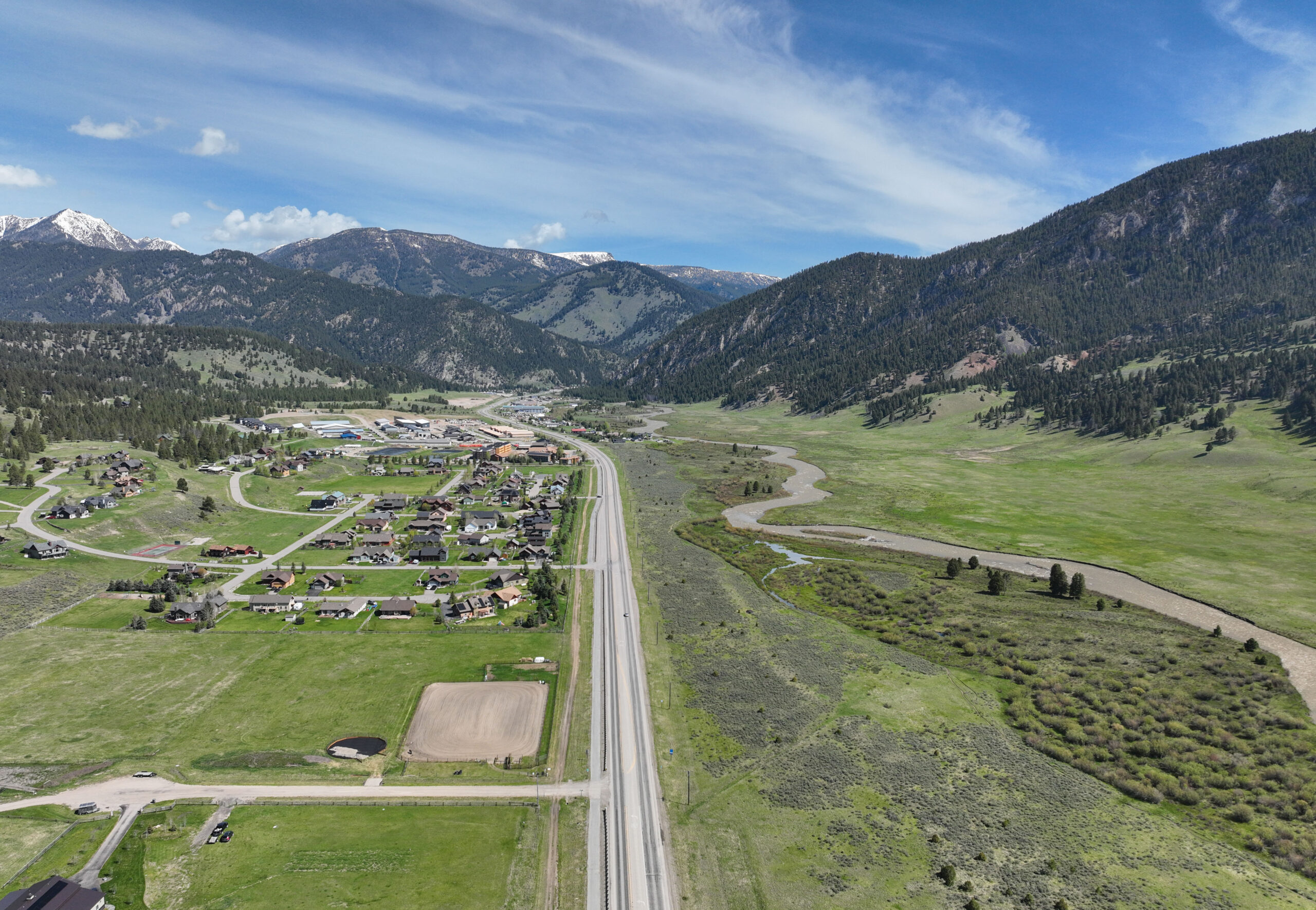
But without the funding, Big Sky’s wastewater treatment could remain a clash between two extremes: for most of the community, treatment is “probably the best in the state… potentially the region” with a new, top-notch $50 million Water Resource Recovery Facility; but the Gallatin Canyon portion of Big Sky—including the Lazy J commercial area and the Ramshorn, Buck’s and Quarry neighborhoods—continues to treat wastewater using a scattering of sub-optimal, decentralized septic systems.
“Two miles down the hill from that ‘best-in-state’ system, is potentially the worst-in-class,” said Mace Mangold, an engineer and project leader with WGM Group, at the Feb. 11 Resort Tax board meeting.
Mangold described the dire funding needs for the long-anticipated Gallatin Canyon sewer project aiming to rid the area of its septic systems, many of which are believed to release significant nutrients into the groundwater adjacent to the Gallatin River.
If built, the new centralized sewer would collect and pump wastewater to Big Sky’s WRRF to be treated to Class A-1 standards and reused through irrigation and snowmaking. In the opposite direction, purple-pipe infrastructure would provide reuse options for BSCWSD’s highly treated wastewater through groundwater discharge and irrigation, as part of Big Sky’s commitment to avoid discharging into the river as most communities, like Bozeman, do.
The project has been delayed by rising costs, and 2026 will be a make-or-break year with decision time looming in early 2027. A chance to improve the future health of the Gallatin River may come down to money.
Originally, the project was estimated at $42.75 million.
It’s now expected to run $50 million, due to an increasingly costly challenge: sewer pipes would need to run alongside a narrow, two-mile stretch of Montana Highway 64, requiring expensive engineering and timely collaboration with the Montana Department of Transportation.
“That is our hurdle,” Mangold said in his presentation to the Resort Tax board. “That really has been our slowdown for the last year… five years ago, it was a $12 million estimate. Our best guess is it’s about a $20 million scale.”
The remaining $30 million cost includes construction, subsidizing connection costs for property owners, and purchasing treatment service at the WRRF from the Big Sky County Water and Sewer District, a separate entity from the Gallatin Canyon County Water and Sewer District.
Mangold said the current situation has the project at a “funding crux,” in which existing money must be spent soon to preserve future matching funds. But today, the existing money isn’t enough to guarantee a finished product, so the project is not shovel ready.
By early 2027, leaders need to solidify the true costs and assemble a reliable financing stack, as well as a plan with the Montana Department of Transportation. It’s nearly decision time.
“So that’s our present-day status, and our crux point,” Mangold said.
‘We’re behind this project’
Resort Tax board member Michelle Kendziorski commented on the project’s merit.
“I think BSRAD was put in place for infrastructure, and water is a piece of that. I really do think this is important, Kendziorski said. However, she urged the canyon district to finalize a plan as soon as possible and expressed concern that the Big Sky Resort Area District is being tasked with so much funding.
BSRAD has invested $1.4 million since 2020 into the canyon project, also setting aside $12 million from the 1% for infrastructure that has not yet been allocated or spent. The only other funding source is federal: in 2021, the project earned a $2 million American Rescue Plan Act grant through the state plus another $950,000 ARPA grant distributed by Gallatin County. User fees will eventually cover roughly $10 million in debt, but first, the canyon sewer district needs to close an additional gap of at least $10 million.
“If this project is going to be successful, it has to be a lot more than Resort Tax,” board member Kevin Germain added. “We don’t have the money to do all the things that water and sewer needs, the fire department needs—what this community needs… We’re behind this project. We want to see it succeed. But we need help, it can’t just be us.”
BSRAD Executive Director Daniel Bierschwale said the project is currently “not financially feasible” for BSRAD to fund beyond its current commitment of $200,000 per year and the $12 million earmarked from 1% collections.
Expensive up-front, the infrastructure could enable long-term financial benefits.
For one, the sewer design would enable BSCWSD to dispose of some of its water downhill through groundwater discharge and irrigation, saving upwards of $10 million compared to pumping uphill over the next five to 10 years. In addition, BSCWSD would be paid by the Gallatin Canyon district for treatment and reuse.
Board member Sarah Blechta highlighted another advantage: snowmaking infrastructure can expand with a higher volume of treated wastewater. Big Sky Resort recently joined the Spanish Peaks and Yellowstone clubs in earning a permit to make snow using recycled wastewater, and a robust snowmaking system would support tourism and bolster Resort Tax collections in dry winters. Plus, a human-supported snowpack may support aquifer recharge each summer.
If funding falls short, here’s plan B: Mangold said the canyon district will likely still construct a sewer, but instead of connecting to the WRRF, the district would pump wastewater to a smaller, less sophisticated, and somewhat redundant treatment plant.
“Why build another treatment plant when you’ve got best-in-class right up the hill, two miles away,” Mangold said. “… And you’re gonna end up with a lesser solution. You’re gonna end up with a sub-$20 million solution that’s going to fix one-third of the canyon.”
Leaders need buy-in for key funding tool
As project costs ballooned over the past two years, leaders approached the Gallatin County Commission for approval to create a targeted economic development district, or TEDD, to keep the project financially feasible and help subsidize adoption costs for property owners.
A 2024 financial feasibility study determined a TEDD would be key to cover the $10 million gap, as grants of that size are highly competitive and unreliable. Mangold believes the canyon sewer project is the “poster child” for the kind of infrastructure TEDD is designed to fund.
In October 2025, Gallatin County Commissioner Zach Brown announced the county would not support a TEDD, noting that private developers of the sizable Quarry neighborhood, alongside public funding from BSRAD and BSCWSD—plus “corporate firms” with stakes in Big Sky—should be able to foot the bill. Brown’s primary concern is his view that a TEDD proactively incentivizes development, and he compared the situation to Bozeman’s “infill development” downtown.
Mangold said that while TEDD can sometimes be used as a catalyst to incentivize development, this case is different because the primary goal is environmental-infrastructure-based, not economic.
“It’s fundamentally a tool to fix infrastructure deficiencies that likely won’t fix themselves… It’s better development while fixing an existing problem to the environment, so it has this double-benefit that most TEDDs don’t,” Mangold told EBS in a phone call. “… And without it, you’re potentially going to get neither.”
County commission approval is required to create a TEDD.
The sewer project was such a sure thing—or so it seemed, two years ago—that Gallatin County approved the Quarry subdivision for construction using temporary septic infrastructure, under the pretense that developers would soon flip a switch onto the new sewer system. Quarry developers argued the neighborhood would support project affordability by providing a large user base.
“I appreciate all the effort that is going on up there to eventually connect this development as well as neighboring properties that are on well and septic—many of which are deteriorating—to central water and sewer district… and my support for The Quarry project is contingent upon that eventual connection,” Brown said in March 2024, reported by Laurenz Busch of Bozeman Daily Chronicle. “This would be a really inappropriate place to [stay on septic] given the underlying groundwater and health and safety concerns.”
The county’s approval came within a year of the Gallatin River’s impairment designation in spring of 2023. Still, leaders felt confident that the sewer would alleviate any environmental concerns created by the Quarry.
Mangold said the Quarry’s septic infrastructure is “very good quality” but inferior to the sewer system. And without the sewer, it’s an additional 135 homes plus apartment buildings and commercial space—adding to an area already full of septic systems within walking distance of the Gallatin River.
So, despite Gallatin County’s serious concern about the project failing, the commission 19 months later rejected a funding scheme that would make the project possible.
“There’s no bluffing going on here,” Bierschwale said Feb. 11. “We’re at a position where, either we have the money and we have the solution with the county, or we don’t. And so I would advocate to the community: Do you want to see the canyon district happen? We need to be advocating at the Gallatin County Commission, massively, right now or this is going to fail. Period.”
If the county continues to oppose a TEDD and insists on leaving environmental infrastructure in the hands of private developers, “the project has the potential to die,” Mangold said. The result could be another pocket of flawed infrastructure like the current crisis in Firelight Meadows.
“We will just be forced to fix the problem again. Big Sky continues to have to fix the problem, time and time again,” Blechta said. “… A huge waste of time because it’s just going to cost us more in 20 years.”
Mangold hopes to warm Gallatin County up to that reality.
“Without a TEDD, we need to chase more money, and we need letters of support, and we need [Gallatin] County to be a co-applicant on bigger grants… We need $10 million scale. And that’s either a TEDD component, or federal grant component,” Mangold explained. Gallatin County will need to be a partner in either scenario.
On Feb. 23, the Gallatin County Commission sent a letter to DEQ asking the agency conduct a “comprehensive” Montana Environmental Policy Act study on the project. The outreach was lauded by conservation groups including Upper Missouri Waterkeeper, Gallatin River Task Force, American Rivers and Greater Yellowstone Coalition.
The opinion of those organizations may decide the project’s fate.
“If this is something that we are collectively working towards, with the main goal being improving the quality of our impact to the river, we need the conservation groups to really be on our team with this,” Bierschwale said.
“We need to hear from them resoundingly that they’re behind this,” Germain added.
Mangold said the project team is working to re-engage various groups and earn letters of support.
Kristin Gardner, GRTF chief executive and science officer, shared a statement via email with EBS regarding the project.
“The Gallatin Canyon sewer project has the potential to be one of the most important investments we can make in the long-term health of the Gallatin River. By replacing septic systems with modern infrastructure, we reduce nutrient pollution at its source and protect water quality for future generations,” Gardner stated.
Germain highlighted Upper Missouri Waterkeeper as a make-or-break partner. The nonprofit recently expressed “tentative support” for the project but later sued Montana DEQ for its approval of a recent canyon sewer deviation application—a very small piece of the project related to Montana Highway 64 navigation.
Germain noted it could derail the project if legal fees were layered onto a tight budget.
Matt Elsaesser, Waterkeeper’s deputy director, chimed into the BSRAD meeting to clarify that the recent lawsuit “really was about the overall public process and transparency with the agencies,” and added that he sensed “a lot of agreement” among Big Sky leaders that an environmental assessment of the the canyon sewer would be a worthwhile component of the project.
In a follow-up email to Explore Big Sky on Feb. 26, Elsaesser provided a statement from Waterkeeper regarding the group’s stance on the project.
“Solving the well-established ecological and public health challenges presented by legacy septic in Big Sky and the Canyon Area remains critical to restoring and protecting the Gallatin River’s health. For rural communities across the West, centralized treatment remains a bang-for-buck solution offering better pollutant control, enforceable sideboards guaranteeing accountability, and pooled use of scant resources.”
Elsaesser added a caveat urging full transparency from state agencies, including a “robust” framework of public participation framework. The statement echoes years of litigation by the group against Montana DEQ for its approval of the Quarry subdivision, including the recent lawsuit related to the canyon sewer project.
“The Gallatin is too important for anything other than the highest standards of care and full disclosure of all infrastructure proposals, their relationships, their impacts, and alternatives, before any decisions are made,” Elsaesser stated. “Transparency combined with proven solutions to water pollution is the best approach to securing both public and private support, and critical funding.”
Project leaders will continue discussions in March, involving conservation groups, BSRAD and BSCWSD.