

Tracking the wild in Yellowstone’s snow
By Benjamin Alva Polley EBS COLUMNIST
On an unseasonably warm March evening near Pray, Montana, while most visitors scan the horizon for the quick thrill of a wolf sighting, Jim Halfpenny is more interested in what’s under their feet.
For Halfpenny, the story of the wild is written in clues: a faint scuff in the snow, a distorted paw print cast in plaster, a broken bison vertebra, a raven’s GPS trace arcing across a digital map. To walk with him through his research center in Gardiner, is to realize that almost everything you thought about wildlife was a rough draft. He’s been working on the second, third, and fourth drafts for decades.

Halfpenny introduces himself modestly: not as a “wolf biologist,” but as an ecologist whose world is cold. He defines his specialty with three words—latitudinal, altitudinal, seasonal—and that triad has pulled him from the alpine tundra of Colorado to the polar deserts of Greenland, from Yellowstone’s Lamar Valley to Antarctica. He has worked on all seven continents, in countries including Japan, Greenland, and New Zealand, he led American expeditions to East Greenland in the 1970s, and he wears the Antarctic Service Medal to prove that his affinity for the cold is not a metaphor.
Yet for many in the Greater Yellowstone ecosystem, he is first and foremost the man who can read a track the way other people read a book.
A detective of the snow
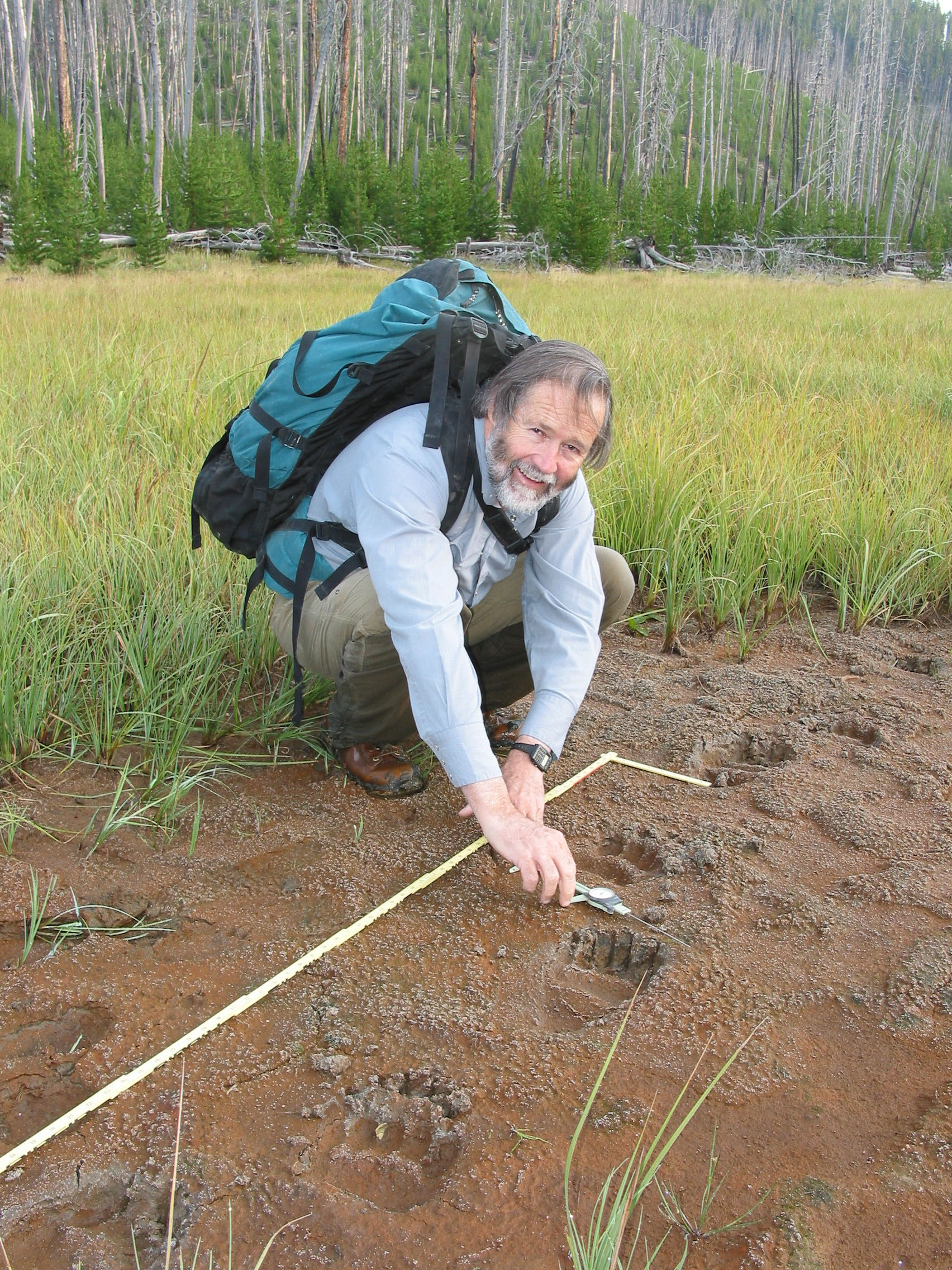
Halfpenny came of age in a world that no longer exists. In the 1950s in Scottsbluff, Nebraska, his parents would hand him a can of Vienna sausages, a can of mandarin oranges, and a can of plaster of Paris and tell him to “go track raccoons.” He did. By his own account, he had memorized every natural history and polar exploration book in the local library. Ernest Thompson Seton’s “Hunter’s Signs” and “Animal Tracks” was a favorite and a blueprint.
By age 14, hunters were paying him to do what he would have done for free: find wounded animals they had shot and lost. Long before “forensic wildlife tracking” was a buzzword, Halfpenny was quietly inventing it.
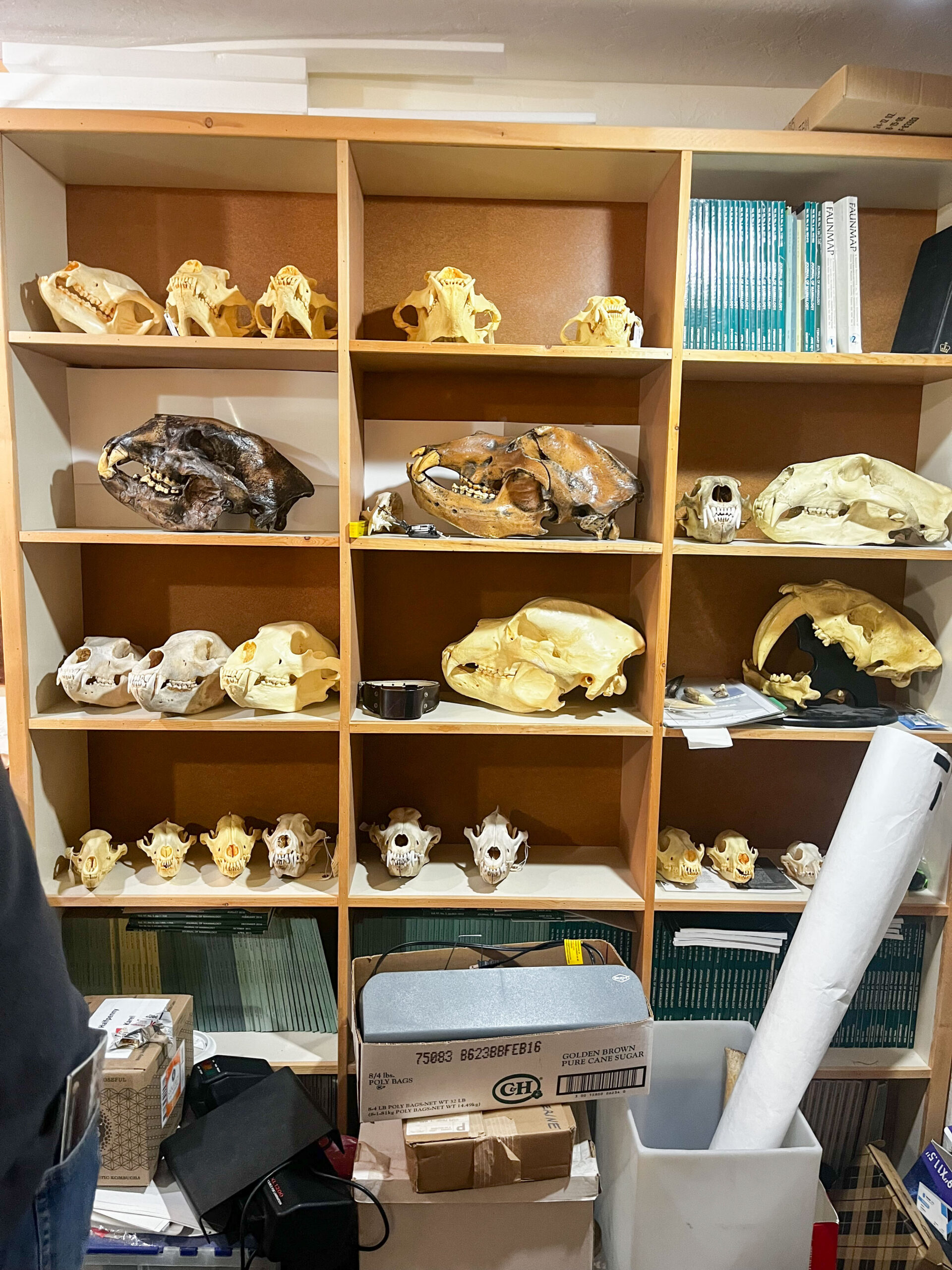
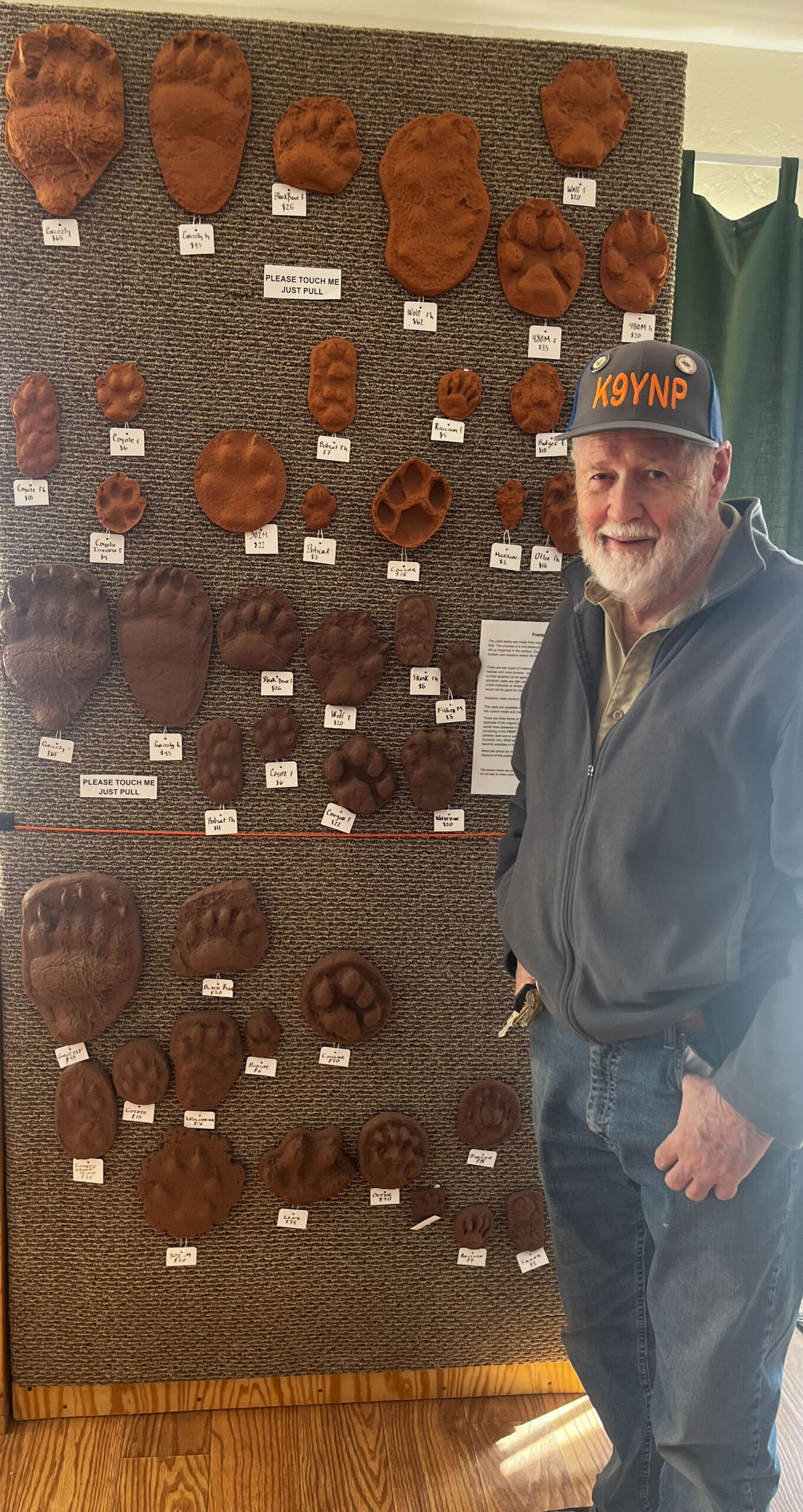
Today, he wears blue jeans, a gray fleece and a gray baseball cap embroidered with orange letters spelling K9YNP, his ham radio call sign. In the basement classroom of his Gardiner Track Education Center, those early obsessions have solidified into an astonishing archive. There are collections of hair and scat, bones and skulls, and more than 10,000 plaster casts, as well as digital and 35millimeter images of tracks—wolves, coyotes, cougars, wolverines, lynx, bears even Bigfoot. Each supposed bigfoot track is carefully labeled, not because he believes in the creature, but because serious trackers must be willing to seriously debunk.
The cases are arranged by what he calls the cardinal rule of evidence: “the more important the case, the worse the evidence.” On the top shelves sit pristine, museum-quality casts. As you look downward, the tracks get messier: partial impressions, distorted snow melt, three‑toed wolves that lost digits to being stomped on by large ungulates. These are the real‑world tracks that confound biologists and game wardens, the tracks he has spent a lifetime teaching people to interpret.
He’s not content with dirt and snow, either. Halfpenny helped pioneer the use of track plates—chalked or sooted surfaces laid over adhesive paper, baited to tempt passing animals. When the animal crosses, it leaves a perfect, ink‑like print. He has binders of plate prints from across North America, and he literally wrote the manual that federal and state biologists use to distinguish marten, fisher, wolverine and Canada lynx.
In an era obsessed with GPS collars and remote cameras, Halfpenny’s devotion to footprints might seem quaint or obsolete. It isn’t. It’s subversive. Trackers, unlike instruments, must be physically present. They must slow down. They must pay attention.
The man behind the wolf charts
Halfpenny’s name is now inseparable from Yellowstone’s wolves. He started working with them in 1975, decades before the famous 1995 reintroduction from Canada. When wolves began moving down from British Columbia into Montana, someone had to answer the rancher’s million‑dollar question: “Who ate my prize sheep?” Halfpenny was the one called to tell a wolf from a dog, a cougar from a bear, by the tracks and signatures they left behind.
When the reintroduction finally happened, the federal government funded the capture, transport, and initial release of wolves into Yellowstone and central Idaho—and little else. Salaries, flight time, radio collars, and long‑term monitoring would rely on ingenuity and donations.
Halfpenny’s contribution was the wolf chart—an annual “playbill” of the wolf cast in the Yellowstone theater. Each pack appears in a distinct color, alpha male and female at the top, subordinates below, with colors following dispersers as they move to other packs, revealing genealogies at a glance. The charts became coveted wall art for wolf watchers, and a funding stream: money from every chart sold goes to the Yellowstone Wolf Project.
From that simple idea sprang something extraordinary: a full genealogy of the Yellowstone wolf population. Combining field observations from an army of wolf watchers with PhD‑level genetic work, Halfpenny and collaborators, Leo Leckie and Shauna Baron, built an exhaustive family tree with over 1,200 animals. When they approached Ancestry.com to host it, the company at first assumed they meant humans. After “half a dozen calls” and some disbelief about “animals,” the wolf tree went live. Schools now use it to teach genetics and ecology; fans follow their favorite wolves the way others follow sports teams.
On the 25th anniversary of reintroduction, Halfpenny and coauthors turned the charts into a phone‑book‑thick volume: every chart since 1995, plus short biographies of the first 1,300 wolves. For the 30th anniversary, having learned the limits of human endurance, they picked 22 particularly famous wolves and the breeding alphas of each extant pack, giving 40 individuals full‑page biographies and genealogical “fan charts.”
Wolves like 907F, who ran blind in one eye into her 12th year, with a lineage stretching back to the original Canadian founders. Wolves like 13M, “Old Blue,” a shy alpha whose mate stayed by his body for days after his collar switched to mortality mode, then tracked the pack through the snow to rejoin them. Wolves like 253M, who survived being hamstrung by a rival, limped across states, was trapped and relocated twice, became the alpha male of two packs in Jackson Hole, and was ultimately the first legally harvested wolf there at age seven.
These are not abstractions in population models; they are individuals with histories, injuries, strange journeys, and descendants. In a policy debate that too often collapses wolves into symbols—of wilderness, of federal overreach of rural resentment—Halfpenny insists on the concreteness of their lives.
Between biology and politics
Halfpenny is blunt about the politics that swirl around wolves and bears. He has spent enough nights in backcountry cabins, enough days in agency meetings, to know that science doesn’t float above politics. Rather, it slogs through it.
On proposals to remove federal protections for grizzlies and wolves, he returns to first principles: the Endangered Species Act was designed to recover species to the point where states could manage them, not to confer permanent federal guardianship. By the federal recovery criteria originally set for wolves in the Northern Rockies, he argues, those goals have been met. Montana alone now has about 120 packs and well over 1,200 wolves.
But he also knows how numbers can hide value. From a population standpoint, the loss of a few habituated Yellowstone wolves that wander over the park boundary each year and get shot is “not that big of a deal.” From a scientific standpoint, losing a wolf with seven or eight years of radio‑collar data and a known place in that vast family tree is a gut punch.
He’s not naïve about state politics, either. “Trust but verify,” he says of state management plans. The real target for wolf numbers, in his view, is not the bare minimum to avoid genetic collapse, nor the maximum fantasy of those who’d prefer a landscape untouched by livestock and people. The target is a messy, shifting “social level” of wolves that human communities will tolerate.
If that sounds unsatisfying, that’s because it is. “Ecology rarely offers clean answers,” he said to a fireside chat at Sage Lodge near Yellowstone’s north entrance. As he reminds audiences, in biology there is rarely a single cause; the “answer equals A plus B plus C plus D.”
“Are Yellowstone’s riversides recovering because wolves reduced elk browsing, or because of climate change, or beaver activity, or human land use? Likely some mix of all of the above, with different weights in different valleys,” he said.
The measure of a life’s work
Jim Halfpenny’s CV is long and decorated: PhD in biology, ecology, and mammalogy from the University of Colorado; former director of the Mountain Research Station and its Long‑Term Ecological Research program; past senior instructor and board chair at NOLS; Fellow of the Explorers Club; and Vietnam veteran with the Navy Achievement Medal with Combat “V.” He appears in multiple editions of “Who’s Who.” He’s also authored at least 26 books, 15 plastic laminated guides, and eight CDs and videos.
But those bullet points don’t fully capture the impact of his work.
You see it instead in quieter things: in the kid who downloads his Yellowstone wolves app and realizes that wildlife is not an amorphous mass but a set of individuals with birthdays and death dates and cousins; in the state biologist who peers at a blurry snow track and, thanks to Halfpenny’s manuals, can say with confidence whether it belonged to a marten or a wolverine, a coyote or a wolf; in the volunteer who learns from him that wolves and grizzlies don’t just “compete” in some abstract way, but negotiate each carcass with hunger, numbers and social ties.
In a time when conservation fights are increasingly fought on screens and in courtrooms, Halfpenny’s legacy is deeply, insistently physical. It resides in plaster, in chewed bones, in broken vertebrae, in chalk dust, in snow pits dug year after year to measure how winter itself is changing.
It is easy to argue about wolves in the abstract. It is harder and more honest to bend down next to a track, place your hand against it, and imagine the living animal that made it. Jim Halfpenny has spent a lifetime helping the rest of us do exactly that.
Benjamin Alva Polley is a place-based storyteller. His words have been published in Rolling Stone, Esquire, Field & Stream, The Guardian, Men’s Journal, Outside, Popular Science, Sierra, and WWF, among other notable outlets, and are available on his website.