

Budget deficit is draining reserves as BSFD commits to maintaining emergency services
By Jack Reaney SENIOR EDITOR
The background and fallout of Gallatin County’s $8.3 million tax error impacting the Big Sky Fire District is well understood. The path forward remains painful, and fire district officials hope the Big Sky Resort Area District can provide some additional short-term funding.
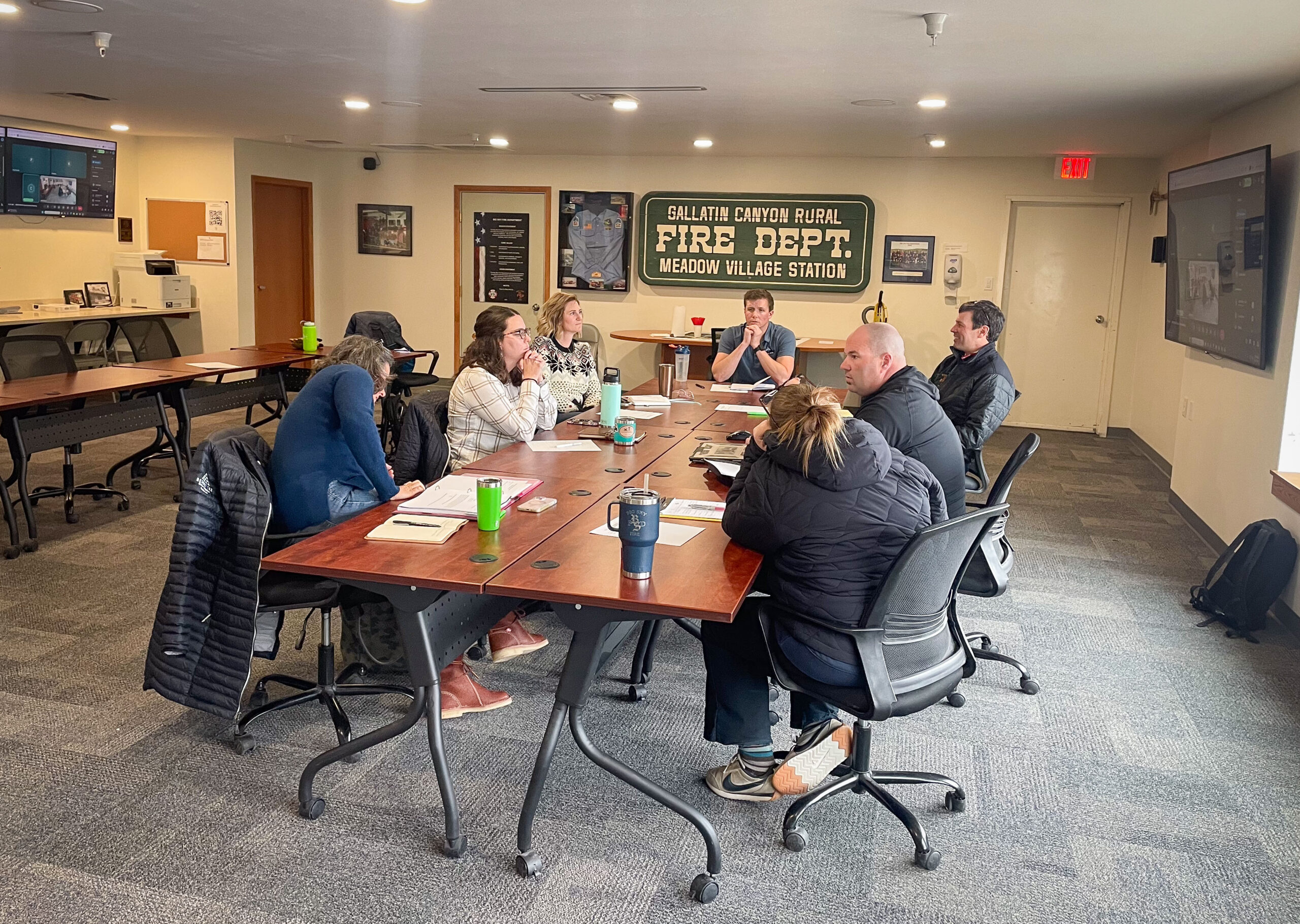
On Tuesday, March 31, the fire district board hosted a BSRAD subcommittee to review and evaluate the existing interlocal agreement between BSRAD and BSFD—a three-year funding agreement totaling $3.55 million, with one year remaining. The fire district said it plans to ask Resort Tax for an additional $900,000 for fiscal year 2026-27, through an amendment to the current agreement.

Resort Tax board member Sarah Blechta said the subcommittee pushed for a meeting because BSRAD needed to know what kind of emergency support the fire district planned to ask for. Board member Grace Young also asked for more clarity.
“To help us plan better, we need to ask for more forecasting… We need the long term,” Young said. “We need to know: is this a two-year request? Is this a 10-year request?”
Fire district board member Matt Dodd said the money would help offset immediate budget shortfalls and allow BSFD to maintain its emergency response capabilities. He noted that $900,000 represents roughly one-quarter of the three-year, $3.55 million agreement, and that the fire district’s external finance officers recommended asking for $2 million. The board agreed that $2 million would be an unreasonable request.
“What we’re not going to do is keep going back to BSRAD and saying, you need to keep propping us up,” Dodd said.
Now facing a $2.3 million budget shortfall year-over-year, BSFD is operating under a structural budget deficit of roughly $400,000 this year, and a projected deficit of $740,823 for next year. Currently, BSFD is burning through operational reserves which are held for emergencies like this.
“The $900,000 ask allows us to cover that shortfall, and cover some of the shortfall this year, which allows us, big picture, to keep operational reserves that frankly, we need. We need those operational reserves in large part because we don’t know what’s going to happen next year… but we do know that the community is growing,” Dodd said.
Blechta said the BSRAD subcommittee is grateful for the meeting with BSFD, which helped dig into the complexities of a difficult situation impacting the community.
“The meeting was productive, and we are now focused on getting the remaining questions answered—work the department is actively undertaking—ahead of the April 15 meeting,” Blechta stated in a follow-up email to EBS.
Staff salaries dominate budget: ‘We’re burning through money’
The fire district’s call volume is increasing at a compounding rate of 10 to 12% every year. In 2017, BSFD received 416 calls and employed 21 full-time staff. By 2025, BSFD received 1,560 calls—nearly quadruple the volume in eight years—and staff had nearly doubled to 41.
Even with local trends showing a stagnant or declining year-round population—with shrinking enrollment impacting local schools, for example—visitation and tourism continues to grow, and BSFD gets more calls.
Furthermore, BSFD is committed to paying a living wage. Only six of its 41 union staff live in Big Sky; Dodd said it’s a testament to BSFD’s strong working conditions and pay that firefighters are willing to put their lives on the line for a community where they don’t live. But being a regional leader in firefighting costs more, Dodd explained.
The fire department currently allocates 94.65% of its total budget toward wages, salaries and benefits. Operating expenses represent just over 5% of BSFD’s total budget.
“I don’t know how to cut it any leaner than that,” Dodd said. “… That’s the biggest struggle we have, is we are burning through money. And we’re burning through money to support the guys that are out protecting the community.”
BSFD administrators took a voluntary 5% salary cut, and the district is currently in regular negotiations with its firefighters union—regardless of the tax issue, the union’s current contract was set to expire June 30—with the goal of reducing payroll in response to budget challenges. Union President Chris Laukant thanked BSRAD for considering the stopgap funding adjustment.
BSFD also opted to not hire four recommended full-time positions this year, which saved $400,000 to $600,000.
Other budget cuts included snow removal, protective gear and uniforms, medical supplies, heavy equipment purchases, and two-thirds of the budgets for outside training opportunities and heavy equipment maintenance.
“Every single thing that’s on a line item has been assessed and re-assessed, and re-assessed,” said Division Chief Jeff Bolton. “… The PPE and uniforms, and all those things got cut down as well.”
If anything is in question, it’s the district’s decision to proceed with the cash purchase of a $1 million parcel beside its training facility. Fire district leaders have justified the time-sensitive opportunity to acquire three-plus acres of Big Sky land for that price, especially land adjacent to existing facilities, but many community members have expressed disapproval.
“The public perception is your reality, and the fact that you bought the land is just a bad public perception, whether you had [cash] in the reserves or not,” Blechta said, adding that while the purchase will be a “great asset” long-term, it may have been wise to finance the purchase. “… You have to, at some point, start thinking with a PR hat.”
Board chair Carol Collins noted that the $1 million came from capital reserves, not operating reserves—it could not legally be reallocated toward wages or other operational costs.
Dodd acknowledged the pushback, and reminded the public of the land’s purpose, which is to serve as a public safety center, replacing the current fire station and Gallatin County Sheriff’s Office.
“Long-term it’s going to allow us to increase our service district, which lowers ISO scores for all the homeowners in the district, hopefully saving them some money,” Dodd said.
In general, Dodd acknowledged the importance of explaining how BSFD found itself in the current situation, and how it plans to avoid a similar crisis in the future.
He emphasized that as far back as 2023, former Fire Chief Greg Megaard and his to-be successor, Dustin Tetrault, approached Gallatin County with concerns about the tax collections. They were reassured that all is normal.
Still, in 2024, Chief Tetrault escalated the question to the Montana Department of Revenue, and BSFD received the same assurance. Only after Tetrault continued to push—including similar questions to Madison County—did the problem finally emerge.
“Part of [Chief Tetrault’s] mission has been transparency,” Dodd said. “And—good, bad or otherwise—it has been transparent. And it’s ruffled some feathers in town, but that’s what needed to happen, frankly… You shine a light on things, and things get figured out awful quick.”
BSFD will formally present its ask during the April 15 Resort Tax board meeting.