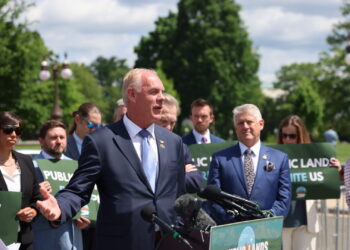


Attorney General Austin Knudsen issued a cease-and-desist letter claiming the local prosecutor was noncompliant with state law.
By JoVonne Wagner MONTANA FREE PRESS
Montana Attorney General Austin Knudsen has accused the Gallatin County Attorney’s Office of improperly withholding confidential criminal justice information from federal immigration authorities and demanded that the local prosecutor’s office reverse its position.
Knudsen made the assertions in a Thursday press release announcing a cease-and-desist letter sent to Gallatin County Attorney Audrey Cromwell. The letter is the second such cease-and-desist letter Knudsen has issued in recent months to a local municipality regarding its relationship with federal immigration authorities. Helena received a similar letter from the attorney general in March claiming that a recent resolution violated Montana’s 2021 law banning “sanctuary cities.”

In his more recent letter, the attorney general’s office said that the Gallatin County prosecutor’s office had a “policy” not to recognize U.S. Immigration and Customs Enforcement as a law enforcement agency entitled to receive certain confidential information.
To illustrate the county attorney’s stance, Knudsen referenced an October email from Cromwell’s executive assistant, attached to the cease-and-desist letter, stating that the prosecutor’s office “does not legally recognize” ICE as an agency that is entitled to receive confidential information under Montana’s Confidential Criminal Justice Information statute. The letter said that ICE could still file a standard waiver request for such information, as any member of the public can.
In his letter, Knudsen stated that the Gallatin County attorney’s position was “legally incorrect and inconsistent with Montana law.” That state law defines a criminal justice agency as any federal, state or local government agency, designated by statute or by the governor, and that performs “the administration of criminal justice” as its “primary function.”
In an emailed statement Thursday afternoon, Cromwell said that the county information requested by ICE last fall was “nonpublic” regarding an individual in a civil matter. In that case, Cromwell said, her office had determined that ICE was not acting as a criminal justice agency. The attorney’s office then advised that a District Court judge would be able to determine whether that information should be released, Cromwell said. Her statement went on to specify that there is “no blanket policy” that prohibits cooperation with ICE.
“To reiterate, there is no overarching policy at play,” Cromwell said. “Each request, whether from a federal agency, state agency, local agency, press, or a member of the public is evaluated individually, and our office applies Montana law to determine whether dissemination is permitted. Montana law clearly reflects that Montanans have a heightened right to privacy, and that principle is embedded throughout our evaluation process.”
“My role as County Attorney is to ensure that Gallatin County complies with the law while also protecting the County from unnecessary legal exposure. That includes carefully safeguarding confidential information and respecting the privacy rights guaranteed under Montana law,” Cromwell’s statement continued. “Ultimately, our obligation remains clear, to uphold and protect individuals’ constitutional right to privacy as required by Montana law. I look forward to responding further to Attorney General Knudsen on this matter.”
Other Gallatin County officials were unaware of Knudsen’s letter before being contacted by Montana Free Press. In a written statement, the Gallatin County Commission said it could not speak to the “internal decisions or communications” made by Cromwell, a separate elected official, but said the county has directed its own staff to “work with ICE in the same manner that we would with any other Federal agency partner.”
“Our staff has to process questions about accessing criminal justice information the same way for all external agency partners. There is no ‘policy’ in Gallatin County directing our staff to recognize ICE any differently than other federal law enforcement agency, nor is there any legal opinion of this sort that the Commission is aware of,” the statement said.
Knudsen directed the county attorney to immediately recognize ICE as a criminal justice agency by revoking the policy and demanded that the local office communicate with the attorney general by Monday, April 6, to share any relevant communications regarding the policy.
“Let me be clear: Montana is not California,” Knusden wrote in the letter. “This state does not embrace policies that isolate our law enforcement partners or undermine the enforcement of duly enacted federal laws. Montana supports cooperation among all levels of law enforcement, including ICE, to ensure that our communities remain safe and that the rule of law is upheld.”
Knudsen’s outreach to Gallatin County comes just a week after the city of Helena rescinded its own immigration resolution that advised the Helena Police Department to “avoid” working with ICE. That January resolution was the subject of the attorney general’s March cease-and-desist order.
Helena hired Missoula-based attorney Natasha P. Jones to provide legal counsel on the case. During a multi-hour public meeting last month, Jones recommended that the city rescind the resolution to avoid a lawsuit with the attorney general, citing significant legal and budgetary risks.
After the Helena City Commission voted 4-1 to scrap its resolution, both Knudsen and Gov. Greg Gianforte said the city made the right choice.
“The commissioners made the right decision voting to keep the Helena community safe,” the attorney general wrote in a statement. “This resolution should never have been passed in the first place. My office will continue to hold any jurisdictions in violation of Montana’s sanctuary city prohibition accountable.”
“In Montana,” Gianforte wrote in a Facebook post, “we banned sanctuary cities to keep our cities safe. The City of Helena made the right decision to rescind its resolution and allow the Helena Police Department to continue its cooperation with federal immigration authorities.”