


By Tyler Allen EBS Senior Editor
BIG SKY – President Barack Obama on Aug. 31 began a three-day trip to Alaska and touched off his visit with a blunt warning about human-caused climate change.
“Human activity is disrupting the climate, in many ways faster than we previously thought,” Obama told an international conference on the Arctic, at Anchorage’s Dena’ina Civic and Convention Center. “The science is stark. It is sharpening. It proves that this once-distant threat is now very much in the present.”

The president spoke about the effects of a warming globe on the country’s only Arctic state, including a fire season that’s a month longer than it was in 1950; how more than 5 million acres of Alaska had burned this summer; and that during the past six decades, “Alaska has warmed about twice as fast as the rest of the United States.”
The speech was the president’s gravest warning about climate change to date, and he continued his trip the following day in Seward, speaking to reporters with the Exit Glacier as a backdrop. The iconic, 2-mile-long glacier has retreated more than 800 feet since 2008, according to satellite data.
Big Sky resident and glaciologist Twila Moon also uses satellite data, studying the ice sheets atop Greenland and Antarctica as she creates a new dataset to document their ice loss. The two landmasses are home to the only two ice sheets on the planet, while the rest of Earth’s persistent ice is found in ice caps and glaciers, like Alaska’s Exit Glacier.
Ice sheets are so massive that their movement isn’t controlled by the terrain beneath them – like glaciers and ice caps – rather their interactions with atmospheric and ocean temperatures, as well as gravity. Satellites are the only viable way to study them on a global scale, along with their effect on rising sea levels.
If all Greenland and Antarctica’s ice melted, global sea levels would rise approximately 66 meters. While that may be centuries away, if ever, projections are virtually standard in the scientific community that a 1-meter average rise in global sea levels is likely by 2100.
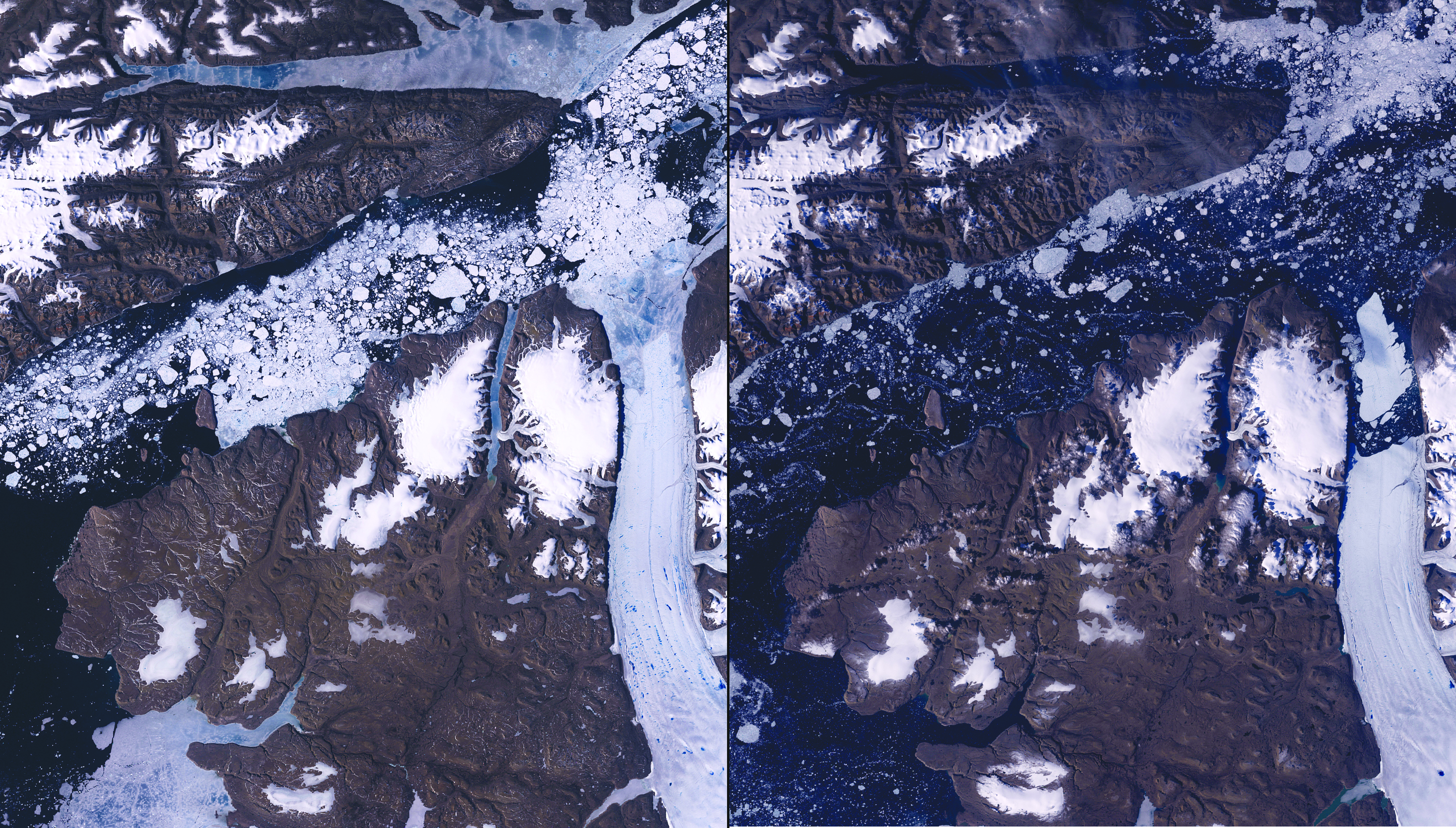
“The good thing is that there’s more than one way to measure how much ice there is, and how much we’re losing,” said Moon, a National Science Foundation postdoctoral fellow at the University of Oregon. “We want to be able to measure it more than once – it gives us a lot of confidence in knowing how much we’re losing and how quickly.”
On May 30, 2013, data from the Landsat 8 satellite became available to Moon and other researchers around the globe. A partnership between NASA and the U.S. Geological Survey, the mission acquires high-quality data for observing land use and change, according to the USGS website.
“This satellite has the ability to image everywhere on earth every 16 days,” Moon said. “Previous data has been limited to how much of the ice sheet we can image and how often.”
Moon works with data from NASA’s ICESat (Ice, Cloud, and land Elevation Satellite), which was the benchmark of its Earth Observing System mission from 2003-2009 measuring ice sheet mass balance as well as collecting data on topography and vegetation characteristics, among other things. The ICESat was decommissioned in August 2010, but ICESat-2 is scheduled for launch in 2017.
“There are tens or hundreds of thousands of researchers around the world using different satellites,” Moon said. “There’s a lot of sharing of this data between countries [and] collaboration between researchers around the globe.
“There’s a lot of concern in the science community that with reduced [federal] funding we’ll see fewer satellites going up,” she said.
The concern seems to be warranted, especially in U.S. where the Republican-held Congress has been working to slash NASA’s Earth studies budget.
“Scientists denounced the Republican-controlled U.S. House of Representatives’ NASA budget proposal that would take money away from Earth studies, including those of climate change, and funnel it toward space exploration, a move critics say could hinder the space agency’s ability to better understand global-warming trends,” wrote Phillip Ross in a May 3 International Business Times article.
The House passed a budget that would cut funding of Earth science by more than $300 million – an 18 percent decrease from fiscal year 2015, and a 26 percent decrease from the White House request for 2016. The Senate has yet to pass its version of a budget for fiscal year 2016.
Ross also cited a May 1 op-ed published in the Washington Post by Marshall Shepherd, a former scientist at NASA’s Goddard Space Flight Center.
“Cuts in the $300-500 million dollar range as proposed literally take NASA’s earth science program from the ‘enhanced’ smart phone era back to the first-generation ‘flip’ phones or maybe the rotary phone,” Shepherd wrote.
“Climate science is a political issue which is a travesty,” Moon said. “We have to embrace this issue as one not of politics, but one of morality.” Pope Francis argued this in his groundbreaking encyclical earlier this year, and the leader of the world’s second-largest carbon emitter echoed the sentiment on Aug. 31.
“We don’t want our lifestyles disrupted,” Obama said. “In countries where there remains significant poverty, including here in the United States, the notion is, can we really afford to prioritize this issue? The irony, of course, is that few things will disrupt our lives as profoundly as climate change.”