

By Jen Clancey STAFF WRITER
A slideshow presenting photos of homes in Big Sky elicited reactions from a crowd of 45 people at the Willson Hotel Wednesday, April 8.
“Oh no,” one audience member groaned upon viewing a photo of a juniper shrub hugging the side of a house. Chuckles spread through the room of homeowners, business leaders, county planners and HOA members. Juniper, it turns out, is highly flammable and a no-no within five feet of homes at risk for wildfire. Big Sky Fire Department Wildland Fire Division Chief Jon Trapp continued to the next slide, and another audience member discussed potential improvements as part of the annual Owners Association Sustainability Workshop.

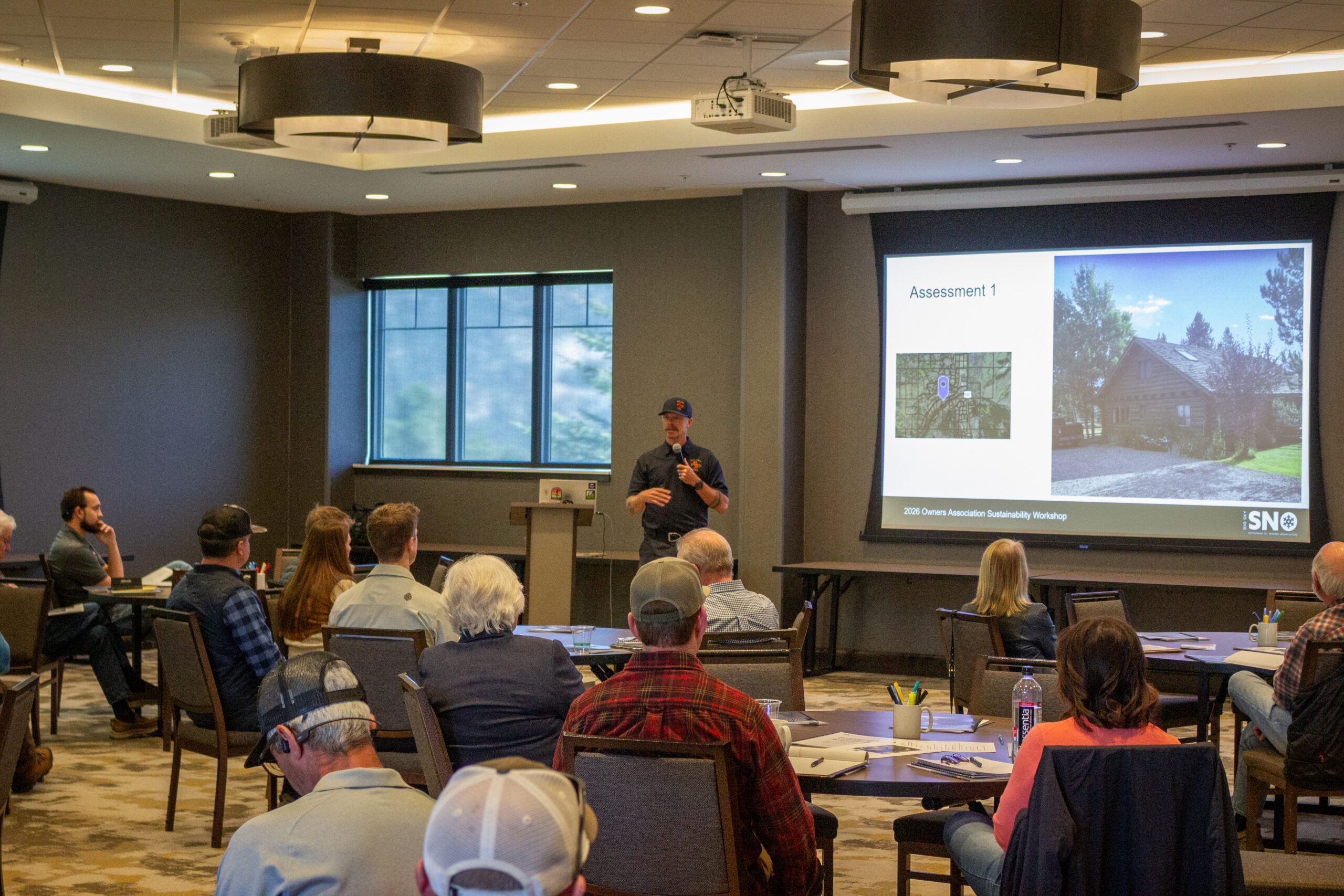
Hosted by Big Sky Sustainability Network Organization (SNO) and Big Sky Fire Department, the event prepped homeowners for a wildfire season that began a few weeks ago with small blazes across the state. This year, temperatures are expected to be warmer and conditions drier, making for an even more troubling outlook for a community already at a higher risk of wildfire than 96% of the country.
Trapp learned about the upcoming season during a Northern Rockies Coordination Center meeting in Missoula on Tuesday, April 7. The interagency wildfire management crew consists of federal and state groups and released forecasts of upcoming months.
“The outlook is showing that we’re going to have warmer temperatures than usual and less precipitation than usual,” Trapp explained at the workshop. Montana is also impacted by La Niña and El Niño climate patterns, respectively bringing cold temps and precipitation, and warm conditions. NOAA shared this week that the La Niña cycle has ended, and predictions show a 61% chance that El Niño’s warmer temps will arrive between May and July. Forecasts also described a potential range of El Niño impact all the way to “very strong,” which is sometimes called a “super” El Niño.
Trapp described how climate change factors in.
“It’s changing weather patterns above our head and changing the way that rain falls on the landscape,” Trapp said at the workshop. “And so it’s a significant thing that’s affecting our fire season.”
The past La Niña was considered weak, delivering less precipitation and cold than usual, making for a challenging summer in western states.
“It’s a concerning recipe at this point,” Trapp said.

Lizzie Peyton, director of SNO, reminded people why this workshop could be empowering at the beginning of the presentation.
“This year we’re putting awareness into action,” Peyton said. “We’re trying to create a space where you can walk onto a property and feel like you can be part of the solution and ensure that we’re making our community a safer and more resilient space.”
There are three primary ways a home can catch on fire: embers, surface fire and direct flame contact, and radiant heat. Trapp showed examples of materials and landscaping that make a home more susceptible to fire, and encouraged the audience to point out opportunities for improvement.
The workshop shared photos of Big Sky homes, some passing the test with flying colors, and others needing just a few tweaks to keep, say, a pile of wood beside the house from becoming a deposit spot for wind-carried embers.
Attendees also pointed out combustible outdoor furniture, cushions, cracks in logs in a home’s exterior, long and dry grass, and wondered aloud if a homeowner had recently checked under their deck for flammable dead leaves or storage. The information presented is part of a larger effort by BSFD, SNO and Alpenscapes to spread the word about defensible spaces and how homeowners can take initiative to prevent wildfire spread and support the safety of their neighbors.
Cody Marxer, Madison County planning director, explained that county residents are interested to learn more about defensible space and the workshop is an opportunity to bring information back to the community.

“So a lot of people—especially [those] that move in from other states where they’ve experienced wildfire—they come in really looking for that guidance on, ‘how do you advise for this’ and ‘what’s our best emergency egress,’ sort of things of that nature,” Marxer said. While well-versed in mitigating wildfire risk to homes, she said the sessions are always a good refresher.
“It’s a good reminder going into summer,” Marxer said.
Justin Hill, CEO of Big Sky Land Management, was also present. Hill has worked in fuel mitigation, a way to reduce dead trees and brush from feeding a wildfire, for 20 years and said he learns new things each time he goes to a workshop about wildfire prevention and mitigation.
“You never know what’s gonna happen until summer, but, you know, all the predictions and stuff would say it’s gonna be a pretty big priority,” Hill said.
Whether the event imparted new knowledge or served as a refresh, attendees left with some more practice in problem-solving for wildfire risk reduction in their neighborhoods.