


These stops uncover the history and the ghost stories that linger around downtown Bozeman.
By Annie O’Neill EDITORIAL STAFF
Bozeman’s ghost stories are close enough together to explore in one evening. Along the way, you’ll find the old jail with a history of escapes and an execution, a theater with reports of a mysterious figure, and a bar where the jukebox allegedly has a mind of its own.
This route adapts AfterBoze’s “Bozeman Phantom Pursuit,” with additional historical details and stops. It follows Main Street from west to east before heading south to Montana State University. Most stops are a short walk apart.
One thing to keep in mind: Historical records can tell us what happened in these buildings. Ghost stories tell us what people say happened later. Reports of hauntings aren’t proof of paranormal activity.
Stop 1: Lewis & Clark Motel
824 W. Main St.
Start at the western end of downtown, beneath the neon marquee of the Lewis & Clark Motel.
The motel’s ghost stories begin with a chill in the air.
Guests have reportedly felt temperatures plunge without warning and spotted faint, glowing orbs that vanish when approached.
Local lore offers an even stranger explanation: The spirits of long-dead visitors are said to return.
The sign itself has a more traceable story. RoadsideArchitecture.com dates the motel to 1976 and credits owner William J. Sebena designed and built the marquee, drawing inspiration from the signs of Las Vegas.
Look for: The marquee from the sidewalk after dark. The motel is a working business, so respect guests’ privacy and stay out of restricted areas.
Stop 2: Gallatin History Museum
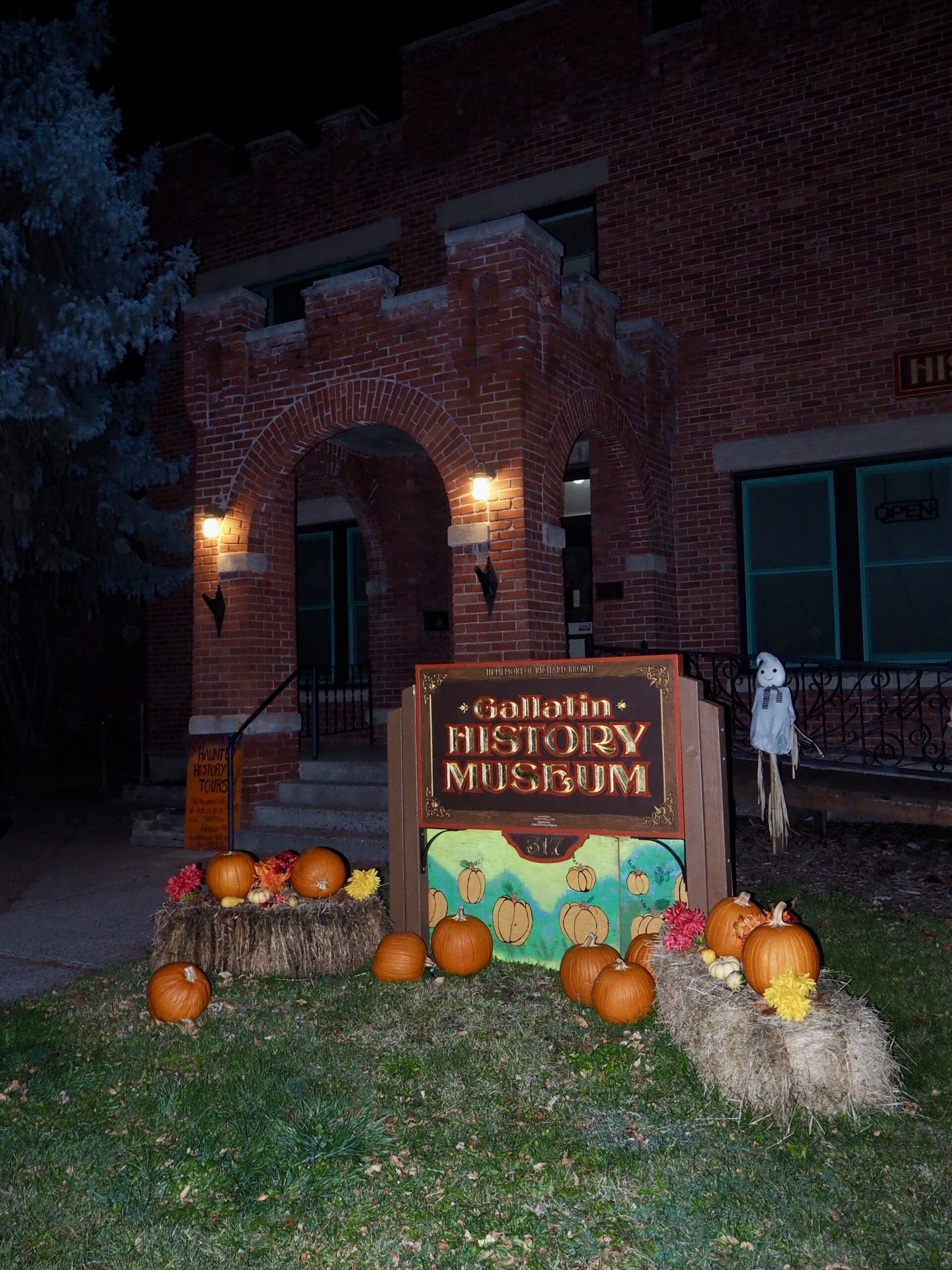
317 W. Main St.
The old county jail has enough documented history to make an impression without any ghost stories.
According to the Gallatin History Museum, architect Fred Fielding Willson designed the jail, which opened in 1911. Just 20 days after opening, six inmates escaped. The museum’s account of the building’s history also highlights its escapes, hanging and unsolved mysteries.
In July 1924, authorities hanged convicted murderer Seth Danner inside the jail in what historical accounts describe as Gallatin County’s last legal execution. The county continued to use the building as a jail until 1982, when it moved its prisoners to a new facility.
The Gallatin Historical Society then helped secure the old jail’s future as a museum. Today, visitors can explore the building’s history and hear the stories that have grown around it.
Those stories include reports of footsteps overhead and claims that the jail keys move after hours. But the museum’s then-executive director offered a more skeptical take in a 2011 interview with Downtown Bozeman: He said he had seen no evidence of a haunting, though he would welcome a conversation with any spirit willing to stop by.
Look for: The trapdoor and “Siberia,” the jail’s isolation cell, where a message scratched into the floor is a chilling reminder of its prisoners.
Stop 3: The Baxter
105 W. Main St.
The Baxter began as a community investment. According to the hotel’s official history, about 250 people helped fund the project. The hotel opened in 1929 and later welcomed guests including Eleanor Roosevelt and Richard Nixon.
After operating as a hotel for decades, the building became condominiums in the 1980s. Its grand staircase remains one of its most distinctive features and is the setting for one of its ghost stories.
Brides have reportedly described feeling an arm around their waists or a hand on their hips as they descended the stairs, as if someone were steadying them. Local lore holds that brides have felt an unseen hand on the Baxter’s grand staircase, according to Reddit accounts.
The Baxter’s next chapter is already in the works. The owners announced plans to restore it as a boutique hotel, with completion targeted for fall 2027.
Stop 4: Ellen Theatre
17 W. Main St.
The Ellen opened on Dec. 1, 1919, with a screening of “The Miracle Man.” According to the theater’s official history, the Story family built it and named it for their matriarch, Ellen.
Willson, who also designed the old jail, designed the theater, which hosted variety shows, silent movies, school plays and even an opera.
After years of decline, Montana TheatreWorks bought the building, renovated it and reopened it in December 2008 with “A Christmas Carol.”
The theater’s ghost stories are less easily documented. Employees have reportedly described seeing a man in a black suit on the balcony and in the women’s restroom. Others have said they felt someone standing behind them, only to find no one there.
Some versions of the story suggest that the figure could be connected to the Story family, though the identity of the alleged apparition is not verified.
The Ellen also follows a longstanding theater tradition: the ghost light. Theater workers leave a single bulb burning on an otherwise dark stage, both to help prevent accidents and, according to theatrical lore, to keep the ghosts at bay.
Stop 5: Crystal Bar
123 E. Main St.
At the Crystal Bar, the ceiling is a collection of stories in its own right, from fake IDs to bra straps.
The bar has operated under the same name in the same storefront since at least 1933. The building’s history reaches back further to the late 1800s, when the space served as a slaughterhouse and butcher. Rails once used to hang meat are still visible in the ceiling.
Douglas “Grunch” Sandiland bought the bar in 1985 and covered the ceiling with confiscated fake IDs. Bras now hang from hooks and fixtures throughout the place. After Sandiland died in 2010 without a signed will, the Bozeman Daily Chronicle reported his heirs intended to preserve the bar’s character.
Then there are the paranormal claims. Employees have reportedly heard the jukebox playing without anyone operating it, while another story describes laughter coming from empty booths.
Stop 6: Montana State University campus
Montana State University
Finish on campus, where a network of utility tunnels has inspired stories about what might be lurking underground.
A Bozeman Daily Chronicle report described the tunnels as infrastructure for steam lines, communications cables and water. According to that account, construction began in 1995, and the network extends about 1.6 miles from the university’s heat plant.
The report also included a university official’s description of the tunnels as well-lit and well-maintained.
Folk-tales describe mysterious occupants in the tunnels, while Outside Bozeman has recounted claims of props moving and lights switching on and off at the old Strand Union Theatre.
Safety note: Keep to the surface. The tunnels are for university utilities, so don’t enter them.
Bonus stop: The Old Bozeman Hotel
321 E. Main St.
The Old Bozeman Hotel dates to 1891, when the Romanesque-style building formed part of the city’s effort to establish itself as a prominent Montana destination. The historic property is known for its architectural details and former hotel accommodations. It is now the home of a coffee shop, restaurant, bar, comedy club and nightclub.
The building has also acquired ghost stories. Outside Bozeman’s Wicked Bozeman coverage and other local accounts have circulated tales of unexplained lights and merchandise that seems to move on its own.
Turn the walk into a friendly contest. Award a point for the best photo at each stop and another for every historical detail or ghost story someone can recall at the end.
The real reward is seeing Bozeman through a different lens.