

By Mel Crichton EBS COLUMNIST
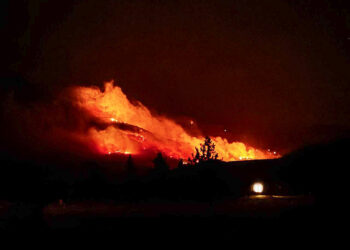
With wildfire becoming a bigger part of our lives, especially as low snowpack increases its likelihood, I sat down with Jeff Cadry, who is leading a preventive approach to wildfire for Yellowstone Club, a.k.a. Firewise YC. Since firewise practices can apply to any community, I asked him to discuss the topic with regards to all of Big Sky, and beyond.
Wildfire Wire: Tell us about yourself.
Jeff Cadry: I came to Big Sky from Minnesota, for one year of ski bumming after college, and 15 years later, I’m still here. I got addicted to the good life. My wife and child love this community. I work for Lone Mountain Land Company as an environmental manager, a very broad title, but specifically I focus on how we manage forestry across our LMLC properties. I have a master’s degree in forestry from Colorado State University, and trees and plants are my passion.
WW: You’re involved with a program called Firewise Yellowstone Club. What is firewise?
JC: Firewise USA is a recognition program put together by the National Fire Protection Association to create frameworks for neighborhoods and communities to prioritize fire risks and put action on the ground.
WW: What’s the benefit of that?
JC: Lots of benefits. One is mitigating the risk of wildfire burning down homes. Another is creating a safer environment for humans in the event of a wildfire.
WW: I’ve heard that if you minimize massive fires, you can also create better biodiversity where you’ve had small, limited fires. So there’s healthy growth coming up underneath the canopy.
JC: Absolutely, it’s more than just protecting homes, it’s also about protecting our environment. Our ecosystem evolved with fires burning regularly, and we suppressed them for the last 100 years and that has had some impact. But there are ways that we can modify our landscapes to mimic fire to create a healthier ecosystem.
WW: What do you have to do to be firewise?
JC: It starts with creating a board of community members, with the fire department—Big Sky Fire or Yellowstone Club Rural Fire Department—and then sitting down to create a plan for a risk assessment, then assessing the majority of homes in the community, putting together an action plan based off of that risk assessment, and then executing that action plan. Doing just a little bit every year can go a long way. And with all that, doing an education event for the area.
WW: You say assessing the majority of homes, so you don’t need to be 100% to be firewise?
JC: Yep, the recognition can go for an entire community or an entire subdivision, but getting most of the homes in that risk assessment and pointing out the things that need to be done are the essentials.
WW: Has this been hard to do?
JC: Surprisingly no. It was a big thing to digest in the beginning at Yellowstone Club, but the further I got into it, the more I realized that it was this framework that you’re creating to apply action, and it’s very well laid out by the NFPA so you bite it off in smaller chunks.
WW: You’re a wildfire neighborhood ambassador, as am I. We sometimes find neighbors that push back, saying, “I’d rather let it burn; I’ll take the insurance money and leave.” Do you see that in YC?
JC: I don’t. For the most part, it’s been met with really great reactions. In this day and age, we’ve seen enough mega fires throughout the U.S. that most people realize that wildfire is a real threat. It’s not if a fire burns through Big Sky, but when.
WW: Are there financial benefits to becoming firewise?
JC: There are, indirectly. Insurance companies recognize the benefits of firewise. There are no guarantees that it will lower your rate, but it won’t hurt your situation if an insurance company is evaluating a property and you have a framework plan for mitigation.
WW: Recently Montana has made it easier for insurance companies to offer rebates, and if they deny insurance, they are required to provide their reasons for denial. Have you seen any effect with the high-end housing at YC?
JC: Not specifically yet, but to be fair, I’m not as involved on the insurance side.
WW: How big or how small can a firewise community be?
JC: It can be as small as your street, say two-plus homes, or it can be large—I believe up to 3,000 front doors. So there’s a big range in there. And so it’s up to your board to take on as many or as few homes as necessary.
WW: Can an HOA be the firewise board?
JC: Yes, the HOA can be the board. But you just need a community member involved in the HOA and the fire department.
WW: So, why you?
JC: It’s partly my job but also because I think it’s a program that’s worthwhile. It’s a way to put ownership into homeowner’s hands and show them that, “Here are your risks, and here are the ways you can manage those risks. Here’s the most important and the least important priorities.” I think it gives clarity to homeowners on how they can get at these risks effectively.
WW: Anything else that YC is doing regarding fire safety?
JC: Yeah, a number of things. I think one of the most exciting prospects right now is YC, along with Big Sky Fire and the Forest Service, are working together to identify potential control lines in the event of a wildfire. Community wide, we’re all working together to forward think on how we can be better prepared in the large-scale model of wildfire.
WW: You mentioned control lines—places where they can stand up to fire. We may see some work happening around this and wonder what’s going on. What will we see physically?
JC: You’ll see some work along roadsides, major roads and some minor roads, clearing vegetation back to the right of way and beyond. There will be activity that you may not see more on the periphery of our communities, doing fuel reduction, whether that’s in YC, Moonlight Basin, or Big Sky Fire clearing fuel breaks and creating lines for bulldozers in the event of fire.
WW: Anything else?
JC: Moonlight Basin and Spanish Peaks were recently recognized as firewise communities. We saw the work and the benefits there, and it seemed worthwhile to pursue Firewise for YC. Likewise, I think this program could apply to many communities in the greater Big Sky area, specifically HOAs. The infrastructure is set up for these communities, and it would be pretty easy to work with the fire department. I would be happy to help any HOA that wants to go through this process.
WW: Great! Back to HOAs, something we deal with as wildfire ambassadors. We have at least 80 HOAs in Big Sky. We don’t exactly know their boundaries. I understand you’re working on a map.
JC: We’re working to put some lines on a map and really understand the extent of each of these HOAs and communities, and I think that’ll be a helpful tool moving forward for wildfire risk reduction management, ingress and egress planning, and evacuation procedures. There’s many benefits to identifying HOAs. You can see where your gaps are.
WW: Thanks for your time.
Mel Crichton acts as neighborhood ambassador coordinator for Fire Adapted Big Sky. He may be reached at kj9c@comcast.net.