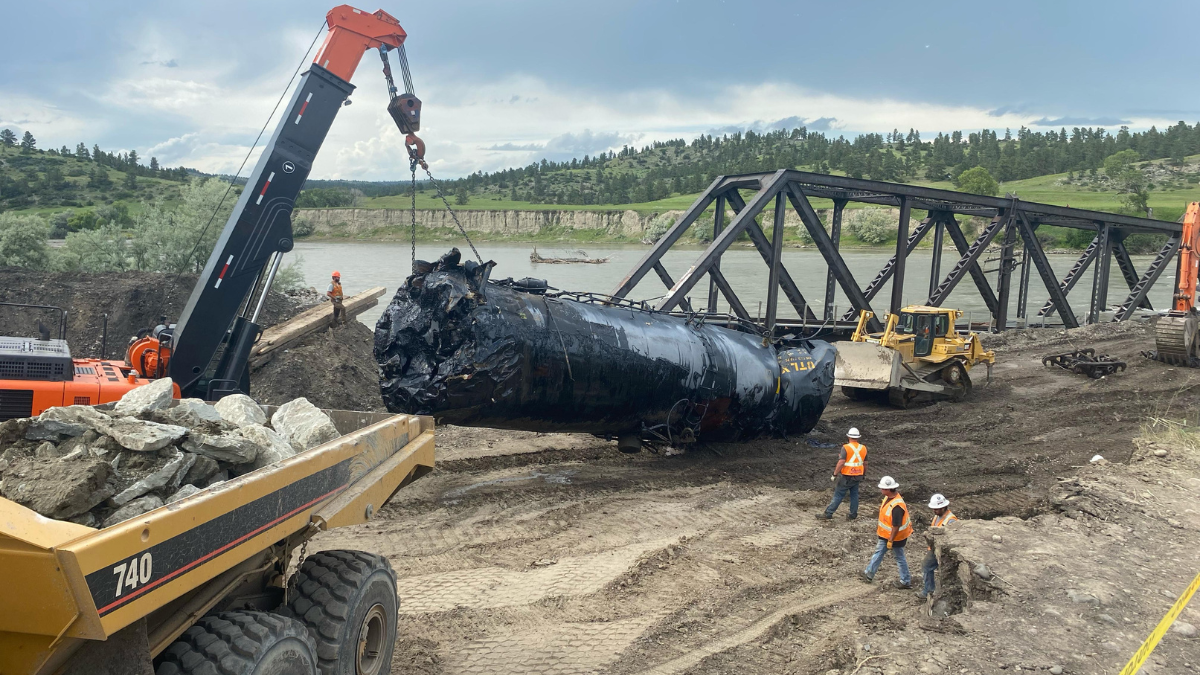

EPA: Investigation into circumstances leading to bridge collapse is ongoing.
By Amanda Eggert MONTANA FREE PRESS
Nearly two weeks after a bridge collapse and train derailment sent 10 rail cars plunging into the Yellowstone River, authorities are starting to quantify the volume of molten asphalt that entered the river.
Six of the 10 Montana Rail Link rail cars that fell into the Yellowstone June 24 were carrying molten asphalt, and most of those cars leaked at least some asphalt.

Respondents to the accident estimate that as much as 500,000 pounds of asphalt spilled into the Yellowstone, which flows from mountains in Yellowstone National Park before joining the Missouri River just east of the Montana-North Dakota border.

U.S. Environmental Protection Agency public information officer Beth Archer said this week that crews were working to garner a more precise estimate of the amount of material released into the Yellowstone by weighing the asphalt remaining in each of the six asphalt cars that entered the river. The last of the cars lodged in the river was removed on July 3.
“We do have folks that are cutting open [the recovered] railcars,” Archer said. “That will help us get an estimate of how much asphalt material did enter the river.”
Archer said the asphalt, which was molten when it was put into the rail cars, is not water soluble, meaning it has not dissolved in the river. Water quality monitoring reports have not detected petroleum hydrocarbons in the Yellowstone as a result of the spill, she said. Asphalt is a roadway binder that’s made out of the heavier constituents of crude oil.
According to a 2009 report on liquid asphalt spills produced by the University of New Hampshire’s Coastal Response Research Center, asphalt can harm living organisms in a variety of ways, ranging from ingestion and exposure to chemicals contained in the asphalt to smothering and “physical fouling.” Archer said the latter issue — that of animals becoming entrapped by the asphalt — has been a primary concern. The asphalt has shown a tendency to stay together and float until it’s come into contact with sticks, rocks and other solid materials, Archer said.
“It’s technically considered an oil under our response authority, so we’ve been calling it an oil, but it is really like a sticky, asphaltic material that globs together and acts like tar,” Archer said. “One of the primary concerns is animals getting physically stuck, especially on days where it gets hot. The material heats up and gets stickier. … There is also a risk to micro- and macro invertebrates, especially when it gets stuck up on the shores. It can cover up some of those animals.”
Archer said response crews have found eight wild animals that have been impacted by the spilled material. They include five birds (four killdeer and one yellow warbler), two garter snakes and one bullsnake. Archer encouraged members of the public who find material associated with the spill in or along the river to report it to rpderailment@mtrail.com. That email address can also be used by landowners filing a claim for damages. Sightings of impacted wildlife should be reported to the Oiled Wildlife Care Network Response Hotline at 888-275-6926.
About one-third of personnel assigned have been identifying areas contaminated by the asphalt and collecting it. As of Tuesday evening, about 75,000 pounds of material have been removed. The vast majority of the material collected thus far has been found within 10 miles of the bridge collapse, according to a dashboard the EPA set up to track the clean-up, though material has been recovered as far downstream as Billings.
“I think it’s realistic to expect that not all of this material is recoverable,” said Archer, adding that crews are trying to clean up larger pieces of material without trampling sensitive areas to get to smaller pieces of the asphalt.
The response team is composed of officials from Montana Rail Link and representatives from the EPA, Montana Department of Environmental Quality, the U.S. Fish and Wildlife Service and Stillwater County Disaster and Emergency Services.
Irrigators immediately downstream of the incident, which occurred between the agricultural communities of Reed Point and Columbus, were initially advised to halt river withdrawals, but that advisory has since been lifted, Archer said.
The investigation into the circumstances leading to the bridge collapse is being conducted by the Federal Railway Administration. Archer said she’s unsure when the agency will release its findings.
Next steps for the mitigation effort will likely include an assessment of the damages, Archer said. In addition to cataloging ecological damage, agencies will likely attempt to quantify economic impacts, which could include considerations such as the closure of public fishing access sites. A 3.5-mile stretch of the Yellowstone near the bridge remains closed to the public. The assessment will also likely include a proposal to mitigate impacts and a plan for reducing the likelihood of similar occurrences in the future.
Wendy Weaver, executive director of Montana Freshwater Partners, a Livingston-based nonprofit that works on the restoration, preservation and enhancement of aquatic ecosystems, said the asphalt release brings to mind two other events that resulted in pollution entering the Yellowstone: the 2011 ExxonMobil pipeline rupture that resulted in 42,000 gallons of oil leaking into the river near Laurel, and the 2015 Bridger Pipeline spill that leaked about 40,000 gallons of oil into the river near Glendive.
Weaver, who has been involved with the Department of Justice’s Natural Resource Damages Program that’s charged with using settlement funds to mitigate the impacts of the 2011 oil spill, said she hopes the public will have an opportunity to provide feedback on impacts and mitigation measures.
Weaver described the incident as a “significant cut” in the “death-by-1,000-cuts” scenario that Montana’s waterways are facing. She said her organization — and residents of Park, Stillwater and Carbon counties more generally — are still working to address debris accumulation associated with historic flooding on the Yellowstone last June.
Dan Vermillion, a former member of the Montana Fish and Wildlife Commission and co-owner of Sweetwater Travel, a Livingston-based fishing outfitter, said the discharges of industrial material into the Yellowstone in 2011, 2015 and this year have followed particularly high water years. High water can weaken bridges and pipelines by altering river channels and scouring riverbeds.
“It does seem like we need to take a little bit stronger look at the infrastructure,” he said. “I think a lot of these really old bridges may not have been built for some of these events we’re having. I would encourage everyone to sit down and think about a way to fortify those river crossings.
Montana Rail Link president Joe Racicot has said his company will pick up 100% of the cleanup costs associated with the incident.