


By Rachel Hergett EBS COLUMNIST
I’m no wino.
If I have a glass of wine, it is a whisper of a pour with dinner when someone else orders a bottle. The pairing is key for me; I appreciate the interplay of flavors and how they may contrast or enhance one another.

Otherwise, if I’m honest, I usually take small sips from the glasses of those willing to share. It’s an adult version of Fanum tax—the internet slang term for stealing bits of food from friends. I get to try the wine and do not have to bother with a glass of my own.
The usual victim of said tax is my mother, who happily passes her glass for me to try. It’s a win-win situation for the most part. I get my taste, get to roll the wine around on my tongue and feel it out. And that’s it. There’s more left for others because I didn’t pour myself a glass.
But recently, a wine absolutely floored me in the best of ways. I took my sip, and the wine danced on my tongue in a swirl of complex flavor. I swiftly handed the glass back and stood up. I needed to track down my own. I poured a glass that barely lasted five minutes before I found myself going back for a refill. Then it sadly ran out.
The wine was a bottle my mom had picked up from the Barnard Griffin tasting room in Richland, Washington, while on a trip with friends roughly a decade ago—a 2013 Red Mountain reserve red blend known as the Mammoth II.
“Newly unearthed from the Barnard Griffin Cellar comes this deftly crafted mélange of Cabernet Sauvignon, Petite Verdot and Merlot,” the bottle read, with my mom’s scrawled notes above the label in silver Sharpie adding “decant” and “$60.”
Mom chose to bring the wine to that particular gathering because most everyone else there was a wino, and it was the last of the bottles from that trip, she said when I asked about it later.
“Sixty dollars was a lot,” she said. “I must have really liked it.”

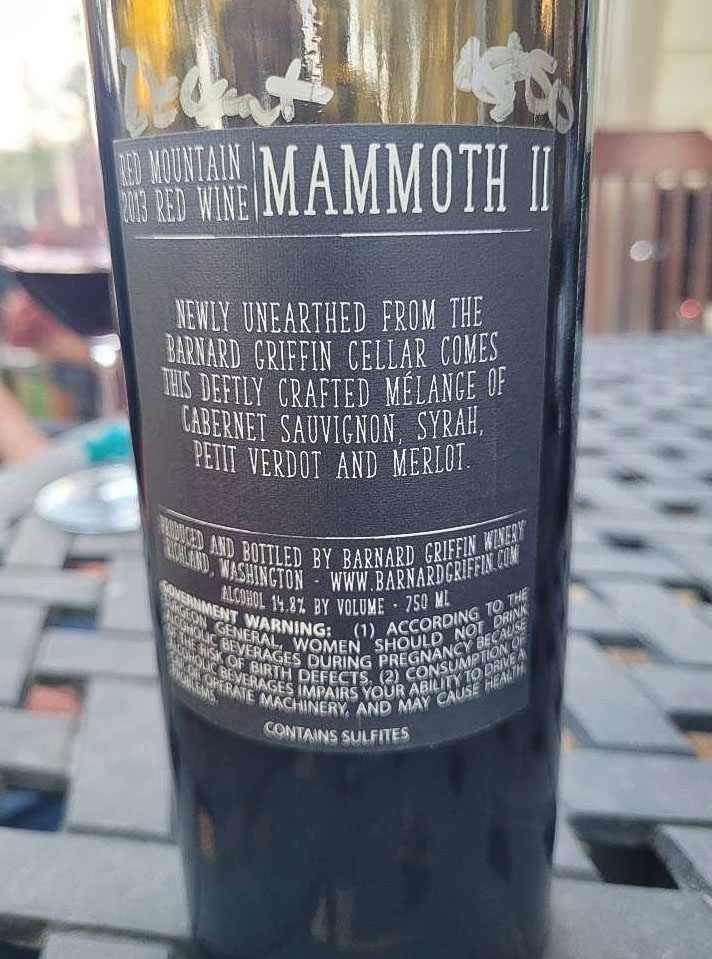
The wine was a full-bodied red blend with hints of deep berry and the spice, leather or smoke of what my mom calls “dirty wines.” She loves, for example, the richness of a Spanish Rioja, and attributes the flavors to the terroir.
In French, and in wine speak, the “terroir” is how environmental factors affect a crop. This is why grapes of the same varietal taste different based on where they are grown. It makes me think of the Lindsay Lohan “Parent Trap” remake where one twin grew up on a vineyard and states she is “partial to the softer California grape” when drinking a European wine.
Red Mountain—I learn because of my interest in this Mammoth II—is a small designated American Viticultural Area within the larger Yakima Valley and Columbia Valley AVAs. If a wine is labeled with a specific AVA, at least 85% of the grapes must have been grown in that region.
Red Mountain is known for grapes that pack a punch of powerful tannins. The region, which is only 4,040 acres, is entirely southwest facing slopes that seem to hold the grape vines up to the sun during the day—giving Red Mountain longer days and warmer temps than any other part of the Columbia Valley. Its fertile soil is credited to repeated Ice Age flooding of glacial Lake Missoula.
“The flood waters redesigned the landscape, configuring the soft mountain slopes and depositing nutrient rich top soils over sand, silt and gravel—as if to anticipate the introduction of wine grapes to the region,” according to a history on the Red Mountain AVA website.
I cannot track down a bottle of the Mammoth II—or III, IV, V, or VI for that matter. So it may just live in my memory. A wine like the Mammoth is special, though I’m now determined to seek out other wines from Red Mountain to compare.
I reach out to Steve Merlino, the beverage manager of The Cave Spirits and Gifts in Big Sky, asking if he has ever had a wine that hit him like a Mammoth. He hasn’t. While he orders the store’s wine, he admits he is also not a wino.
The Cave’s wine section has been revamped and expanded in the last couple years and the store is selling a higher percentage of wine than it ever has. Merlin’s is constantly bringing in new wines based on current trends trickling down from the coasts. But it will probably never see a Mammoth.
Most people in Big Sky are looking for a known wine that can’t miss with a group, like a Jordan Cabernet Sauvignon or Whitehaven Sauvignon blanc, Merlino explains. Name recognition is huge. If he gets too adventurous with the ordering, the wine will sit on the shelves, no matter how much one person may love it.
“What’s good or not is subjective by nature,” Merlino said. “All I can do is try to point people in the right direction.”
I agree that flavor is subjective and the trick is finding what notes in wines speak to you. Others at the table thought the Mammoth was a decent wine. I thought it was the best wine I had ever tasted. And I hope that someday you too will find a wine that hits your palate like a Mammoth.
Rachel Hergett is a foodie and cook from Montana. She is arts editor emeritus at the Bozeman Daily Chronicle and has written for publications such as Food Network Magazine and Montana Quarterly. Rachel is also the host of the Magic Monday Show on KGLT-FM and teaches at Montana State University.