

‘Critical time’ for a ‘relationship refresh,’ BSCWSD leaders say with urgency
By Jack Reaney SENIOR EDITOR
Nearly a year ago, on Jan. 2, 2025, the Big Sky County Water and Sewer District withdrew its $15 million request for Resort Tax funding to construct phase two of its Water Resource Recovery Facility, seeing significant competition in other community projects. The Resort Tax board ended up committing up to $66.8 million between Cold Smoke and Big Sky Community Park, and both “Livable Big Sky” bonds were later approved by voters in May 2025.
In that same January meeting, the BSRAD board voted against funding an $8 million request for the potential sewer project in Gallatin Canyon, an effort that would coincide with the WRRF’s second phase. Resort Tax board member Kevin Germain assured that the delay in water and sewer project funding should not indicate a lack of interest in their objectives.

The year 2026, Germain said, “should be the year of water-sewer discussions in this community.”
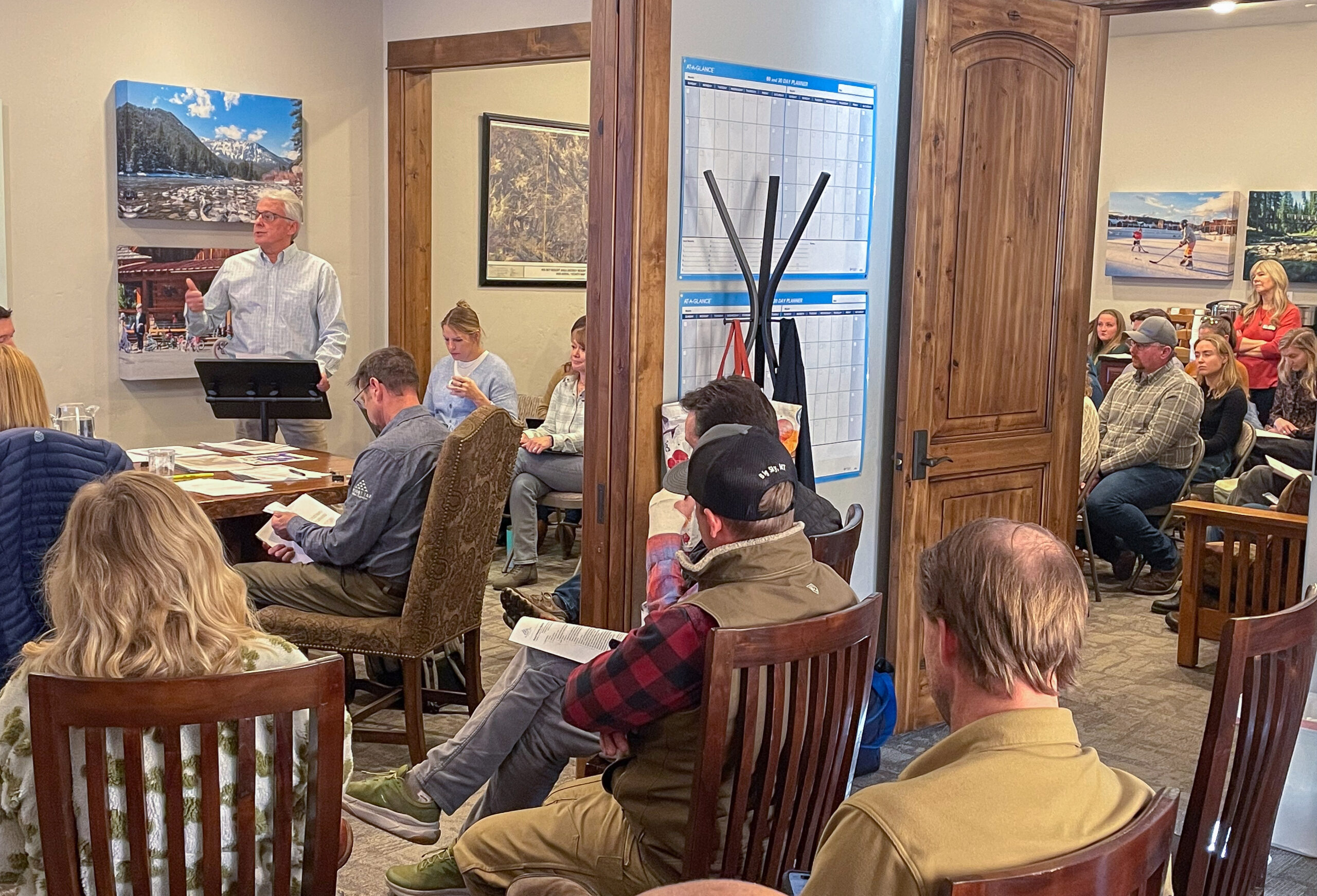
Ten months later, the water and sewer district re-engaged the discussion at the Nov. 13 BSRAD board meeting. Brian Wheeler, BSCWSD board chair, recalled the January meeting.
“I did stress the time-sensitivity of this. And the fact that we’re playing catch-up,” Wheeler said, referring to various challenges in the past five years; “historic inflation” placed a “tremendous burden” on ratepayers, including an additional $7 million during construction of the new WRRF; “frivolous and unsuccessful” lawsuits from Cottonwood Environmental Law Center caused $4 million in defense costs; “staggering” five-year growth in population and tourism has pressured existing infrastructure; and further investments like water source exploration, reuse planning and Firelight Meadows annexation will be expensive projects.
“Infrastructure is essential, and support for the water and sewer district is critical, from BSRAD,” Wheeler said. The district’s other funding comes almost entirely from 3,500 customers, a large reason for the recent increase in user rates. Wheeler told EBS the goal now is to improve financial planning and coordination.
BSCWSD board member Al Malinowski—who previously served on the Resort Tax board from 2004 to 2011—said the communication between organizations needs to improve. He said BSCWSD takes “full responsibility” for the lack of strategic conversations, and is now working to improve it.
“One thing that hasn’t changed [in recent years] is the community value, where we don’t want to discharge into the Gallatin River. That hasn’t changed,” Malinowski said, emphasizing that Big Sky is one of very few zero-discharge communities—a very expensive and “admirable” infrastructure choice, which Germain echoed.
“We want to preserve the Gallatin River and our aquifer, and we want to start fixing what’s going on in the canyon,” Malinowski said.
Gallatin Canyon hosts hundreds of properties reliant on septic systems for water treatment, which experts say are environmentally inferior to the proposed centralized sewer that would pump canyon-area wastewater up to the WRRF for top-notch treatment. However, this sewer project faces a $50 million hurdle, a projected cost that has ballooned since initial design. Leaders are exploring financing options to complement the Resort Tax support: $12 million committed plus $1.2 million for operations, and another potential $8 million that would require voter approval.
Malinowski said the feasibility of the WRRF’s second phase probably depends on the canyon project—which probably depends more on Resort Tax, after the Gallatin County Commission expressed disapproval of a preferred financial tool: a targeted economic development district with tax increment financing.
“Without the canyon [sewer], I don’t know if you can justify creating 7,500 SFEs with phase two of the WRRF, and if that doesn’t happen, we’ve got a challenge on our hands,” Malinowski said.
Brian Wheeler noted that the district is already stretched thin to accommodate planned developments under phase one. Current commitments will be met, but the district will need a second phase to absorb the new water and sewer district being formed in Firelight Meadows.
“And that’s environmental,” Wheeler said. The Firelight neighborhood’s septic infrastructure has been non-compliant with DEQ standards for at least five years.
Hearing the urgency, Germain offered reassurance.
“It was always assumed there would be a phase two. And by the way, Al, there will be a phase two,” Germain said. “And we know that. We just need to work together to get this done.”
The partnership between local districts is muddled by a unique factor.
Some Big Sky residents do not live within the BSCWSD boundary and are not customers. Therefore, they don’t receive the same direct benefit of Resort Tax funding that a BSCWSD customer would, in the form of rate offsets. BSRAD believes roughly 60% of Big Sky’s resort tax revenue is collected within the BSCWSD boundary, where 40% is collected outside of the district, and that 60-to-40 ratio led to BSRAD’s 2020 interlocal agreement to fund 60% of the WRRF using collections from the “1% for Infrastructure” resort tax.
“Not all of Big Sky is in your district, and there’s some huge [resort] tax collectors not in your district,” Germain said, citing Yellowstone Club and Moonlight Basin. “… Ultimately, every Resort Tax dollar that goes to help you guys does not go to help a ratepayer outside of your district. And so it’s a balancing act that we just have to work with you guys.”
BSCWSD officials now believe the ratio is closer to 80% or 90% of resort tax revenue coming from within its boundaries, and that the 60-to-40 ratio does not account for non-resident strain on large entities like Town Center and Big Sky Resort.
Wheeler wants to scrap the 60-to-40 ratio and find a new solution. He encouraged the board to create a joint subcommittee between the districts to improve communication, and strategic and financial planning. Germain favored the idea of a formalized subcommittee and suggested broadening the scope to include other water and sewer companies, such as YC and Moonlight.
Malinowski said he senses hesitancy from Resort Tax to fund BSCWSD moving forward, and it’s “a critical time” to ensure the relationship continues.
“I don’t want to, in any way, suggest that the $27 million [WRRF] contribution, or the $17 million we’ve received to date, is a small amount of money,” Malinowski said. “But also recognizing, that we’re catching up for a lot of years of not having support from Resort Tax—which I’d argue is one of the big reasons that Resort Tax was formulated to begin with.”
Germain said he’s “all in” and appreciative of the conversation, and that he hopes BSCWSD considers the complexity of BSRAD making massive infrastructure investments like the $27 million committed to BSCWSD in 2020. He added that Resort Tax and BSCWSD should join forces and pursue other funding sources.
“I do think the time for this conversation is now, and to continue it and keep working with you guys,” Germain said.