

Wildlife program shaping how thousands of residents, workers and visitors think about bears, and the landscape
By Annie O’Neill EDITORIAL INTERN
People visit Montana to experience the “wild west.” But what they don’t often see is the effort behind keeping the west wild.
“People move, people come and visit the Greater Yellowstone Ecosystem because it’s wild. It’s amazing. It’s the last great stronghold in the Lower 48’s,” said Rich Chandler, VP of environmental operations at Lone Mountain Land Company.

Keeping it that way, for both the animals and the growing number of humans living alongside them, drives LMLC’s Wild Big Sky program. The program started in December 2021 and has reached roughly 4,000 people annually through a mix of employee training and public outreach during farmers markets, various club programming and hands-on safety demonstrations with local businesses.
Montana’s wildlife population continues to push into new corners of the Big Sky area. And Chandler says this shift makes education more critical than ever as their populations grow.

Why this matters now
The program didn’t emerge from a single dangerous encounter, Chandler said. It emerged from a place growing quickly on both sides of the human-wildlife equation.
“Big Sky is growing,” Chandler said, noting that more humans are calling the area home, or at the very least, visiting for short periods or staying longer in the area. “And similarly, wildlife populations are growing in this area.”
In 2021, LMLC brought together leads from its property owners associations, security teams and operations staff to form the Lone Mountain Land Company Wildlife Working Group. The group aimed to unify scattered messaging into one consistent program, which the company formalized under the name Wild Big Sky in 2022.
The company wants every resident, worker and visitor to walk away with a simple message: This is wild country, wildlife is always a possibility, and a handful of habits make a real difference.
The program’s three core points
LMLC built its messaging around three core points, working alongside Montana Fish, Wildlife and Parks:
- Travel in groups of two or more.
- Carry bear spray, and know how to use it.
- Stay especially alert during dawn and dusk, when wildlife are most active, and avoid those times outdoors if possible.
“Those three points are what FWP really puts an emphasis on,” Chandler said.
The company also stresses food and trash management, and it reminds people that Montana law prohibits intentionally feeding wildlife. “This isn’t just us telling you, this is a state-regulated thing,” Chandler said. Wildlife that becomes reliant on human food sources can become a nuisance animal, a designation that can cost the animal its life.
The same core habits apply to the full range of wildlife on the landscape, not just bears.
“If you’re being reasonable and respectful of bears specifically, you’ll be very good in terms of respecting all wildlife,” Chandler said. Keeping distance, securing food and trash, hiking in groups and making noise on the trail apply broadly.
That’s why the company keeps its core messaging consistent rather than reacting to individual sightings, even as grizzlies expand into new parts of Big Sky where they haven’t historically ranged.
“You should at all times expect to encounter wildlife, and you should be prepared for it,” Chandler said. “Changing that messaging creates inconsistencies.” Working directly with FWP biologists and wardens keeps the message science-based and guards against secondhand stories, he said.
Chandler and Bauer both called the work “intentionally repetitive,” since new residents, staff and visitors keep arriving. “The message really is a rinse and repeat message in a lot of ways,” Bauer said. That repetition is paying off, Chandler said: “When you’re hitting numbers like 4,000 people within the community, you start seeing actions change, you start seeing behaviors change. You start seeing a cultural shift.”

The trailer as a meeting point
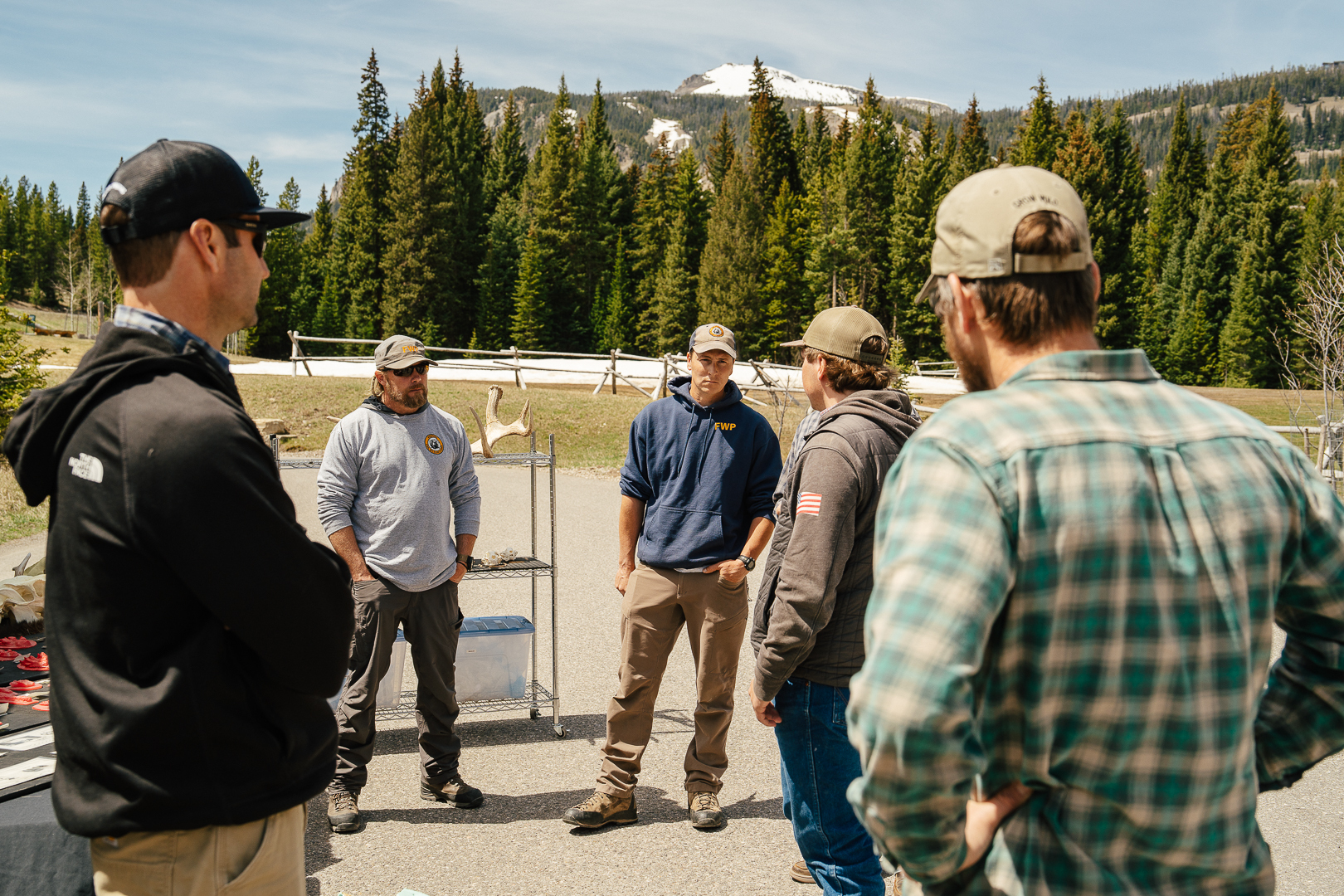
That message travels through Big Sky in physical form. The company’s member clubs fund an educational trailer entirely, and it makes regular stops at farmers markets, staff trainings, homeowners association events and community gatherings throughout the summer. It’s a familiar sight in Town Center.
Inside, hands-on displays, including a bear hide and a bear spray simulator called “Bear on Tracks,” give people a tactile introduction to wildlife safety.
“This is what an encounter could look like,” said Kramer Bauer, wildlife coordinator at LMLC. “This is the muscle memory of pulling bear spray, being able to deploy it.”
For many visitors, it’s their first exposure to the idea at all. “Even last night, there were folks from Miami,” Bauer said. “They never had to deal with this stuff ever before. And I’m like, let’s learn how to spray bears.”
The trailer reached roughly 2,000 people in its first year, 2023, and now reaches nearly twice that number annually, growth Chandler attributes largely to word of mouth as homeowners associations and community groups request it for their own events.
Their training program
A structured internal program backs up that public-facing outreach. Staff complete a Tier 1 online course covering fundamentals, then move into Tier 2, an in-person session tailored to specific departments or contractor crews. Afterward, employees sign a wildlife safety agreement, a program now in its fourth year.
The company is rolling out new initiatives for 2026, including updated onboarding training and an expanded version of the Wildlife Safety Agreement program aimed at reaching the general public, not just employees.
A parallel train-the-trainer partnership with Montana Fish, Wildlife and Parks, also in its fourth year, keeps internal trainers aligned with the agency’s current, science-based information.
“We like the idea that everything is science-based with Fish, Wildlife and Parks there,” Bauer said, adding that the material stays accurate and current, “not something that can be twisted or emphasized.”
Given Big Sky’s mix of full-time and part-time residents, construction workers, hotel guests and outside contractors, Chandler said the company designed its layered approach to reach people wherever they’re coming from.
Part of a bigger commitment
The wildlife program reflects how LMLC wants to see the Big Sky community grow, Chandler said. Environmental stewardship is among the company’s core pillars, and the company wants to build a community that respects the landscape it calls home.
“This place is so special to all of us,” Chandler said. The company’s conservation efforts extend well beyond wildlife education, he said, because the company wants those efforts to carry forward to future generations who will live in Big Sky long after the current team is gone.
Chandler said plenty of companies treat environmental compliance as a box to check but that LMLC aims to go further by building out a significant internal environmental protocol, and it recently created Bauer’s role as wildlife coordinator as the program expanded, a move that reflects that growing investment.
“We don’t feel the regulatory standards are enough,” Chandler said. “We want to go above and beyond that.”
That extends to the company’s work with Montana Fish, Wildlife and Parks, Chandler said. Rather than simply meeting the agency’s legal standards, the company wants FWP to have no concerns about how LMLC manages wildlife on its land.