
By Paul Swenson EBS COLUMNIST

It is another landmark time in the summer, the bushes and trees are blooming. Since I got great feedback from the EBS readership on my evergreen article earlier in the winter, I thought I would give you all another identification article. This time you will find these trees and plants along the river and creek valleys around our region.
To begin with let’s start big: deciduous trees. Our region does not have many, so this makes it easy. There are two species that dominate the landscape: Quaking Aspen and Narrowleaf Cottonwood.


In the figure you can see a number of distinguishing characteristics for these two trees. Both have a smooth white bark, but the Aspen’s extends the majority of the trunk, while the Cottonwood has the white bark on the branches and younger trunk, but a dark grey, rough bark for the majority of its trunk. The Aspen’s branches grow more horizontal, while the Cottonwood’s grow more vertically upwards.
Another major difference is leaves; shape, size and color. Aspen leaves are more intense green, more rounded, and “quake” more in a breeze. Aptly named, the Narrowleaf Cottonwood’s leaves are narrow and arrow shaped, sticky, glossy, and have a little reddish hue throughout the leaf.

These two trees are in the same genus, Populus, so do share a lot of similar characteristics also. They both grow where there is a shallow water table, produce “cotton” which disperses their seeds on the wind, have smooth white bark, and grow from suckers and seeds.
The world’s largest living tree is reportedly the Pando aspen grove in Utah. It is comprised of a single system of roots and shoots that include over 47,000 genetically identical trees spread over 106 acres. Most of our local aspen groves are also clones of a central maternal tree. When you find a small grove, look toward the center to find the original source tree. It might be dead, and it may have already rotted away, but there will still be evidence around.
Montana has four species of Cottonwoods: Black, Lanceleaf, Plains, and Narrowleaf. These trees provide food, shelter, nesting habitat, riparian bank stabilization, and bioremediation of toxins that may exist in ground water. The Plains Cottonwood was instrumental to the success of river trade and exploration of the west. On William Clark’s return voyage down the Yellowstone River, it was at “Big Timber” where they found Plains Cottonwood trees large enough to fashion into dugout canoes. These trees are usually found at lower elevations and become prevalent along the Gallatin River downstream of the Lava Lake trailhead.
Here are a few other leafy shrubs I would like you to look for: Willow, Elderberry, Red-osier Dogwood, and Serviceberry. These shrubs all grow together along the stream and river banks.
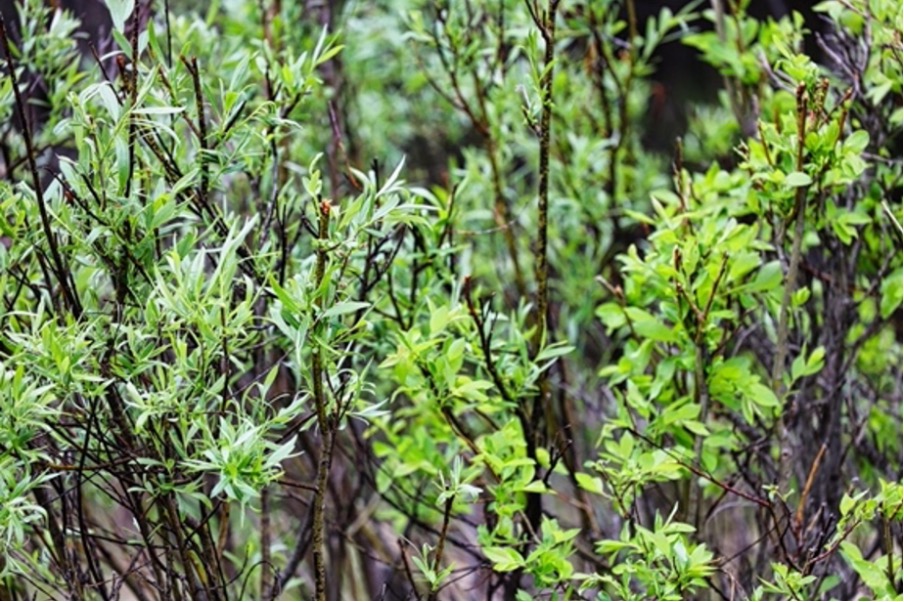
There are at least 45 species of willow in Montana, and it’s typical to find four or five growing together near the river. Look across the river from the Riverhouse and you can spot different types by leaf color, bark color, shape, size, and flower. Willow had been used for hundreds of years as a pain reliever and the chemical found in it led to the discovery of aspirin.
The shrubs that have the most notable flowers that one will see are the Elderberry, Red-osier Dogwood, and Serviceberry. Elderberries have large pom-pom, cream colored flowers one can spot from a large distance. In the fall they ripen to dark red to black colored berries that make great jelly and wine. Indigenous peoples used different parts of this plant for food, medicine, dyes, pipes, and instruments.
Serviceberry flowers are white and can be seen on both sides of 191 from the green bridge to Beckman Flats. They grow in rockslides and along the river. In the fall they produce blueberry-size fruits that are quite yummy. Don’t eat the red ones because they are not ripe and are sour. Another name for this plant is the Saskatoon blueberry. Saskatoon is derived from the Cree name for the plant, “Mis-sask-quah-toomina.”

The last is the Red-osier Dogwood. This shrub has the bright red bark you notice along the river, especially after the leaves have fallen. It produces a large inflorescence of white flowers nestled in between four arrow shaped leaves. So how can you identify the dogwood? By its bark.
So now it’s your turn to get out there and find these plants. If you are the one driving, please have someone else do the looking.
Paul Swenson has been living in and around the Big Sky area since 1966. He is a retired science teacher, fishing guide, Yellowstone guide and naturalist. Also an artist and photographer, Swenson focuses on the intricacies found in nature.