


By Ashley McEnroe EBS CONTRIBUTOR
Emotion and engineering: two terms often at loggerheads, yet an amalgam of both figures into the often-contentious realm of speed limits. Anyone traveling Gallatin Canyon and Montana Highway 64 between Big Sky Resort and U.S. Highway 191 has seen it: road-killed elk, deer, bears, raptors and even wild turkeys. And bighorn sheep, revered as the local school mascot and iconic species. Over the past month at the turnout beyond the bridge just west of the Conoco station on Montana 64, a lone bighorn lamb waited for a mother that would never return from the other side of the road, where all that remained of her were ravens flitting up as traffic roared past. Heart-wrenching, horrible, wasteful: the visions of carnage are unavoidable to passersby, even at the high speed of “Mountain Time” in a mountain town on the move.
While much fruitful discussion of solutions, from improved wildlife crossing signage to costly overpass construction, has made the pages of this and other newspapers, the low-hanging fruit of lowering the speed limit to increase motorist reaction time and decrease deadly crashes remains largely unpicked.
This newspaper has diligently covered the dangers of U.S. 191, including an April 25, 2025, feature, “Highway 191: Montana’s ticking time bomb of a road,” and also in 2016, when EBS ran a story about road-killed bighorns and a human death on Highway 64 near the confluence with U.S. 191 and the need for a speed study to save lives.
A speed study, and an ‘unsatisfied’ result
In 2024, the Montana Department of Transportation released a speed study determination for U.S. 191 after a two-year process that originated with a passionate request from two Big Sky residents: Suzy Samardich, who lives near Lower Dudley Creek Road, and David Stewart, a resident of Ramshorn subdivision. In 2022, Samardich and Stewart gathered hundreds of signatures from locals interested in having speed limits on Highways 191 and 64 reviewed and, hopefully, reduced. During the process nearly every local entity, including the Big Sky Resort Tax board, chamber of commerce, nonprofits and businesses, voiced their support for lower speed limits by at least 10 miles per hour across the board to match Big Sky’s increasingly treacherous traffic realities.
The results were underwhelming.
In the 2022-24 speed study determination, MDT approved a 45 mph speed limit on U.S. 191 through the 191/64 intersection and a 5 mph reduction for the rest of the study area. This study area encompassed the five-mile stretch of U.S. 191 from mile marker 45 to 50, essentially just south of the Riverhouse restaurant to the Jack Smith Bridge, the first to cross the Gallatin River as you head north from Big Sky. Aside from the 45 mph leadup to the 64 interchange, most speed limits were set at 55 mph. As for Highway 64, signage and speed limits were not even addressed in the 2024 determination.
However, two years after the approval, the signage approved by the study is still incomplete on U.S. 191. According to current signage, the 55 mph zone starts north of Ophir School, leaving the speed limit at the school, the Riverhouse and Jake’s Horses with the old 60 mph sign, made even more confusing as it stands beside a 45 mph school zone sign that only applies when its yellow lights are flashing during certain times of day. School traffic, pedestrians, a busy Riverhouse with guests parking along the highway, Warren Miller Performing Arts Center visitors and horses carrying riders of varying abilities are mixing with rocketing trucks and cars, many of them exceeding the speed limit. There is no 55 mph sign southbound after the 191/64 intersection, where new subdivisions are under construction.
Samardich calls the MDT’s final determination “disappointing,” while Stewart looks back on the frustrating speed study experience as something he would rather forget.
“At the time, my kids were just learning to drive, pulling out on 191 in front of traffic going 60 to 65-plus miles per hour,” Stewart said. “When they went skiing, they were going through the Highway 64 interchange with oncoming trucks going over 50 miles per hour at the light. It kinda made me sick to my stomach.”
At the conclusion of the speed study, “Suzy and I were crushed,” Stewart added.
“We were very unsatisfied with the result,” Samardich said. “This was a community effort. Our intention was to make our community safer. We failed because that didn’t happen.”
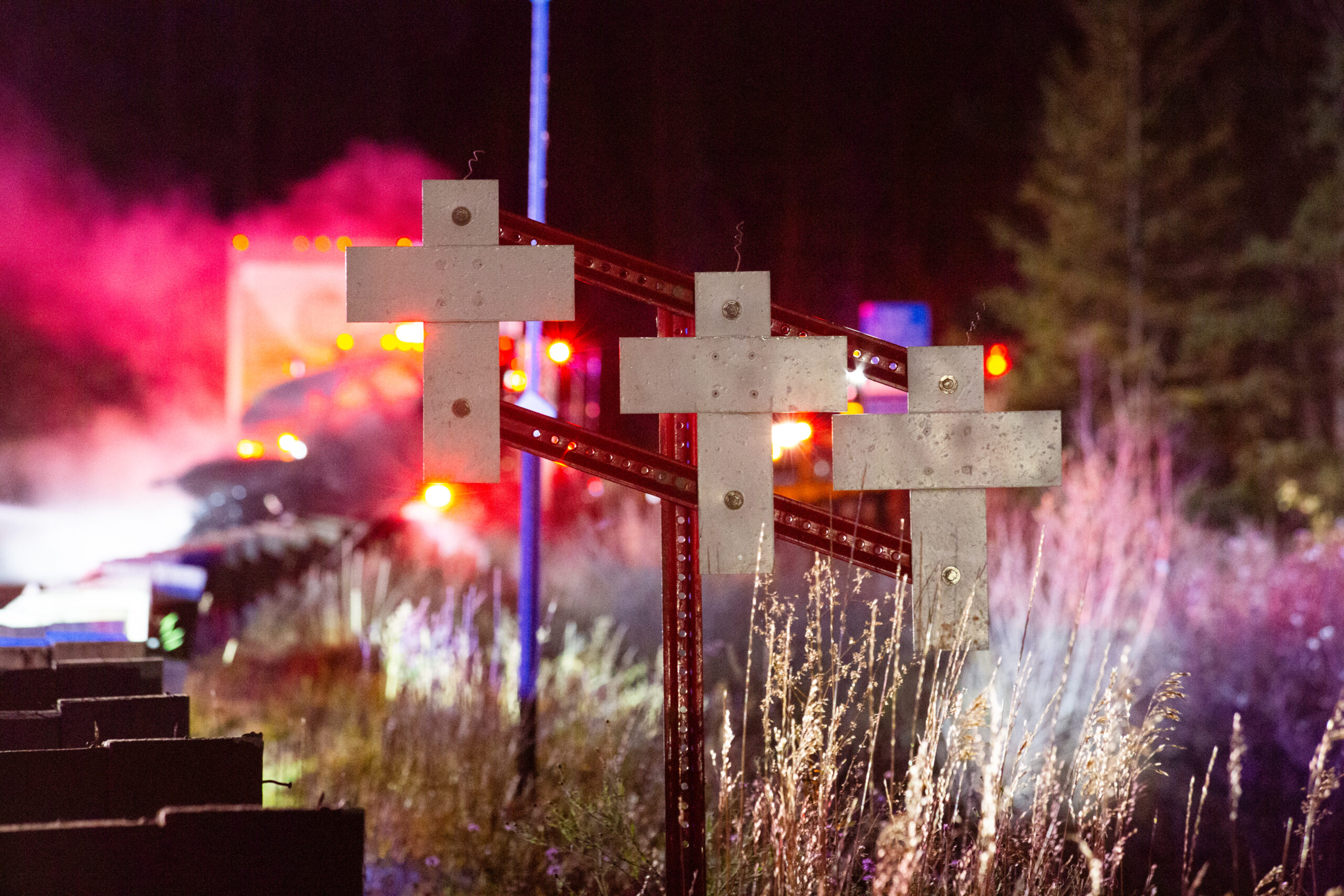
The safety issue haunts Samardich, who witnessed a highway death at the end of her driveway back in 2005. On a clear October day, a northbound car on U.S. 191 was stopped while attempting to turn left toward the line of mailboxes near Samardich’s driveway entrance, located close to where Dudley Creek flows under the roadway. A northbound dump truck zooming up from behind, in an attempt to avoid rear-ending the stationary car, swerved into the southbound lane and collided head-on with a Honda Civic driven by 28-year-old Bozeman resident Andrew Fischer. A white cross stands at the spot today. Samardich recalls heading down to the highway right after the wreck and encountering the shattering aftermath.
“Andrew died in my driveway,” she said.
“Today, we have semis, heavy construction trucks, most of our workforce commuting from the Bozeman area, recreationalists, tourists, icy and snowy roads, wildlife crossings and speeding,” Samardich said. “As you come into Big Sky, you are entering a resort community where the hallmarks are fly fishermen and skiers. And all of this is on a 60-mile-per-hour road going into residential areas with businesses all along the way on Highway 191.”
Stewart takes his horses across the highway from Ramshorn to the Porcupine trail system and faces the hair-raising prospect of navigating between oncoming motorists in both directions.
“Lots of tourists, when they get past the canyon and the light, see an open stretch, and they just go,” Stewart says. “They don’t understand there are houses there, the Riverhouse, Jake’s Horses. When you don’t know, you don’t know.”
Samardich and Stewart saw the speed study process they began in 2022 as the solution to a growing safety problem that would only get worse with the rapid pace of Big Sky’s growth—everything from bustling nonstop residential, commercial and resort construction, to more visitors for local events. The anticipated result: higher projected tourism, and with it, more traffic.
Speed studies typically take one to two years and involve local, county and state participants. It begins with concerned citizens asking their county commission to approve a request for a speed study. In Big Sky’s case, the Gallatin County Commissioners discussed Samardich and Stewart’s petition in an open meeting and voted to ask MDT to conduct the study.
“There is no rule about what triggers the process,” said Gallatin County Commissioner Zach Brown. “We receive many requests for different stretches of U.S. 191. Often, we get feelings-based information from the public and advocacy groups, and we have to weigh that against engineering methodology.”
Because MDT has jurisdiction over state roads and highways, the Gallatin County Commission cannot approve or deny any changes proposed by the study but can decide whether to advocate for any recommended changes. The ultimate decider of any new speed limits or engineering on state roads is the Montana Transportation Commission, a board consisting of five members, each appointed by the governor for a four-year term.
MDT Butte District project development engineer Brandon Jones said speed studies primarily occur in summer, and they can take anywhere from a few months to about a year, depending on how many are already on MDT’s to-do list.
Speed studies evaluate road conditions, gather collision data, record animal carcass numbers and identify a factor known as the “85th percentile”—the speed at which 85% of the people drove at or below in ideal conditions during the study. The result is a map and detailed analysis of specific roadway stretches with any recommended changes to speed limits and other engineering alterations—new and improved signage or lighting, road widening, turn lanes, bridge improvements and other remedies.
For the Big Sky study, data was collected in 2023 and 2024, followed by months of data compilation. MDT released its findings and recommendations in 2024, which then went to the Montana Transportation Commission for a final decision. The commission voted to tweak U.S. 191’s speed limits in a few areas, including 45 mph in the stretch leading northbound to the traffic light at the Conoco. Otherwise, speed limits are generally 55 mph. The speed study noted that drivers typically exceed posted speed limits.
MDT’s May 2024 Speed Limit Recommendation memorandum, based on the speed study, included a forward-gazing comment: “A 50-miles per hour speed limit does not fit the existing rural town environment and will become more inappropriate with further incoming development along this route and Big Sky proper. Furthermore, the roadway does not meet design standards with an inadequate shoulder width and has pedestrian activity along the route.”
“We were very unsatisfied with the result. This was a community effort. Our intention was to make our community safer. We failed because that didn’t happen.”
Suzy Samardich, Big Sky resident
With hopes—and, Stewart and Samardich note, advocacy from all three Gallatin County commissioners, state Rep. Jane Gillette and state Sen. Pat Flowers—that speed limits in the area would be adjusted downward by 10 mph across the board, Stewart and Samardich were devastated by the 2024 speed study’s results.
“The study ignored all the people who live here,” said Stewart. “Suzy and I were crushed. It was years of work down the drain.”
One major problem with speed studies in Montana, Samardich said, is the underlying “85th percentile” standard.
“The problem with the 85th percentile is it matches driver behavior, and human behavior is not always aligned with safety,” Samardich said. “Letting people decide how they want to drive, rewarding construction traffic for speeding—it’s designed to fail. It’s designed to respond to extremes.”
MDT’s decision to keep speeds around Big Sky mainly above 45 mph sent a message, Samardich said, that it prioritizes “speed and convenience.”
“We need to prioritize safety, people and wildlife,” she noted. “It’s a quality-of-life issue for the people who live here and the people who visit.”
As for Shane Sanders, who represents the district that includes Gallatin County on the Montana Transportation Commission, the 2024 speed study outcomes were appropriate.
“I came in thinking slower is always better, but the main thing I had to accept is slower is not always safer,” Sanders said. “If a majority of people are going 65 mph and we set the speed limit at 45 mph, that’s where we get large accidents.”
Sanders, who has served on the Transportation Commission since Gov. Greg Gianforte appointed him in 2021, does not have an engineering or transportation industry background but believes he brought a “fresh set of eyes” to the speed study decision-making process. He says he spent a lot of time with engineers during the MDT study and asked plenty of questions, including whether large trucks should even be allowed on U.S. 191 in Big Sky.
At one point during the speed study, Samardich and Stewart invited Sanders to Big Sky so he could examine the situation firsthand. As Sanders slowed down on U.S. 191 to turn into Samardich’s driveway, an 18-wheeler quickly gained on him and, riding Sanders’ bumper at high speed, laid on the horn before flying past as Sanders turned off. It was another hair-raising, typical day in the neighborhood, Samardich said.
While Samardich and Stewart today express doubt that Sanders listened to the concerns of Big Sky residents, organizations and businesses that supported reduced speed limits, Sanders said he’s “the most sympathetic” to community sentiment.
“I think we [Montana Transportation Commission] are doing a better job at listening to communities,” Sanders said.
The prevailing behavior of motorists, core to the 85% standard, was persuasive to Sanders’ decision to approve the MDT speed study findings. Those findings noted that, across the study area, motorists were exceeding posted speed limits.
“Decisions must be safety-based, but compliance is the issue,” Sanders said. “If the speed limit isn’t even being enforced now, and we lower the speed limit, what will change?”
Scofflaws shouldn’t set the standard, Samardich counters. “The 85 percent rule is antiquated and doesn’t take into account the real-life situation in Big Sky.” As for enforcement, she noted, “If the cops pull people over, the speeding stops.”
Samardich points to West Yellowstone, which sees over four million visitors annually, with most of them passing through Big Sky to get there. Over one million trips on U.S. 191 are for visiting Yellowstone National Park, where tourism has soared over the past decade. Entering West Yellowstone from the north on U.S. 191, speed limits gradually decrease down to 25 mph in the zone featuring local storefronts, restaurants, turnoffs to the park and other attractions, and the traffic light in the center of town.
“In West Yellowstone, which is a lot like Big Sky in many ways, people don’t just fly through. It’s absurd we have such a high speed limit in Big Sky,” Samardich said. “It’s not safe.”
Almost a decade before the latest speed study, MDT conducted a 2015 speed study that found posted speeds were too high. That 2015 study covered U.S. 191 from milepost 43, near the Corral Bar, to milepost 57 and encompassed Ophir School and the Highway 64 interchange. It found the then-existing 55 mph speed limit signs near the Highway 64 intersection should have been marked as 50 mph as far back as October 2007. Today, signage remains out of compliance with the recent 2024 speed study decision.
Since the 2015 speed study, Big Sky traffic and construction have exploded. In October 2024, Montana Free Press reported that over the past decade on U.S. 191 between Bozeman and West Yellowstone, some segments have seen an 82% increase in average annual daily traffic counts. On an average day, more than 10,000 vehicles travel U.S. 191, and that number can swell to more than 15,000 during peak tourism season. The 2024 MDT speed study indicated that U.S. 191 in the Big Sky area has experienced a 24 to 28% increase in traffic since 2018. The report noted that traffic volumes were 42% higher in summer.
Meanwhile, one in four crashes on U.S. 191 involve wildlife.
The wildlife factor
In a 2023 report, the nonprofit Center for Large Landscape Conservation and Montana State University’s Western Transportation Institute published the results of a two-year study, the U.S. 191/Highway 64 Wildlife & Transportation Assessment, examining the highway from Four Corners to Beaver Creek near Highway 64.
“Collisions involving wildlife make up a quarter of all reported crashes on U.S. 191 between Four Corners and Beaver Creek. That’s nearly five times the national average,” said CLLC Road Ecologist Elizabeth Fairbank, who co-authored the study.
“If you look at the statewide data on the Montana Wildlife and Transportation Partnership planning tool maps, there are several areas on Highway 191 north and south of Big Sky that are really problematic spots for wildlife collisions.”
According to the CLLC study, on Highway 64, over 13% of collisions involve wildlife. Across Montana, the statewide average is 10%, while the national average is 5%. A driver in Montana has a one in 53 chance of hitting an animal every year—the second highest of any state in the nation.
CLLC’s study revealed that, from Four Corners to West Yellowstone, more than 1,850 elk, deer and other species were confirmed killed on U.S. 191 in the 10 years leading up to 2020. Because these numbers include only crashes reported to law enforcement and carcasses deer-sized or larger left in or beside the road and picked up by crews, Fairbank maintains that actual wildlife deaths are much higher. Reported losses amount to $27 million in personal injury and property damage, or $60 million if the intrinsic value of wildlife—which considers species’ ability to remain on the landscape—is included. These figures include costs for all documented roadkill: deer, elk, moose, bighorn sheep, wolves, black and grizzly bears and bison.
The expense per collision is mammoth on a personal level. The average cost of vehicle repair and human injury or death for hitting a deer is over $14,000. This rises to nearly $45,500 for striking an elk and over $82,600 for a moose collision. Those are 2020 numbers, Fairbank notes, with 2026 costs significantly higher.
The 2024 MDT speed study on U.S. 191 revealed that, of the 47 vehicle crashes occurring from 2019 to 2021, nearly half (19) were due to driving “too fast for conditions,” and eight incidents were wildlife collisions.
If a roadway speed limit is reduced to protect motorists and animals, law enforcement plays a vital role in public education and compliance. Another companion to speed limits is the concept of “traffic calming”: roadway changes that encourage drivers to slow down. Speed bumps, medians, roundabouts and reduced lane numbers are some examples. Studies show that traffic calming, combined with lower speed limits, reduces accidents by up to 60%.
With motorists, especially newcomers from urban areas, unaware that wild animals can appear suddenly and unexpectedly on highways, reaction time and physics make a huge difference.
According to the Insurance Institute for Highway Safety, the higher a vehicle’s speed, the more distance it travels from the time a driver detects an emergency to the time the driver reacts, and the more distance needed to stop a vehicle once the driver starts to brake. High speed also increases the risk that an evasive steering maneuver will result in loss of control, like a rollover.
“Collisions involving wildlife make up a quarter of all reported crashes on U.S. 191 between Four Corners and Beaver Creek. That’s nearly five times the national average.”
Elizabeth Fairbank, Road Ecologist, Center for Large Landscape Conservation
Then, there’s the issue of sheer energy: when impact speed increases from 40 to 60 mph (a 50% increase), the energy produced by a crash increases by 125%. It’s physics: high speed equals a greater likelihood of severe injury or death. Then, there’s the danger of a large animal, on impact, flying through the windshield into the vehicle, resulting often with deadly results.
Even small speed limit changes make a difference. From 1993 to 2017, an IIHS study found that a 5 mph speed limit increase on all roads nationwide led to nearly 37,000 more traffic fatalities, and most of those deaths were on roads not classified as interstates or freeways.
In the absence of expensive infrastructure such as wildlife overpasses, fewer animal deaths on highways can be achieved through lower speed limits with motorist compliance. Kevin Hurley, the vice president of conservation-emeritus for the Bozeman-based Wild Sheep Foundation, points to a success story in southeastern Arizona. With the intent to tackle bighorn sheep highway deaths, a lower speed limit was imposed for big trucks hauling loads to and from the Morenci Mine. “This effort successfully decreased bighorn mortality,” Hurley reported.
“Speed reduction would be the cheapest option,” Hurley said, adding that traffic calming devices like well-marked speed humps also have a proven track record of slowing vehicles down.
In Deer Lodge County, MDT’s Brandon Jones says the 35 and 25 mph speed limits on Montana Highway 1 east and west of Anaconda were established years ago due to collisions involving highway-speed vehicles encountering locals turning onto driveways. In addition to decreasing crashes, a side effect of the lower speed limits has been a drastic reduction in deaths for the area’s renowned bighorn sheep.
Far to the north of Big Sky, on Montana Highway 200 between Thompson Falls and Plains, Montana Fish, Wildlife and Parks wildlife management biologist Bruce Sterling counted 470 bighorn sheep killed on the highway over the 35 years leading up to his retirement in 2020. After 200 bighorns died on the highway, MDT put up yellow wildlife crossing signs on Sterling’s recommendation. Bighorn highway deaths continued. Yellow flashing lights were added, to no effect. Then, a motorcyclist died after hitting a sheep, and things started happening.
On the most dangerous three-and-a-half-mile section for wildlife, MDT, with Sterling’s cooperation, installed an illuminated reader board warning of the wildlife crossing hazard, established a speed limit reduction from 70 mph to 55, and built fencing on both sides of the highway to funnel animals to an underpass. To prevent bighorns from becoming trapped on the highway between the fences, MDT placed low-voltage electrified mats on the road where the fencing ended.
“Bighorn mortality dropped dramatically,” Sterling said. “It works.”
According to Jones, the agency is planning wildlife passages as part of U.S. 191 bridge projects over the next few years, with a view to reducing wildlife deaths. In spring 2027, MDT aims to replace the Cougar Creek bridge north of West Yellowstone with a structure providing more river clearance and a wider span to create a wildlife path beneath the highway. A similar upgrade is in the offing nearer the north mouth of Gallatin Canyon, where a new bridge is being proposed with added height and span to accommodate a wildlife passage on the south bank of Spanish Creek. The passage is made more pressing because the bridge project also includes a southbound passing lane, which will likely increase highway speeds. MDT expects to award the contracts for the Spanish Creek project in 2029.
A private landowner effort to create a wildlife crossing on U.S. 191 near Big Sky is also underway. Three years ago, the Gallatin Valley Land Trust purchased the last remaining lot in the Dudley Creek HOA, a span of several highway-adjacent lots north of the Dudley Creek Road turnoff. GVLT then began negotiating with private landowners across the highway to gain their approval for a wildlife overpass.
“We knew someone would buy the property and develop it, and its value as a wildlife crossing would be lost,” said GVLT Executive Director Chet Work. He noted that, in the proposed wildlife passage site, he knows around five elk and a wolf have been recently killed by vehicles, and grizzly bears have been sighted on the highway shoulder.
The Dudley Creek HOA overpass will likely be a concrete structure incorporating native vegetation and rocks to blend with the environment. Fencing along the highway, starting at Dudley Creek Road, is part of GVLT’s plan to funnel wildlife toward the overpass. CLLC has completed the geotechnical and design aspects, Work said, assuring construction harmonizes with area hydrology and geology.
“The overpass design is based on species and gender of each species preferences,” Work added. “For instance, elk cows and their babies will go through an underpass, but bulls prefer overpasses.”
Because of these differing preferences, GVLT is also planning a wildlife underpass at the Jack Smith Bridge north of the Dudley Creek HOA. The project will entail raising the bridge’s height and increasing its span to accommodate a wildlife path on flat ground below that animals can comfortably use to bypass the road, even during high-water events.
Now, funding is the next hurdle. Currently, federal funding for this and other similar projects is in limbo. Competition is fierce, with organizations across Montana applying.
More opportunities for public input and change for Big Sky highway safety lie ahead, according to Big Sky Resort Tax Executive Director Daniel Bierschwale, who supported the 2022 petition for a Big Sky speed study.
“The speed study is a ‘layer of the onion.’ What’s most important is for the public to engage in feedback, especially in multi-year efforts like MDT’s Optimization Plan for U.S. 191 and Highway 64.”
Our community’s founding father, the famed broadcaster and native Montanan Chet Huntley, once described Big Sky as “A place free from congestion, pollution, ugliness and noise.” In 1973, outlining what made Big Sky unique in all the world, he said our community’s perfect planning and protection of wildlife set us apart. “There is simply no justification here whatsoever to create a high-density situation and start stacking people on top of each other … Big Sky has a fundamental purpose: to live in harmony with nature at her very best.”
Amidst the velocity of trucks and cars, one can imagine the founder’s spirit, a silent figure standing by the white cross on U.S. 191 near Dudley Creek and gazing down at a black bear cub struggling after being sideswiped by a semi. A little fish the bear had just caught in the Gallatin River gasps on the pavement nearby. While dramatic, it’s a scene that actually occurred last summer. As traffic veered around to whiz onward to Bozeman, some drivers stopped. Someone called the authorities, and someone took a picture of the dying cub and fish and posted it on social media. As for the silent figure, if he could speak as he so fluently did as a newsman in life, what would he say?
Perhaps, he would echo the words of longtime Big Sky resident J.C. Knaub, who 10 years ago was on Highway 64 near the Conoco and saw standing stunned in the road a bighorn ram missing its right horn, right eye and the side of its face after being struck in traffic. Knaub said, “We’re killing the very thing that makes this place special.”
Ashley McEnroe is a Big Sky resident and field editor for the Wild Sheep Foundation, based in Bozeman. She is also the author of a forthcoming children’s book on Montana bighorn sheep.